
By Marina Silveira, Ph.D.
For us to make sense of sound, many inhibitory and excitatory neurons in the auditory pathway need to interact to process auditory information. Many of these computations happen in the inferior colliculus (IC), which is localized in the auditory midbrain. The IC acts as a hub in the central auditory pathway, receiving and processing auditory inputs and sending the information to higher brain centers.
The IC also receives information from neuromodulatory systems, which alters how a neuron performs its important functions. One example of a neuromodulator in the brain is serotonin. Most people have heard of serotonin because of its connection to mood and depression, but serotonin also affects how neurons in the IC respond to complex sounds, including vocalizations. Recent research suggests serotonin in the IC may be involved in linking hearing loss to social isolation, and that disruptions in serotonin signaling may contribute to tinnitus.
Even with its importance, we still don’t fully understand how serotonin does its job in the IC or which specific neurons it targets. One of the goals of my lab at the University of Texas at San Antonio is to map out the IC circuits that respond to serotonin and to learn how those circuits change during age‑related hearing loss. In the long term, this knowledge could help us design better treatments.
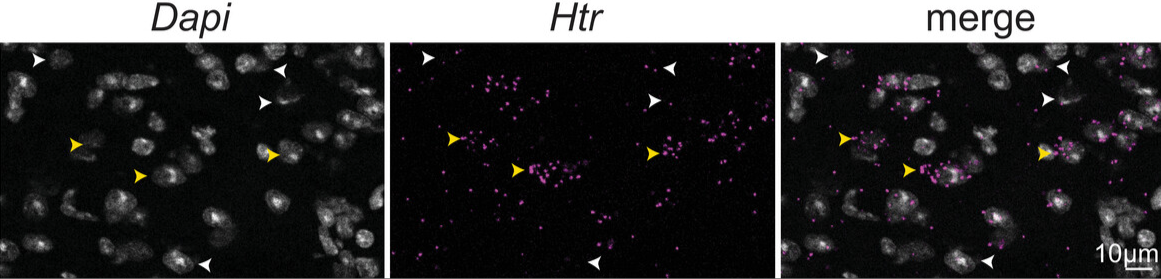
Examples of serotonin receptor expression. Cells are considered positive (yellow arrow) if they show three or more puncta (bright spots), while those with fewer are considered negative (white arrow). Credit: Galindo, Nazir, Silveira/Journal of Comparative Neurology
As an initial step toward this goal, we published our first paper in the Journal of Comparative Neurology in February 2026. We used a technique called in situ hybridization that lets us visualize where certain gene transcripts are located in thin slices of brain tissue. This allowed us to map where different types of serotonin receptors appear in the IC.
We found that different types of serotonin receptors are present in the IC. Among those receptors, some receptors are known to increase neuronal activity in the presence of serotonin, while others are known to decrease the activity of neurons in the presence of serotonin.
More importantly, we discovered that these receptors are not randomly expressed by neurons in the IC. Instead, there is a differential pattern of expression: Neurons that produce glutamate (the main excitatory neurotransmitter in the brain) express receptors that when activated by serotonin will decrease neuronal activity. On the other hand, neurons that produce GABA (the main inhibitory neurotransmitter in the brain) are activated by serotonin.
In other words, serotonin seems to quiet down excitatory neurons while boosting inhibitory ones. This differential modulation of glutamatergic and GABAergic neurons by serotonin may help us to understand the role of serotonin in auditory disorders such as tinnitus and age-related hearing loss. The goal of my lab in the next few years will be focused on answering those questions.
This paper was coauthored by Karen Galindo, a current doctoral student at the University of Texas Southwestern Medical Center, and Zoya Nazir, who will be starting her Ph.D. this fall. We are thankful for the HHF support in making our work possible.


Marina Silveira, Ph.D., is an assistant professor in the department of neuroscience, development, and regenerative biology at the University of Texas at San Antonio. Her 2026 Emerging Research Grant is generously funded by Royal Arch Research Assistance.
The team’s paper, “Distribution of Metabotropic Serotonin Receptors in GABAergic and Glutamatergic Neurons in the Auditory Midbrain,” appeared in the Journal of Comparative Neurology in February 2026.
The Latest Blog Posts




A simple, universal visual warning system (like a red, yellow, or green noise-level indicator at a concert venue, racetrack, or theme park) instantly conveys danger, warning, or safety to people of all ages. Combined with access to basic foam earplugs and insertion instructions, a simple prompt can transform behavior.