

Each October Hearing Health Foundation is pleased to announce our newly funded Emerging Research Grants scientists. We thank our scientific reviewers and Council of Scientific Trustees for their role in determining the awardees.
Our ERG program is the leading seed funding opportunity for hearing and balance researchers. The Elizabeth M. Keithley, Ph.D. Early Stage Investigator Awards honor the impact of our former board chair on the field and focuses on supporting the next generation.
ERG also includes Expanded and Focused Discovery Awards, which are grant opportunities in specific topics (such as central auditory processing disorder, hyperacusis, Ménière’s disease, and tinnitus) that are open to eligible investigators at any career stage.
Supporting hearing and balance research is crucial, as it receives only a small fraction of federal funding compared with other chronic conditions, and despite the widespread prevalence of hearing conditions. We are deeply grateful for the continued dedication of our generous donors who make these grants possible.
Thank you, and congratulations to the 2027 grantees.
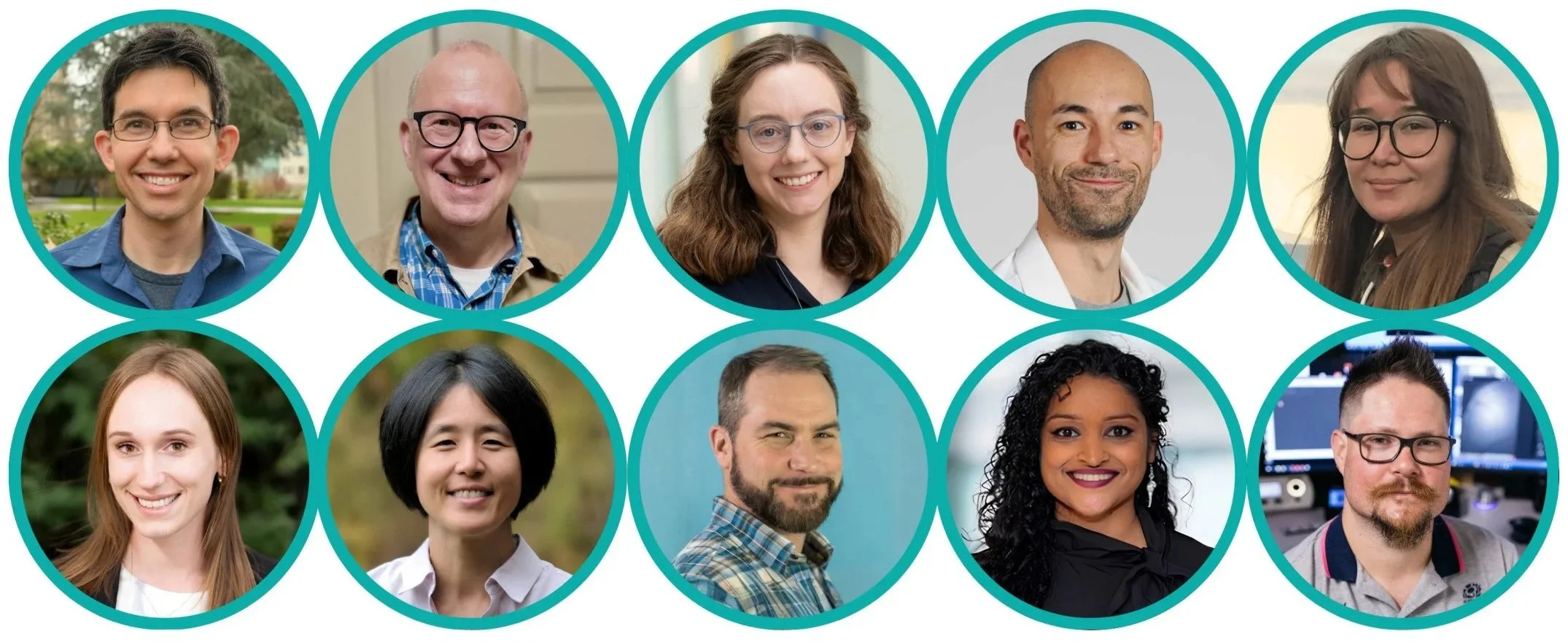
The 2027 first-year Emerging Research Grants scientists are (from left to right, top row): Brad Buran, Ph.D., Douglas Epstein, Ph.D., Jenelle Feather, Ph.D., Paul Gratias, Ph.D., and Marina Kabirova, Ph.D.; (bottom row) Jacie R. McHaney, Ph.D., Lina Reiss, Ph.D., Mark A. Rutherford, Ph.D., Kirupa Suthakar, Ph.D., and Ross S. Williamson, Ph.D.
First Year
Brad Buran, Ph.D.
Oregon Health & Science University
Drug-mediated cochlear synapse regeneration: reversing central gain and hyperacusis in a gerbil model.
Douglas Epstein, Ph.D.
University of Pennsylvania, Perelman School of Medicine
Defining the role of EYA4 risk variants in the pathogenesis of Ménière’s disease.
Generously funded by an anonymous donor
Jenelle Feather, Ph.D.
Carnegie Mellon University
Models and mechanisms for auditory event categorization.
Recipient of an Elizabeth M. Keithley, Ph.D. Early Stage Investigator Award, generously funded by William Randolph Hearst Foundations
Paul Gratias, Ph.D.
Mass Eye and Ear
Efferent function and noise vulnerability in otoferlin-deficient and gene-therapy-treated cochlea.
Recipient of an Elizabeth M. Keithley, Ph.D. Early Stage Investigator Award, generously funded by Zellis Family Foundation
Marina Kabirova, Ph.D.
The University of Chicago
Age-related disruption of calcium homeostasis in vestibular sensory cells.
Generously funded by the Meringoff Family Foundation
Jacie R. McHaney, Ph.D.
The University of Texas at Austin
Neural and cognitive mechanisms of hearing-aid signal processing.
Recipient of an Elizabeth M. Keithley, Ph.D. Early Stage Investigator Award
Lina Reiss, Ph.D.
Oregon Health & Science University
Role of abnormal binaural fusion in central auditory processing disorder.
Generously funded by Royal Arch Research Assistance
Mark A. Rutherford, Ph.D.
Washington University in St. Louis
Preventing or mitigating hyperacusis with blockade of calcium-permeable AMPA receptors.
Generously funded by Hyperacusis Research
Kirupa Suthakar, Ph.D.
The University of Texas at Dallas
Serotonin signaling of auditory efferent neurons in noise-induced hyperacusis and tinnitus (NIHT).
Ross S. Williamson, Ph.D.
University of Pittsburgh
Active corticofugal control of sound localization in noise.
Generously funded by Royal Arch Research Assistance
Second Year
Bshara Awwad, Ph.D.
Mass Eye and Ear
Auditory-limbic circuit dynamics as therapeutic targets in hyperacusis.
Generously funded by Hyperacusis Research
Patrick Cody, Ph.D.
University of Pittsburgh
Comprehensive hearing recovery evaluation of novel targeting sequences for cell-type–specific gene therapy for hearing loss.
Recipient of an Elizabeth M. Keithley, Ph.D. Early Stage Investigator Award, generously funded by Zellis Family Foundation
Jia Guo, Ph.D.
Columbia University
Enhanced cochlear endolymphatic hydrops imaging for Ménière’s disease with intracochlear MRI contrast delivery via microneedle.
Hui Hong, Ph.D.
Creighton University
Peripheral auditory input regulates lateral cochlear efferent system.
Recipient of an Elizabeth M. Keithley, Ph.D. Early Stage Investigator Award
Jane Mondul, Au.D., Ph.D.
Purdue University
Sound-induced plasticity of the lateral olivocochlear efferent system.
Recipient of an Elizabeth M. Keithley, Ph.D. Early Stage Investigator Award, generously funded by William Randolph Hearst Foundations
Patrick D. Parker, Ph.D.
Johns Hopkins University School of Medicine
Emergence of tonotopically organized spontaneous activity in the brain after genetic disruption of MET channel function.
Generously funded by the Les Paul Foundation
Marina Silveira, Ph.D.
University of Texas at San Antonio
Age-related changes in neuromodulatory signaling in the auditory midbrain.
Generously funded by Royal Arch Research Assistance
Hearing Health Foundation sincerely thanks our community for their steadfast support of hearing and balance research. Additional details about the first-year projects are available here at Meet the Researcher and will also appear in our Winter 2027 issue of Hearing Health magazine that comes out in January. For details about the second-year projects, check Meet the Researcher or see our Winter 2026 issue of Hearing Health.
The next cycle for ERG applications opens October 13, 2026, with letters of intent due December 17, 2026. Sign up for alerts on our ERG page.
The Latest Blog Posts



Our Emerging Research Grants program is the leading seed funding opportunity for early stage researchers. ERG also includes Expanded and Focused Discovery Awards, which are grant opportunities in specific topics (such as central auditory processing disorder, hyperacusis, Ménière’s disease, and tinnitus) that are open to eligible investigators at any career stage.