
By Xiaodong Tan, Ph.D.
Hearing loss caused by cisplatin, a widely used chemotherapy drug, is a major side effect of life-saving cancer treatment, affecting more than 500,000 cancer patients globally every year. Our previous research showed that honokiol—a multifunctional small molecule extracted from herbal medicine (the genus Magnolia)—protects against cisplatin-induced hearing loss (CIHL) while does not interfere with cisplatin’s ability to reduce tumors. We also found that honokiol boosts the activity of sirtuin 3.
Sirtuins are a family of seven enzymes found throughout different parts of cells that play a key role in regulating oxidative stress and cellular damage. In this study, we looked at whether honokiol boosts other members of the sirtuin family, not just sirtuin 3, while protecting against CIHL in mice with active tumors. Our results were published in the journal Pharmaceuticals in October 2026.
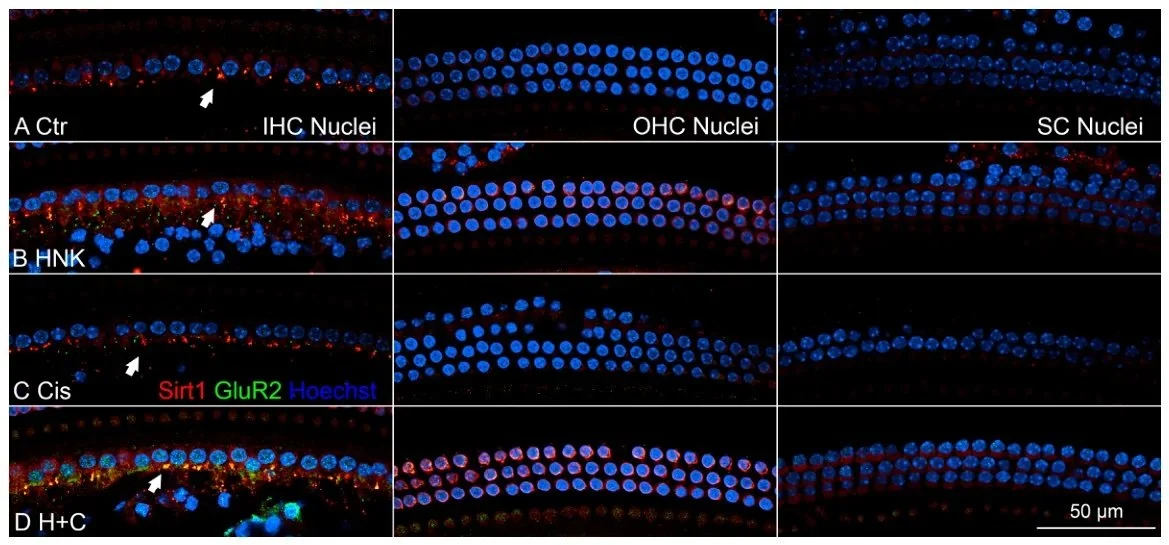
Inner ear tissue images showing Sirt1 (red) and nerve receptor GluR2 (green) levels across four groups: (A) untreated Control, (B) Honokiol-only (10 mg/kg), (C) Cisplatin-only, and (D) Honokiol + Cisplatin. Panels highlight inner hair cells (left), outer hair cells (middle), and supporting cells (right). Honokiol treatment increased Sirt1 levels around—but not inside—cell nuclei (B, D), while white arrows mark Sirt1 spots at inner hair cell connections overlapping with GluR2 (green). Credit: Thomas et al./Pharmaceuticals
We used adult female mice genetically programmed to develop breast tumors. To mimic standard human chemotherapy regimens, the mice received cisplatin in three 14-day cycles (a low dose of 4 mg/kg/day for four consecutive days per cycle).
One hour before each cisplatin dose, mice were treated with honokiol (ranging from 5 to 20 mg/kg). Hearing was measured by tracking shifts in auditory brainstem response (ABR) thresholds and examining changes in cochlear synapses. We then measured the levels and location of sirtuins 1, 2, 3, 5, and 7 in the cochlea using immunostaining (fluorescent tagging) and RT-qPCR (gene expression analysis).
We found that cisplatin caused significant hearing loss in the high-frequency range (24–32 kilohertz). Pre-treatment with honokiol reduced this high-frequency hearing loss and protected cochlear function.
A dose of 10 mg/kg of honokiol provided the best balance of protecting hearing in and overall survival of the mice. Our tissue imaging showed increased protein levels for sirtuins 1, 2, 3, 5, and 7 in the cochleae of honokiol-treated mice. Gene expression testing confirmed a significant increase in sirtuin 3 mRNA.
Boosting the sirtuin enzyme family plays an active role in how honokiol guards the cochlea against cisplatin-induced damage. Determining the effective dose response in this animal model provides a critical foundation for translating honokiol into clinical human trials to prevent hearing loss caused by chemotherapy.
Notably, for the first time, we detected sirtuin immunoreactivity (Sirt1, 2, 3, and 5) directly at the inner hair cell ribbon synapse. This suggests sirtuins play a direct role in maintaining and protecting inner ear synaptic function.
While honokiol clearly boosted sirtuin levels as hearing was protected, this study only shows a link, not direct proof of cause and effect. To prove that sirtuins are directly responsible for protecting hearing against cisplatin, follow-up studies must test what happens when individual sirtuins are blocked or removed. In addition, more tumor models are necessary to verify honokiol-mediated hearing protection against CIHL.

A 2017 Emerging Research Grants scientist, Xiaodong Tan, Ph.D., is an assistant professor in the department of otolaryngology–head and neck surgery at Northwestern University’s Feinberg School of Medicine. Tan and team's paper, “Sirtuin Upregulation in the Cochlea During Honokiol-Mediated Protection Against Cisplatin Ototoxicity,” was published in the journal Pharmaceuticals in October 2026.
The Latest Blog Posts





Pre-treatment with honokiol—a multifunctional small molecule extracted from herbal medicine (the genus Magnolia)—reduced high-frequency hearing loss and protected cochlear function.