
I spent years learning how to live with hearing loss. Now, I’m trying to make sure other young people think about their hearing before they have to.
By Catherine Lin
I was in 4th grade when I found out I had a hearing loss.
At that age, I did not really understand what that meant. I just knew that sometimes I could not hear what people were saying. I would miss parts of conversations, misunderstand instructions, or watch everyone else react to something I had not heard.
So I learned how to hide it. When I did not understand something, I smiled. When everyone else laughed, sometimes I laughed too, hoping I had guessed correctly. Instead of asking someone to repeat themselves again and again, I started pretending I had heard them the first time.
Eventually, hearing loss began affecting more than just what I could hear. It affected how I saw myself.
There is a word in Chinese that describes how I felt especially well: 自卑 (zìbēi). It is difficult to translate perfectly, but it describes a feeling of insecurity and inferiority that makes you shrink yourself around other people.
That was exactly what I did. I became quieter. I hesitated before speaking. I stayed inside the small circle of people and situations where I felt comfortable because stepping outside of it meant risking misunderstanding someone, answering a question incorrectly, or having to explain why I had not heard something.
For a long time, I thought it was easier to make myself smaller than to explain my hearing loss. But friendship slowly changed that.
As I grew older, I met people who made me realize that I did not have to treat my hearing loss as something embarrassing. One of those people was my friend and classmate, Sanni.
Sanni never made me feel like asking someone to repeat themselves was inconvenient. She listened when I talked about my experiences and saw how something as seemingly simple as hearing could shape my confidence, the way I communicated, and the way I moved through the world.
Little by little, friendships like ours helped pull me outside the small circle I had built around myself. I became more comfortable speaking up when I could not hear something. I stopped feeling as though I needed to pretend I understood.
Most importantly, I started realizing that my hearing loss did not have to be something I hid. That shift also made me look differently at the people around me.
I would see friends blasting music through their headphones. At school events, concerts, and games, everyone would stand surrounded by noise without thinking twice about it. Someone would pull out their phone and turn the volume up another few clicks because the music was not loud enough.
To them, it was nothing. To me, it was hard not to notice.
I knew what it was like to carefully choose where to sit in a classroom so I could hear better. I knew the hesitation of wondering whether asking someone to repeat themselves one more time would be annoying. I knew how exhausting it could be to constantly fill in the pieces of conversations my ears did not catch.
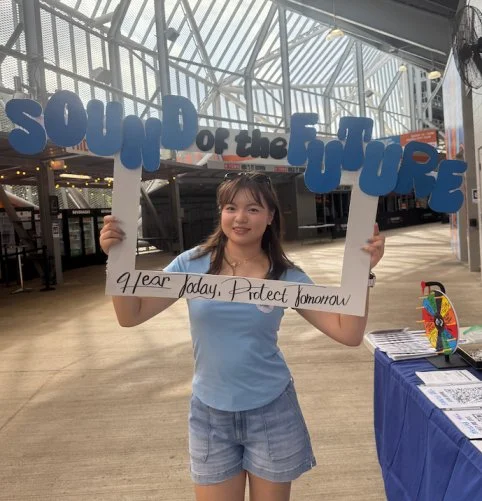
Catherine Lin at a health expo at Shell Stadium in California.
And yet, I was surrounded by people treating their hearing as if it were guaranteed.
I do not blame them. Before hearing loss became part of my life, I probably would not have thought about it either. That was actually what bothered me most.
We teach young people to protect so many parts of our health. We hear about sunscreen, nutrition, exercise, sleep, and screen time. But hearing rarely seems to enter the conversation until something has already gone wrong.
I kept wondering: Why are we waiting until people lose their hearing to teach them how important it is? That question eventually became Sound of the Future.
I co-founded Sound of the Future with Sanni because we wanted hearing health to become something young people could understand before it became personal to them.
For me, that mission came from living with hearing loss. For Sanni, it grew from being beside me and seeing how deeply hearing loss had shaped my confidence and my everyday life. As we talked more about my experiences, hearing health stopped feeling like an issue that affected some distant group of people. It became something she cared about too.
Together, we began asking a bigger question: What if we could help young people protect their hearing while also creating a community where being Deaf or hard of hearing never made someone feel like they needed to make themselves smaller?
That became the foundation of our work. Our mission at Sound of the Future is to raise awareness about hearing health while also amplifying the voices and experiences of people who are Deaf or hard of hearing.
But I quickly learned that awareness is not as simple as telling someone, “Loud sounds can damage your ears.”
Teenagers already hear warnings all the time. If hearing health feels like another lecture telling them what not to do, they will probably tune it out. So I started thinking about what I would have listened to.
Maybe it is a pair of earplugs handed out before a loud event instead of a long speech about noise exposure. Maybe it is a simple chart showing when volume becomes dangerous. Maybe it is another student saying, “I know you think this could never happen to you. I thought that too.”
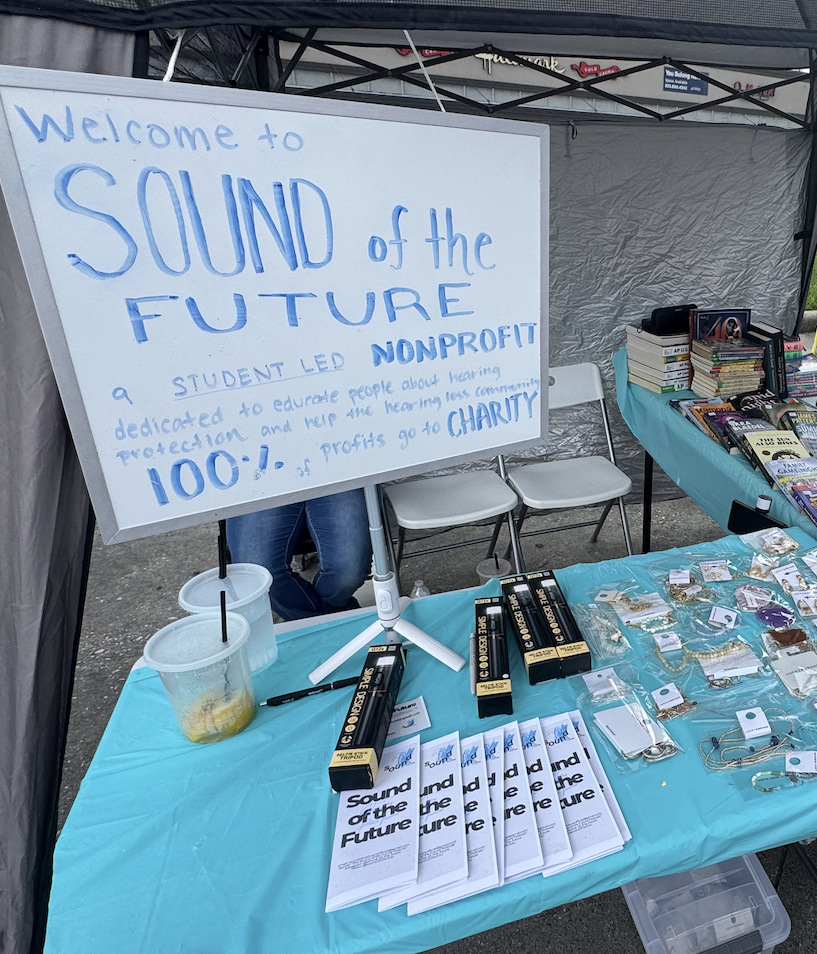
The nonprofit has been attending street fairs and other venues to help spread the word of safe listening habits.
Through Sound of the Future, we have begun creating educational materials, participating in community events, and developing hearing health care packages that include earplugs and information about safe listening.
None of these things alone will prevent every case of hearing loss. But I have learned that prevention often starts much smaller than that. It can be lowering your headphones a few clicks. Wearing earplugs at a concert. Taking a break from loud noise.
Or simply realizing that your hearing is something worth protecting. One small decision today could protect thousands of moments you have not heard yet.
There are sounds I miss. There are conversations I wish I had heard more clearly and moments when I wish I had not felt the need to pretend I understood. But my hearing loss also gave me a reason to pay attention to something most people my age rarely think about.
When I tell another teenager to protect their hearing, I am not telling them to stop listening to music, refrain from going to concerts, or to be afraid of loud places.
I am telling them because I want them to keep listening. To the songs they love. To their friends laughing beside them. To their families talking around the dinner table. To all of the small sounds they may not realize matter until one day they are harder to hear.
I learned how valuable hearing is after losing part of mine. My hope is that you do not have to lose yours to learn the same lesson.
Catherine Lin is a high school senior in Texas and the co-founder with Sanni Arimanda of the nonprofit Sound of the Future. Follow them at instagram.com/sound_of_the_future.
The Latest Blog Posts



Hearing loss began affecting how I saw myself. There is a word in Chinese that describes how I felt: 自卑 (zìbēi), a feeling of insecurity and inferiority that makes you shrink yourself around other people.