
By Ben-Zheng Li, Ph.D.
My research involves developing and applying computational modeling and neural engineering techniques to better understand how the brain processes sound in order to advance hearing research. One goal is to extend the diagnostic potential of hearing tests by connecting their results with underlying changes in neurons. Our paper in the Journal of the Association for Research in Otolaryngology (JARO), published in June 2026, takes a step toward this goal.
The auditory brainstem response (ABR) is a commonly used hearing test that records electrical responses to sound through electrodes placed on the skin. It produces a series of waves as signals travel through the auditory brainstem. However, each wave combines activity from many neurons, making it difficult to identify the specific neural changes responsible for an altered recording.
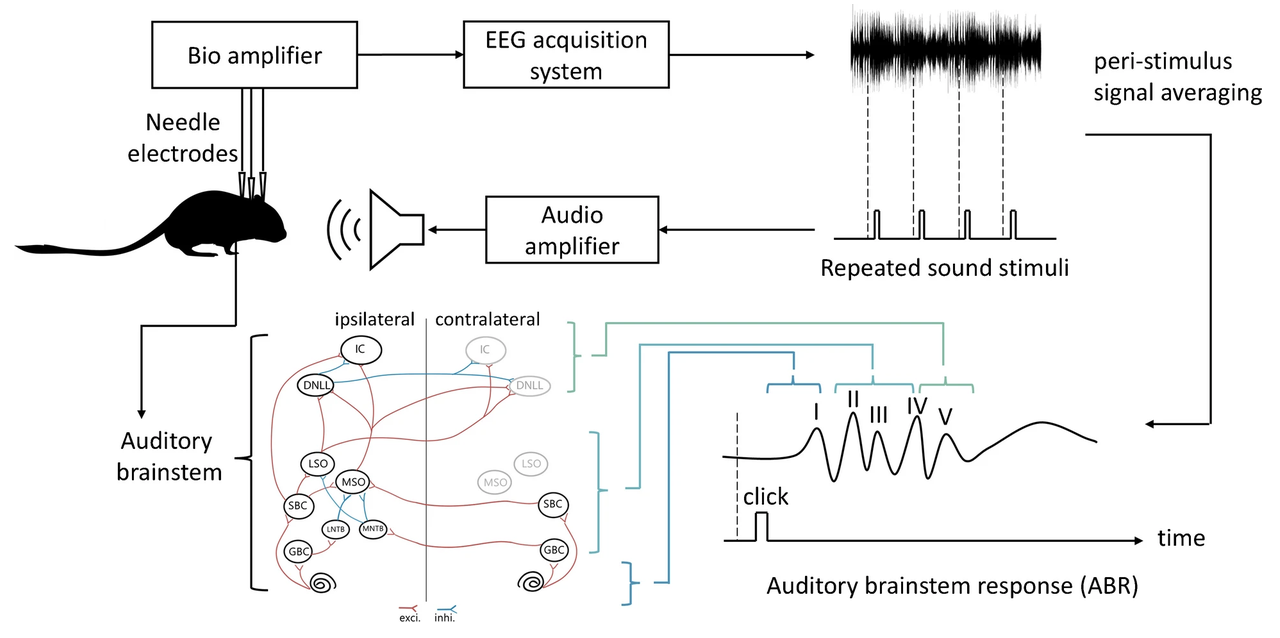
This graphical abstract shows the ABR recording setup (top) and sources of ABR waves (bottom). Credit: Li et al./JARO
My colleagues and I developed a computer model that simulates auditory brainstem circuits and synthesizes ABR waves from the activity of thousands of neurons. By adjusting the properties of these neurons and their connections, we can explore how changes at the cellular level affect the overall response.
We validated the model using recordings from mice with Fragile X syndrome, a genetic condition associated with autism, and from aging gerbils. In the Fragile X model, we simulated increased neural excitability and myelin deficits affecting the insulating layer around nerve fibers. These alterations change how strongly neurons respond and how quickly signals travel. Together, they produced ABR changes that closely matched experimental recordings in wave amplitude and timing.
In the aging model, we explored neuronal alterations in the auditory brainstem and reproduced changes observed in aged gerbils. These results suggest that the model can help identify possible neural explanations for changes in hearing test results.
Beyond these biological changes, we also investigated how the sounds used in testing affect ABR recordings. In our follow-up paper in Neuroscience Letters in October 2026, we showed that the model could capture how changing the duration of a brief click sound affects the shape of ABR waves. This suggests potential for exploring different sound stimuli and ABR testing approaches in future studies.

Ben-Zheng Li, Ph.D., is a research assistant professor at Northeast Ohio Medical University. He was a postdoctoral fellow in the lab of one of the paper’s coauthors, Achim Klug, M.D., at the University of Colorado Anschutz Medical Campus. Li is a 2025–2026 Emerging Research Grants recipient, generously funded by Royal Arch Research Assistance. In July 2026, Li received a National Institute on Communication and Other Disorders K99/R00 Pathway to Independence Award, and he credits the ERG grant for helping him produce the preliminary data and research ideas for the NIDCD proposal.

The paper, “Computational model for synthesizing auditory brainstem responses to assess neuronal alterations in aging and autistic animal models,” was published in the Journal of the Association for Research in Otolaryngology (JARO) in June 2026.
The Latest Blog Posts





A person becomes hard of hearing, caregivers and families start raising their voices, no one likes shouting at another person, the conversations decline.