
Identifying new genes responsible for unexplained genetic hearing loss remains a critical goal as many patients still lack a molecular diagnosis despite comprehensive genetic testing. The tectorial membrane is a specialized, acellular (containing no cells) matrix of the inner ear that helps stimulate sensory hair cells so we can process sound and distinguish different frequencies.
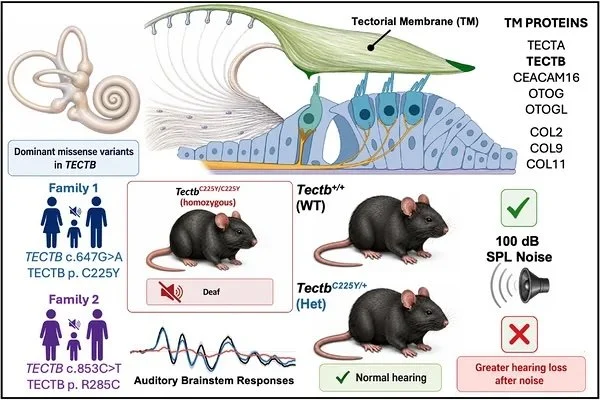
A graphical abstract of the team’s paper. Credit: Hale et al./Advanced Science
While variants in genes encoding several non‐collagenous proteins in this membrane have been identified as deafness genes (TECTA, CEACAM16, OTOG, OTOGL), definitive evidence linking the gene TECTB (beta-tectorin) to human hearing loss has been lacking.
Here, we present genetic and lab evidence showing that specific variants in TECTB directly cause hearing loss by damaging highly critical regions of this protein. Using a genetically modified mouse model, we found that having two copies of the gene variant caused severe structural breakdown of the membrane and profound deafness. Our results appeared in the journal Advanced Science in September 2026.
Interestingly, human carriers with one copy of the TECTB variant have clear hearing loss, but lab mice with just a single variant copy appeared to have typical baseline hearing. To test the environmental component of this discrepancy, we considered the markedly different acoustic environments experienced by humans and laboratory mice. Humans are routinely exposed to a wide range of sound environments throughout life, while laboratory mice are typically housed in relatively quiet, controlled conditions. We therefore hypothesized that noise exposure might unmask latent cochlear vulnerability in the genetically modified mice.
When these single-copy mice were exposed to moderate levels of noise, they experienced permanent, severe hearing loss. The variant creates a “functionally silent” structural weakness in the ear that makes it more vulnerable to loud sounds—disrupting the membrane’s ability to stimulate inner ear hair cells (which send sound signals to the brain) while leaving outer hair cells mostly intact until noise trauma occurs. Thus, these findings reveal a gene–environment interaction in which the variant sensitizes the cochlea to noise trauma, leading to long‐term functional consequences.
Overall, this study provides evidence that TECTB is a novel human deafness gene and illustrates both the value of cross‐species modeling and the importance of considering environmental context. In addition, these results argue for the inclusion of TECTB in diagnostic panels for hereditary hearing loss.
This is adapted from the abstract and discussion of the paper “TECTB Variants Reveal Tectorial Membrane Vulnerability in Dominant Non‐Syndromic Hearing Loss,” published in Advanced Science in September 2026.

James E. Saunders, M.D. (pictured), a 2011 Emerging Research Grants scientist, received the Centurion Clinical Research Award from Deafness Research Foundation (Hearing Health Foundation’s former name). His ERG project, “Genetic Hearing Loss in Rural Nicaraguan Families,” helped inform the new paper. He is a professor of surgery at Dartmouth Geisel School of Medicine and an otolaryngologist at Dartmouth Health, both in New Hampshire.
The paper’s coauthors include 2027 ERG scientist Paul Gratias, Ph.D., the recipient of an Elizabeth M. Keithley, Ph.D. Early Stage Investigator Award, generously funded by Zellis Family Foundation.
The Latest Blog Posts





A person becomes hard of hearing, caregivers and families start raising their voices, no one likes shouting at another person, the conversations decline.