
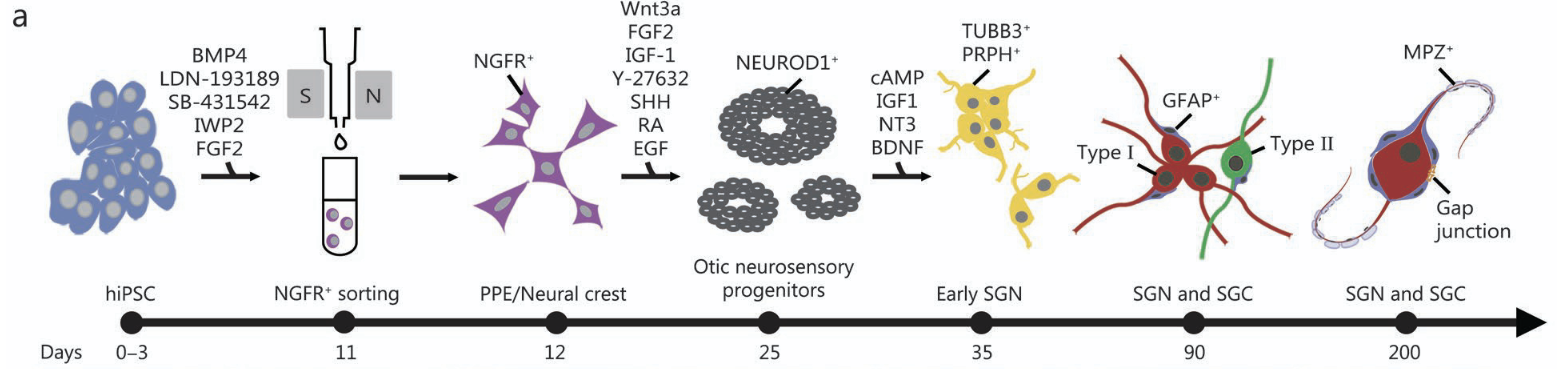
Overview and timeline of a human SGN-like neuron differentiation protocol from stem cells. Credit: Jeong et al./Military Medical Research
Progress in hearing restoration has been limited because human inner ear tissue is hard to access and scientists struggle to grow mature spiral ganglion neurons (SGN) from stem cells in the lab. Now, Hearing Restoration Project (HRP) member Ronna Hertzano, M.D., Ph.D., and team have recreated the key signaling pathways involved in human inner ear development. The resulting SGN-like neurons matched the appearance, molecular structure, electrical behavior, and functional characteristics of real SGN cells in the body. Hertzano is also a former Emerging Research Grants scientist.
To better understand the brain’s response to sound, Ben-Zheng Li, Ph.D., and team developed a computational model that extends the diagnostic potential of hearing tests by connecting test results with underlying neuronal changes. Zheng’s 2025-2026 ERG grant was generously funded by Royal Arch Research Assistance.
A 2011 ERG scientist, James E. Saunders, M.D., and team identified a novel human deafness gene, TECTB (beta-tectorin). Variants of the gene also reveals a gene–environment interaction in which having a single copy of the variant makes the cochlea more sensitive to noise trauma.
Mishaela DiNino, Ph.D., and team quantified that age-related changes in use of acoustic cues may begin in middle age, with even a mild hearing loss leading to difficulty hearing speech in noise. DiNino is a 2020 and 2023 ERG scientist generously funded by the Meringoff Family Foundation.
Now Available:
HHF’s Impact 2026 Progress Report
Read summaries of all of our Emerging Research Grants and Hearing Restoration Project scientists’ publications over the past fiscal year.
Plus:
October Is National Protect Your Hearing Month: How to protect your hearing at concerts without missing the music (see more resources below in Around the Web)

All planned gifts will be matched!
If you have been thinking about how to leave a lasting legacy to the causes that mean the most to you, right now your planned gift to HHF will be matched with our $1 million match challenge.
A planned gift can be as simple as naming HHF as a beneficiary in your will, retirement plan, or life insurance policy. Your legacy gift supports top-tier scientists through HHF’s Hearing Restoration Project and Emerging Research Grants. If you don’t yet have a will or need to update it, our partner FreeWill can help—for free.
P.S. If you include us in your will, please let us know so we can thank you!
Around the Web:
October Is National Protect Your Hearing Month: Are your earbuds damaging your ears? (CNET), a summer of safer listening (Tinnitus UK), noise pollution is a serious but often forgotten public health problem (The Conversation), veterans more at risk of early and severe hearing loss and tinnitus (Military.com), and UNC researchers develop technique to silence MRI noise (UNC Chapel Hill)
Unexpected cognitive improvement emerges in hearing aid trial (MedPage Today), ACHIEVE study links hearing treatment to slower rise in brain-health biomarker (HearingTracker), a change in your voice could be an early sign of cognitive decline (WCNC), and overlooked health test after 50 could help protect your brain (Men’s Journal)
Living with tinnitus can be distressing, so what can you do about it? (The Guardian), deep brain stimulation eases severe tinnitus over two years of follow-up (Bioengineer.org), local ear doctors help music industry workers who have tinnitus (Nashville Scene), and how I found tinnitus relief with free Android apps (ZDNET)
Does the VA pay for hearing aids? (Consumer Affairs), Fortell AI 2.0 hearing aids: a 50-Hour NYC trial (HearingTracker), and using data to personalize hearing aid fittings and patient care (The Hearing Review)
‘Frozen’ animator launches an interactive ASL learning app and vows to keep it free forever (Upworthy), American Sign Language should be required in elementary schools (Ball State University), RIT helps Google develop new technology that converts sign language into text (RIT), the fight to build a permanent center for Deaf people (The Guardian), and deaf adults’ brains rewire to boost ‘danger radar’ (University of York)
What does PTSD sound like? (Psychology Today) and a burst of pink noise may lead to more restorative sleep (MIT News)
A new framework for understanding speech in challenging listening situations (Hearing Health & Technology Matters), when the audiogram is normal but the hearing concern is real (Audiology Online), diabetes and hearing loss (Canadian Audiologist), driving with hearing loss or deafness (HearingTracker), and improving transport accessibility (RNID)
New gene discovery reveals an essential role for Formin-1 in hearing (Tel Aviv University), Sensorion receives French regulatory approval to initiate HearConnex gene therapy trial for GJB2-related hearing loss (The Hearing Review), and the healing power of gene therapy (Harvard Gazette)
A screening tool that can ‘see’ hearing loss and objective multimodal screening for auditory-related disorders (University at Buffalo)
MED-EL launches TICI Unico, a totally invisible cochlear implant and Cochlear surpasses 1 million hours of patient experience in fully implantable hearing technology program (The Hearing Review), plus a new study examines satisfaction and daily use among cochlear implant users (Hearing Health & Technology Matters)
A reflection on growing up with hyperacusis (Journal of Patient-Centered Research and Reviews), a 19-year-old with normal hearing spent two years listening to music that was never playing (Medical Daily), and Curtis Pride turned his MLB journey into a lifeline for deaf and hard-of-hearing kids (LA Times)
Can dogs get hearing aids? (American Kennel Club) and caterpillar twitches in an ultraquiet chamber are helping biologists understand how these insects hear without ears (The Conversation)
Products and services are not endorsed by Hearing Health Foundation. Links provided are for informational purposes only, may require registration or subscription, and may expire.
