
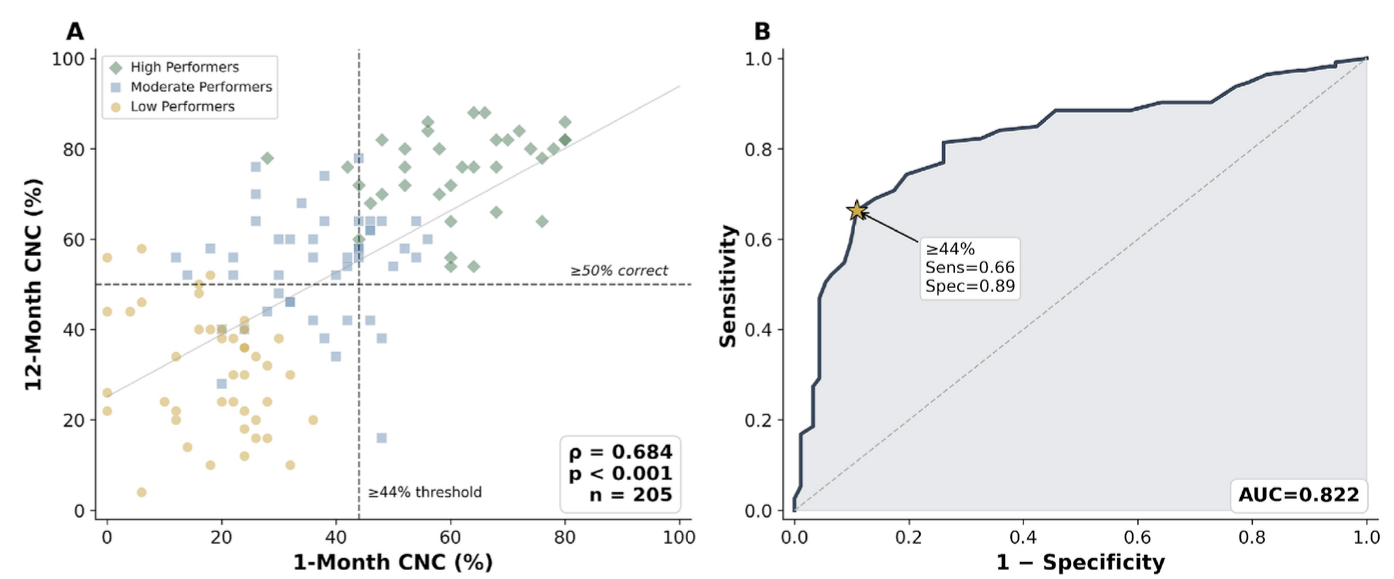
Scoring at 44 percent or better on word recognition at one month is a strong sign of long-term success with cochlear implantation, accurately predicting favorable one-year hearing outcomes. Credit: Younan et al./The Laryngoscope
One of the hardest conversations in cochlear implant care happens before surgery, when a patient asks how well they will hear a year later. Outcomes vary widely and standard pre-implant testing offers little predictive value. Now, 2024–2025 Emerging Research Grants (ERG) scientist Nicole T. Jiam, M.D., has tracked word recognition scores alongside daily processor usage hours at specific time-points post-activation, identifying an initial roadmap for success. Jiam was the recipient of an Elizabeth M. Keithley, Ph.D. Early Stage Investigator Award, generously supported in part by Susan and Steve Kaufman.
ERG scientist Megan Beers Wood, Ph.D., and team trained a deep neural network to help them pinpoint pain thresholds evidenced by behavior in a mouse model, finding that the hearing organ must be intact for sound to produce pain-related behavior. Wood’s 2022–2023 grant was generously funded by Hyperacusis Research.
2022–2023 ERG scientist Subong Kim, Ph.D., investigated differences in speech-in-noise ability to find a combination of factors is involved: early auditory processing, attention, and how strongly the brain represents target speech compared to background noise.
A study led by HHF board member Nancy M. Young, M.D., supports earlier access to cochlear implants for children with hearing loss, as young as 7 months of age.
Andy Groves, Ph.D., a member of HHF’s Hearing Restoration Project and former ERG scientist, has been named the inaugural Stuart A. Kornfeld Distinguished Professor of Medical Sciences at WashU Medicine.
Plus:

All planned gifts will be matched!
A Matching Challenge: 2X the Impact
If you have been thinking about how to leave a lasting legacy to the causes that mean the most to you, right now your planned gift to HHF will be matched with our $1 million match challenge.
A planned gift can be as simple as naming HHF as a beneficiary in your will, retirement plan, or life insurance policy. Your legacy gift supports top-tier scientists through HHF’s Hearing Restoration Project and Emerging Research Grants. If you don’t yet have a will or need to update it, our partner FreeWill can help—for free.
P.S. If you include us in your will, please let us know so we can thank you!
Around the Web:
Innovative virtual program helps veterans find relief from tinnitus (VA Greater Los Angeles), new research seeks to understand serotonin's role in tinnitus (EDM), how 30 years of tinnitus research became a start-up (University of Auckland), and the tinnitus threat that stalks orchestral musicians (Slippedisc)
Nearly 1 in 4 hypertensive adults have sensorineural hearing loss (The Hearing Review), the ‘healthy’ habit that’s silently damaging your hearing (Parade), and brain study reveals hidden clues to a condition that masks dizziness and increases fall risk (Imperial College London)
The uncomfortable truth about hearing loss and dementia (BBC) and what you can do to slow hearing loss as you age (Health)
Tackling hidden hearing loss with digital twins (CORDIS EU), digital auditory screening for cisplatin ototoxicity (Cancer Nursing Today), and hearing aids not enough in noise? How auditory training helps (HearingTracker)
What I found when I scanned the brains of kids creating tunes on the piano (The Conversation) and AI decodes the mathematical ‘fingerprints’ of famous jazz musicians (Scientific American)
Hearing tech startup Legato and its AI hearing glasses (TechCrunch) and RayNeo launches AI smart glasses with real-time captioning and live translation (The Hearing Review)
Why earplugs at gigs are surging (The Music Australia) and 83% of Gen Z have experienced hearing issues after live music events (DJ Mag)
New Jersey lawsuit takes on datacenter’s noise pollution (The Guardian) and how to file a complaint about television closed captions (Hearing Loss Association of America)
Global roll out of a ‘Quiet Hours’ initiative (Sephora) and putting sign language AI into users’ hands (Google DeepMind)
A new question prompt list for persons considering cochlear implants (The Hearing Journal) and a Medicaid advocacy toolkit (American Cochlear Implant Alliance)
8 in 10 ENTs say proposed Medicare cut could limit seniors’ access to specialty care (The Hearing Review) and the largest change to veteran benefits in years is splitting the military community (San Antonio Report)
Scientists recorded 420 human screams and discovered they can have six different meanings (Earth.com) and Universal’s new coaster is a scream—that’s the problem (The New York Times)
How to do your own online health research like a scientist—a biostatistician’s step-by-step guide (The Conversation)
Products and services are not endorsed by Hearing Health Foundation. Links provided are for informational purposes only, may require registration or subscription, and may expire.
