
The Department of Justice’s Project Civic Access initiative has produced sweeping settlements.
By Stephen O. Frazier
You may be one among millions of people who never hear about it, but complaints filed with the U.S. Department of Justice (DOJ) under the Americans with Disabilities Act (ADA) routinely lead to real, enforceable change. These resolutions rarely make headlines, but they quietly make more and more public gathering places aurally accessible.
Imagine attending a public meeting and being unable to hear the proceedings. You ask whether a hearing loop is installed—no. You ask about other assistive listening systems—either none exist, or you’re offered an FM system with no neckloops for your telecoil-equipped hearing aids. After the event, management shrugs and says: “That’s what we have. You’ll have to use a headset or sit closer.”
It’s easy for you to assume complaining won’t change things. You’re wrong—it will!
Under the ADA, the DOJ is required to review complaints. When investigators find violations, they compel venues to install compliant assistive listening systems (ALS), provide neckloops, improve signage, train staff, or take whatever steps are necessary to meet ADA requirements. These actions have been happening since 1990, increased after the 2010 revisions to the ADA, and are happening even more often in the recent past.
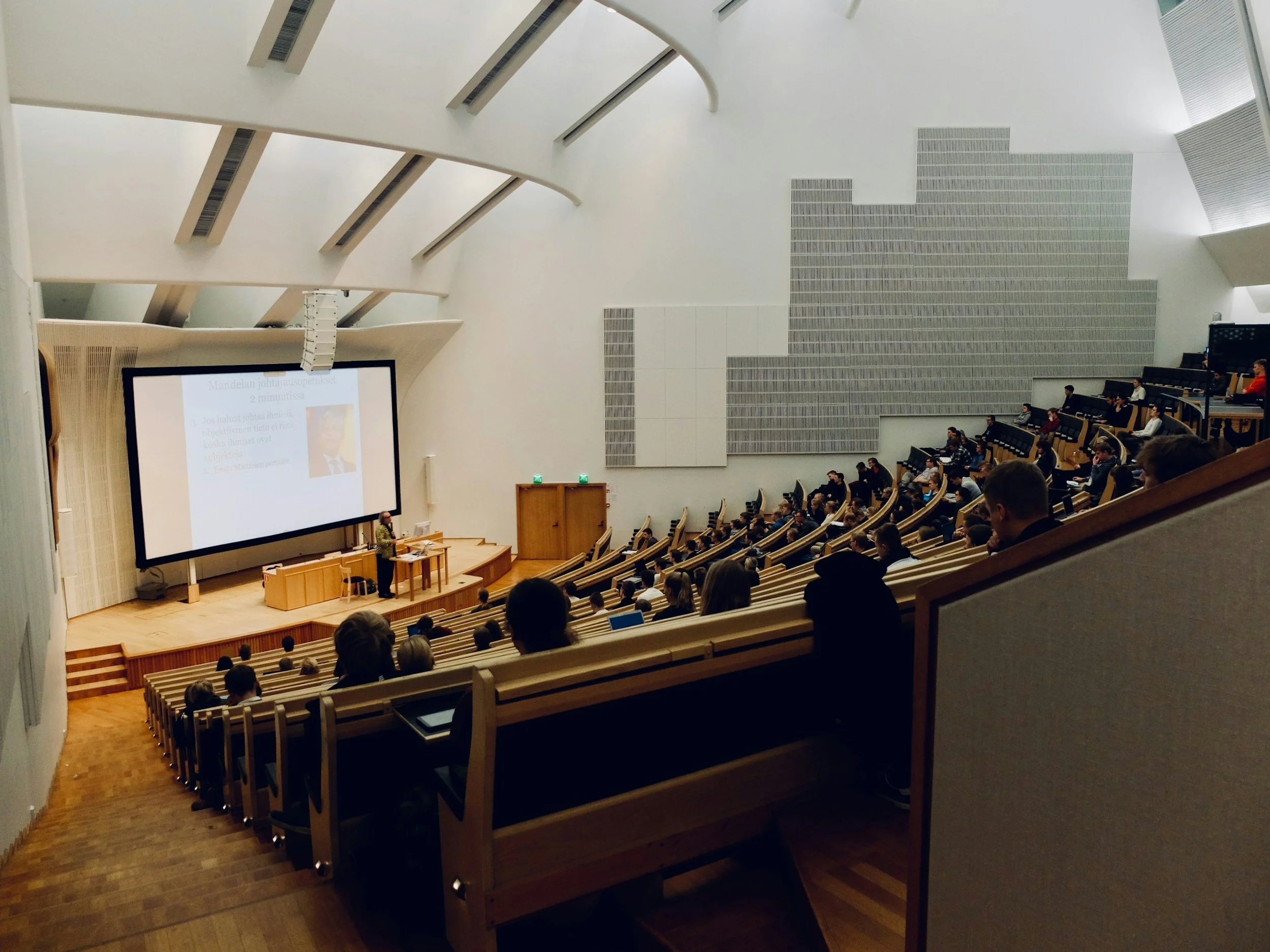
Universities appear frequently in settlement lists for ADA complaints, covering classrooms, auditoriums, stadiums, and performing arts venues. Credit: @domlafou/Unsplash
Real Cases, Real Consequences
ADA complaints cover a wide range of public entities: government offices, sports facilities, theaters, hospitals, universities, and more. Further, investigators frequently uncover additional violations beyond the initial complaint.
A few examples* from hundreds of complaints:
Starion Sports Complex, Mandan, North Dakota (2025): A complaint about accessibility in the newly built complex revealed multiple ADA failures, including a noncompliant ALS. The settlement required corrections to seating, restrooms, counters, and full ALS compliance.
Overton County, Tennessee (2023): The Chancery courtroom used for commission meetings had no ALS. Officials dismissed requests for hearing access, telling people to “sit closer,” and some refused to use microphones. The DOJ’s investigation required the county to install ALS in all spaces where public business occurs, create a formal process for requesting auxiliary aids, and upgrade PA systems.
Cinemark Enfield Square, Connecticut (2022): A physical accessibility complaint led investigators to discover the theater lacked the required number of ALS receivers and had inadequate signage. The settlement mandated more receivers, better signage, and fixes to restroom and food-service accessibility.
A review of recent DOJ resolutions shows a clear trend: Communication access failures now outnumber physical accessibility complaints. Hospitals, clinics, law enforcement agencies, theaters, public venues, and government bodies are increasingly cited for inadequate amplification, missing ALS, poor microphone use, and ineffective communication policies.
Nationwide Compliance
The DOJ’s Project Civic Access initiative has produced sweeping settlements with cities across the country. Many require ALS installation in council chambers, courtrooms, auditoriums, senior centers, and recreation facilities.
Examples include Denver’s settlement requiring ALS and proper signage in all public meeting rooms—not just one. Chicago, Miami, Portland (Oregon), and many others have faced similar requirements.
Entire movie theater chains—including AMC and Cinemark—have been required to increase the number of hearing-aid–compatible receivers, improve signage, and better maintain ALS equipment. Universities appear frequently in settlement lists, covering classrooms, auditoriums, stadiums, and performing arts venues.
Not all complaints stay with the DOJ. For example, complaints about the University of New Mexico's Popejoy Hall performing arts theater were referred to the U.S. Department of Education in light of the venue's education connection. Issues included nonfunctioning neckloops and inadequate signage. The settlement required the postage of signage in the ticket window and adjustments to ALS transmitter settings.
There are no “ADA police.” Enforcement depends on people who need accommodations speaking up. When they do, complaints are investigated—and change usually follows. It won't happen overnight, but if the complaint is a valid one, action will be the result.
How to File an ADA Complaint
For enforcement of the ADA, the DOJ Civil Rights Division recommends filing complaints online at justice.gov/crt/filing-complaint.
You’ll be asked to:
Describe what happened
Identify who discriminated
Provide optional contact information
Upload supporting documents
You may also file by mail at: U.S. Department of Justice, Civil Rights Division, 950 Pennsylvania Avenue, NW, Washington, DC 20530.
Remember: Your complaint won’t disappear into a void. It will be read, reviewed, and—when the ADA has been violated—those teeth in the headline above will bite.
*You can browse these settlements at ada.gov/enforcement.

Hearing Health staff writer Stephen O. Frazier, based in New Mexico, is a longtime, nationally known advocate for people with hearing loss. His three websites (sofnabq.com, loopnm.com, and ccaa.name) offer an online picture of that advocacy.
The Latest Blog Posts





Fifty percent of maximum volume on a power-hungry headphone can be quite gentle. Fifty percent on a sensitive pair of earbuds, plugged into a strong source, can be loud enough to permanently harm hearing.