
By Mishaela DiNino, Ph.D., and Elizabeth Fish
To follow a conversation in a noisy room, an individual must ignore the background noise. We use acoustic cues such as voice pitch and spatial location to focus on a target talker and ignore competing sounds.
Older adults typically experience more difficulty hearing in noise than younger listeners, primarily due to changes in the auditory system that occur with age. One potential link between age-related changes in auditory function and challenges hearing in noise may be a reduced ability to use voice pitch and spatial cues for attending to a target talker in noise.
We investigated this possibility by testing individuals ages 18 to 74 on a speech-in-noise recognition task in which the cue(s) available to differentiate a target talker from the distractor talkers was only voice pitch (“pitch” condition), spatial location (“spatial” condition), or both pitch and spatial location (“both”).
We also examined whether hearing loss or decreased neural function predicted participants’ ability to use acoustic cues during the speech-in-noise recognition task. We collected auditory brainstem responses (ABRs) to measure function of the auditory nerve and brainstem neurons and participant’s hearing thresholds at standard clinical frequencies (250 to 8,000 hertz) and extended high frequencies (EHFs; 10 and 12.5 kilohertz). Although EHF thresholds are not typically measured during clinical appointments, recent evidence suggests that hearing loss at these frequencies can lead to listening challenges.
In our recent paper in Hearing Research, published online in August 2026, we found that older adults achieved lower scores than younger adults on all conditions of the task, indicating that they experienced greater difficulty using the pitch and spatial cues to focus on a target talker and ignore the distractor talkers.
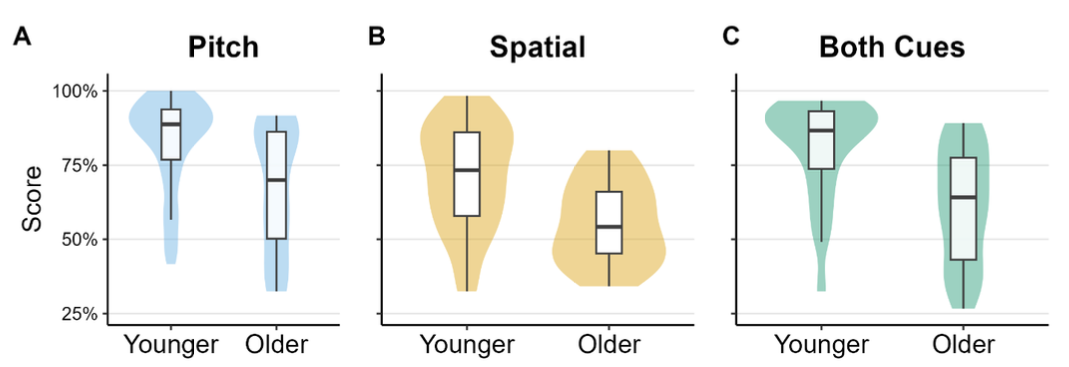
Score distributions for each cue condition separated by age group. A) Pitch cue condition. B) Spatial cue condition. C) Both cues condition. The colored areas indicate score distribution density with wider sections showing more participants achieving that score, and narrower sections showing fewer participants achieving that score. Boxplots are overlaid with the top and bottom of each box representing the 75th and 25th quartiles and the line in the middle of each box representing the median. Credit: Fish and DiNino/Hearing Research
Participants with poorer hearing at standard frequencies demonstrated poorer ability to use the pitch cue during the task. Although many studies have found that hearing loss affects pitch perception, our findings demonstrate that hearing loss also affects a listener’s functional use of pitch cues for hearing in noise.
Participants with poor EHF hearing received lower scores on the spatial cue and “both” cue conditions of the task, suggesting that hearing loss at even these higher frequencies may influence the use of acoustic cues for speech-in-noise perception.
ABRs did not predict scores on any condition. ABRs test the summed response of neurons, but a measure of neural processing that better reflects how well neurons code sound—instead of just their summed response—may have better predicted participants’ use of acoustic cues.
Interestingly, our “older” group included middle-aged (ages 40 and older) adults as well as more senior individuals. Our results demonstrate that age-related changes in use of acoustic cues may begin in middle age. Future studies examining listening challenges in middle-aged individuals could help determine the trajectory of age-related difficulties hearing in noise to identify potential targets for early clinical intervention.
The results from our study provide one explanation for why age-related changes in auditory processing cause challenges when listening in noise: Even mild hearing loss that can occur with aging reduces the ability to use important acoustic cues for hearing a target talker in noise.


Mishaela DiNino, Ph.D. (top), is an assistant professor in the department of communicative disorders and sciences at the University at Buffalo. She is a 2020 and 2023 ERG scientist generously funded by the Meringoff Family Foundation. Study coauthor Elizabeth Fish (below) is a master of engineering student in the department of biomedical engineering at Boston University.
The team’s paper, “Age-related changes in acoustic cue use for speech-in-speech perception,” was published online in Hearing Research in August 2026.

The Latest Blog Posts





A person becomes hard of hearing, caregivers and families start raising their voices, no one likes shouting at another person, the conversations decline.