
By Konstantina M. Stankovic, M.D., Ph.D., FACS, and Ronna Hertzano, M.D., Ph.D.
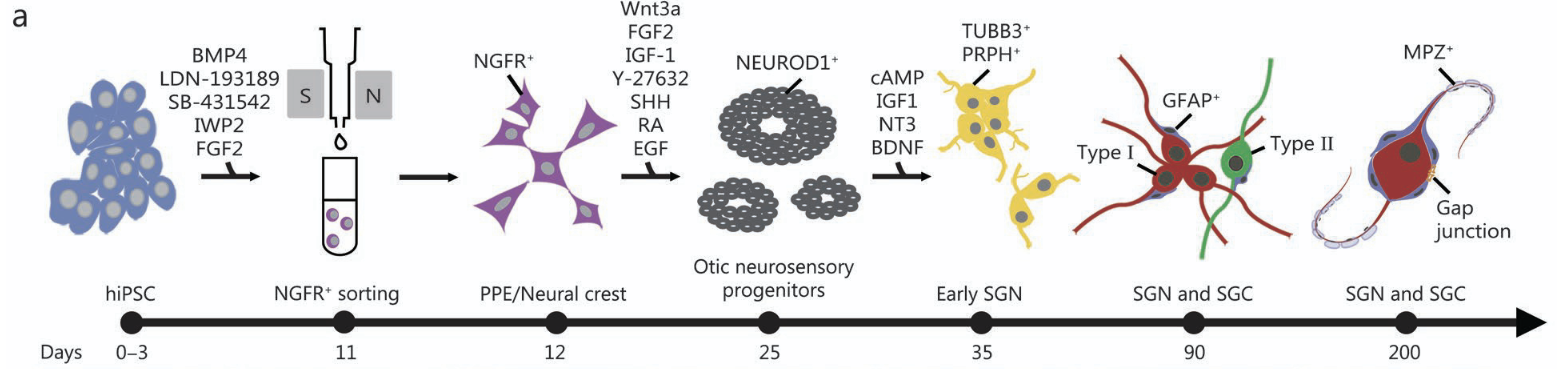
Overview and timeline of human SGN-like neuron differentiation protocol from hiPSCs and matching bright-field images. Scale bar=100 μm. Credit: Jeong et al./Military Medical Research
Spiral ganglion neurons (SGNs) relay auditory sensory information from the cochlea to the brain. Their loss results in permanent hearing impairment in humans due to their limited regenerative capacity.
Progress in hearing restoration has been constrained by the inaccessibility of human inner ear tissue and challenges in generating functionally mature human SGN-like neurons from stem cells in the lab.
To generate human SGN-like neurons from human induced pluripotent stem cells (hiPSCs), we recreated the key signaling pathways involved in human inner ear development, with our results published in the 2026 issue of Military Medical Research.
On day 11 of differentiation, using magnetic sorting we isolated early stage cells that develop into ear and nerve tissues (nerve growth factor receptor-positive cells, precursors of pre-placodal ectoderm and neural crest).
From days 18 to 25, we treated the cell cultures with key signaling proteins, including “sonic hedgehog,” to induce them to become inner ear nerve precursors. We then prompted these neurons to mature using a cocktail of growth factors (BDNF, NT-3, and IGF-1) that support spiral ganglion neuron development.
We then confirmed cellular identity and electrical functionality using single-cell RNA sequencing, molecular tagging (immunocytochemistry), electrical recording (whole-cell patch-clamp electrophysiology), cell co-culturing, and calcium ion imaging.
The resulting hiPSC-derived SGN-like neurons matched the appearance, molecular structure, electrical behavior, and functional characteristics of SGN cells in vivo.
The neurons acquired the distinct two-pronged shape and were wrapped by glial cells. Single-cell gene analysis revealed that these SGN-like neurons were distinct from other brain neurons and showed similarity to type I and type II SGNs. Electrophysiological recordings revealed stable resting voltages and strong firing signals, consistent with maturation.
When grown alongside mouse cochlear hair cells and brainstem cells from the cochlear nucleus, the human nerves formed working electrical connections, successfully sending and receiving signals.
Our study reports a robust and reproducible protocol for generating human SGN-like neurons from hiPSCs, providing a versatile platform for studying human auditory development, disease modeling, drug screening, and cell-based therapies for hearing restoration.

Konstantina M. Stankovic, M.D., Ph.D., FACS (top), is the Bertarelli Foundation Professor and chair of the department of otolaryngology–head & neck surgery at Stanford University School of Medicine. As of October 1, 2026, she is also a new member of HHF’s Board of Directors.

Ronna Hertzano, M.D., Ph.D. (below), a former Emerging Research Grants (ERG) scientist and member of HHF’s Hearing Restoration Project, is the chief of the neurotology branch at the National Institute on Deafness and Other Communication Disorders.
Their paper, “Engineering of functional auditory neurons from human induced pluripotent stem cells,” appeared in the 2026 issue of Military Medical Research.
The Latest Blog Posts



Hearing loss began affecting how I saw myself. There is a word in Chinese that describes how I felt: 自卑 (zìbēi), a feeling of insecurity and inferiority that makes you shrink yourself around other people.