
By Donald Wendorf
I am a retired psychologist, an active musician, and a newcomer to Hearing Health Foundation (HHF). As an artist navigating Ménière’s disease, I would love to see a broader conversation among musicians sharing their stories and practical tips on how they continue making music in spite of hearing challenges.
In that spirit, I wanted to share a bit of my own journey, the workarounds I’ve developed, and the questions I’m still figuring out along the way.
Ménière’s disease affects my left ear. My ear rarely feels totally open, varying in fullness to the point where it can sometimes border on painful.
On top of that, I live with low-level tinnitus—often hearing my own pulse or a low rumble like a generator out in the neighborhood—with occasional volume spikes as loud as a loud conversation. Sound distortion also creeps in depending on the frequency and tone.
My right ear, fortunately, isn’t affected by Ménière’s, though it does bear the standard wear and tear of being 78 years old!
Performance Hacks
When performing, I usually play and sing with a small amplifier and a microphone for vocals, or on a jazz banjo or a pickup in a vintage arch-top guitar (an acoustic guitar with a curved top).
The combination of Ménière’s and tinnitus creates practical challenges onstage:
Finding the right pitch and balance: Sometimes it’s hard to be sure I’m hitting the exact right pitch, or to tell if my guitar strings are properly balanced to blend the highs and lows.
Playing with other artists: Loud venues can amplify my tinnitus, and playing alongside other instruments—especially loud horn sections—can be tough on sound processing.
Using workarounds for the monitor: To get the most out of my “good” ear, I try placing my amp on a chair right beside my right side to act as a monitor. I turn up the overall volume slightly, though I always have to balance that against the risk of audio feedback, spiking my tinnitus further, or overwhelming the audience.
The good news is that the longer I play in any given session, the better my hearing seems to adjust. I still feel like I’m putting across a decent performance—even if I’m not as completely sure about it as I used to be.
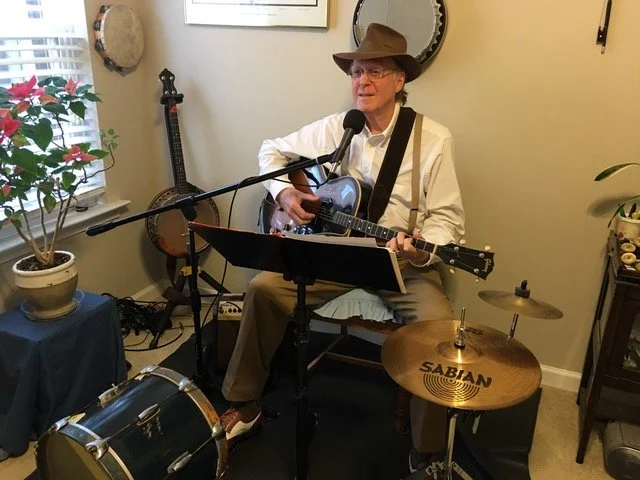
The hat is an 80-year-old Borsalino fedora that the writer’s uncle bought in Europe right after World War II, when he was released from a German POW camp. The instruments carry just as much history.
Old Jazz, Old Instruments, Old Hats
Making music is central to who I am, and my gear reflects a lifetime of stories. I like old jazz, old instruments, old hats, and old stories!
If you look at my photo, the hat I’m wearing is an 80-year-old Borsalino fedora that my Uncle Jack bought in Europe right after World War II, when he was released from a German POW camp.
My instruments carry just as much history. The guitar is a 1953 Gibson ETG-150 tenor guitar. The drum is a field snare tuned down to act as a bass drum. It looked just as ancient back in 1963 when my high school band director gave it to me to practice on! A late-1920s Stromberg-Voisinet tenor banjo sits in the corner, and the little crash cymbal next to it may have belonged to Buddy Rich, the American jazz drummer.
I want to keep playing music for as long as humanly possible, and I know I’m not the only musician finding creative ways to adapt to Ménière’s and age-related hearing loss.
I’d love to hear from other players in the HHF community: What tips, stage setups, or tricks have you learned that help you keep making music? How do you balance sound quality, pitch, and protecting your hearing while giving a great performance?
Donald Wendorf lives in Alabama.
The Latest Blog Posts



Hearing Health Foundation (HHF) is very pleased to announce the addition of four new members to our Board of Directors: Andreas H. Eckhard, M.D., Steven D. Rauch, M.D., Konstantina Stankovic, M.D., Ph.D., FACS, and Daniel J. Tollin, Ph.D.