
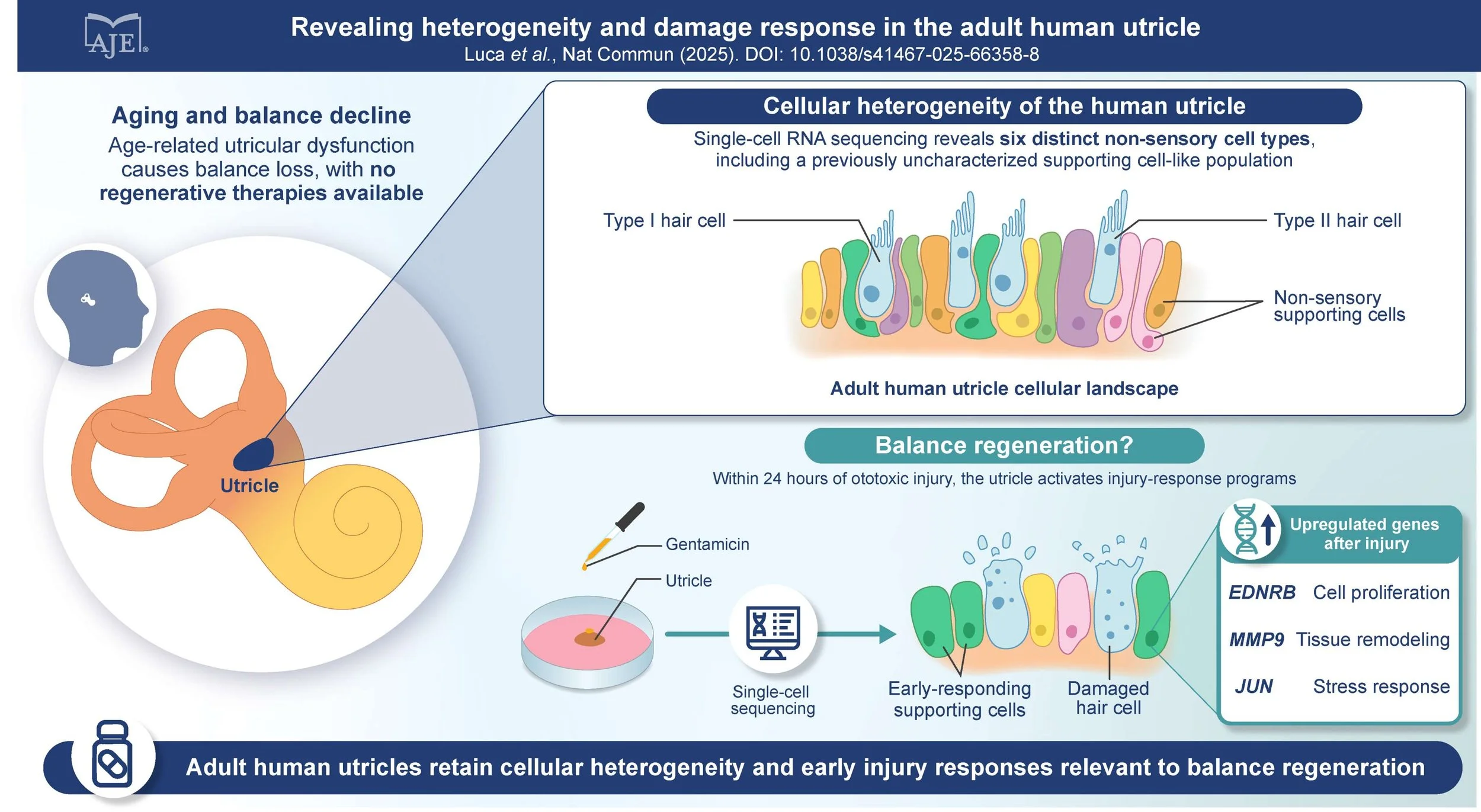
This graphical abstract summarizes the team’s paper. Credit: Luca et al./Nature Communications
Hearing Restoration Project member Alain Dabdoub, Ph.D., and team identified six distinct types of supporting cells in the utricle, the balance organ in the inner ear, each with a unique gene signature. Notably, the researchers identified two “first responder” cell clusters involved in inflammation control and remodeling. They are located near areas where other cells are missing, and near newly formed hair cells, suggesting they may be the utricle’s repair crews.
How the Hearing Restoration Project is transforming inner ear science: HRP scientific director Lisa Goodrich, Ph.D., details how, thanks to the HRP, we have a mechanism for data sharing and collaboration, a way to assess gene expression rigorously and identify relevant patterns, and examples of new hair cell-like cells generated in a post-hearing mammalian cochlea.’
A new paper from HHF board member Anil K. Lalwani, M.D., and team examined music habits of cochlear implant users and finds that better hearing ability significantly correlates with increased time spent listening to music. Lalwani also heads our Council of Scientific Trustees, which oversees our Emerging Research Grant (ERG) program.
2018 Emerging Research Grant (ERG) scientist Philippe Vincent, Ph.D., of Johns Hopkins Medicine secured multiple competitive research awards as principal investigator for projects focused on synaptic regeneration and functional recovery in the auditory system.
HHF partner Hyperacusis Research is featured in this article about the quietest home in the world.
Plus:
This first week of February is Tinnitus Awareness Week! (See more links in Around the Web below.)
Our Fiscal Year 2025 990 and audited financial statements are now available too.

Research Webinar: Noise Reduction Outcomes and Neuroscience
Click to watch the captioned recording, along with reading the transcript and bibliography, of our February 2 webinar, presented by 2022–2023 Emerging Research Grants scientist Subong Kim, Ph.D. Registration for our April 6 webinar opens in March.
Around the Web:
“My tinnitus is like having a play button stuck” (BBC) and living with tinnitus: “the monster on my shoulder” (Bailiwick Express)
Eating more fruit may lower your risk of tinnitus (HealthDay), book proposes standardized stepped-care for tinnitus (The Hearing Review), here’s what experts want you to know about tinnitus (SciTechDaily), 4 best natural remedies for tinnitus, according to a doctor (Today), and study suggests vitamin D deficiency may increase risk of tinnitus (Hearing Health & Technology Matters)
Large-scale music events can cause subclinical hearing damage (Scientific Reports) and when your favorite earplugs fail you: why and how to get a backup now (NoisyWorld)
These hearing aids will tune into your brain (IEEE Spectrum), new AI-powered Fortell hearing aid tackles the age-old problem of noise (Clear Health Costs), OTC vs. prescription hearing aids: what you need to know (Hearing Tracker), direct-to-ear audio streaming can improve accessibility and well-being (The Hearing Review), and pilot program would offer over-the-counter hearing aids to veterans (Stars & Stripes)
Taking the long view in hearing loss research (Medical University of South Carolina), redefining what music sounds like to someone with hearing loss (Penn Medicine), new AI tool accelerates hearing research with unprecedented 3D views of sensory cells (UC San Diego), and first patient with hereditary deafblindness treated with new experimental gene therapy (Radboud UMC)
Researchers identify over 200 gene variants in childhood deafness (MedicalXpress) and the first nine months: why early hearing matters more than ever (ENT & Audiology News)
Elucidating the relationship between hearing loss, social isolation, and dementia (Journals of Gerontology), 40 Hz auditory stimulation shows long-term efficacy in aged monkeys, offering potential for non-invasive Alzheimer's therapy (Chinese Academy of Sciences), hearing aid prescriptions not associated with changes in memory or thinking (American Academy of Neurology), and NIH award for app that predicts fall risk (Hearing Health & Technology Matters)
A guide to traveling with hearing loss (Yahoo!) and the most accessible attractions for people with hearing loss (GN ReSound)
CES 2026: three takeaways for hearing healthcare (Hearing Tracker) and why hearing tech is becoming a bigger focus for consumer electronics (Digital Trends)
Translate your data into music to improve its reach (Nature), now is the era when everyone can easily measure and monitor hearing (The Hearing Journal), and government shutdown ends with key wins for hearing health (American Academy of Audiology)
Puerto Rican deaf interpreter primed to make history during Bad Bunny Super Bowl halftime show (ABC)
Products and services are not endorsed by Hearing Health Foundation. Links provided are for informational purposes only and may require registration or subscription. Links to time-sensitive events may expire.
