
Hearing Health Foundation was pleased to attend Tinnitus Quest’s inaugural 2025 Tinnitus Hackathon. The cofounders of the nonprofit, based in Germany, include longtime friend of HHF Hazel Goedhart, of Tinnitus Hub and Tinnitus Talk, who has also shared her story of living with tinnitus.
Here we share an excerpt from their report about the event, including insights from presenter Daniel Polley, Ph.D., of Mass Eye and Ear/Harvard Medical School. Polley sits on the innovation board of Tinnitus Quest and the scientific advisory boards of American Tinnitus Association and HHF funding partner Hyperacusis Research, through which HHF was able to share his story.
Executive Summary
Tinnitus Quest’s 2025 Tinnitus Hackathon brought together leading scientists, clinicians, funders, and patient advocates to rethink how tinnitus research is conducted and to chart a clearer path toward effective, mechanism-based treatments capable of silencing tinnitus. Unlike traditional conferences, the hackathon prioritized active problem-solving, cross-disciplinary debate, and the development of a shared research agenda.
Participants agreed that the field suffers from fragmentation, insufficient mechanistic understanding, lack of objective measures, and limited industry engagement. They emphasized the urgent need for a shared tinnitus model, precision interventions, rigorous biomarkers, biologically grounded subtyping, validated models, open data, and better integration of neural, genetic, and network-level insights.
Survey and workshop discussions reinforced that the “knowns” of tinnitus remain high level, while the “unknowns” span core mechanistic, diagnostic, and therapeutic questions. Breakout groups explored potential solutions through big data, AI, drug and device repurposing, lessons from other fields, and global research infrastructures—all underscoring the need for coordinated funding and a unified research framework.
From the Tinnitus Hackathon, 10 critical research priorities emerged. These include defining tinnitus mechanisms, resolving whether a final common pathway exists, establishing clinically meaningful subtypes, understanding chronification, validating biomarkers, and identifying precise (multimodal) therapy targets. Tinnitus Quest will now convert these priorities into concrete research questions, funding strategies, and collaborative structures, aiming to accelerate the development of impactful treatments for millions of sufferers worldwide.
Precision, Not Oversimplification
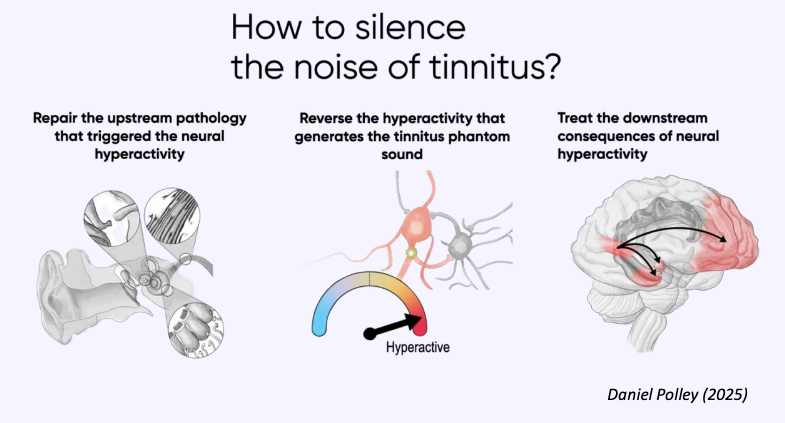
Credit: Daniel Polley, Ph.D., via Tinnitus Quest
Daniel Polley, Ph.D., is a professor of otolaryngology–head and neck surgery at Harvard Medical School and the director of Eaton-Peabody Laboratories, the vice chair for basic science, and the director of the Lauer Tinnitus Research Center, all at Mass Eye and Ear.
Polley emphasized that many current tinnitus research models rely on oversimplified assumptions about how the brain works. He argued that animal models rarely capture the true human condition and stressed the need for:
Targeting endogenous repair processes and well-defined neural circuits
Biomarker-driven precision interventions rather than broad interventions
Placebo-controlled study designs
Adopting rigor and standards seen in fields like oncology
His message: To make progress, tinnitus research must move beyond generic, non-mechanistic interventions.
For more, see Tinnitus Quest’s Tinnitus Hackathon report available in full online and as a PDF. Emerging Research Grants scientist Bshara Awwad, Ph.D., is a postdoctoral fellow in the lab of Daniel Polley, Ph.D. Awwad’s 2026 grant is generously funded by HHF partner Hyperacusis Research.
The Latest Blog Posts




Hearing Health Foundation (HHF) is very pleased to announce the addition of four new members to our Board of Directors: Andreas H. Eckhard, M.D., Steven D. Rauch, M.D., Konstantina Stankovic, M.D., Ph.D., FACS, and Daniel J. Tollin, Ph.D.