
By Lauren Dillard, Ph.D., Au.D.
According to World Health Organization (WHO) estimates, one in five people globally has hearing loss, and that number is expected to rise to one in four by 2050. Many causes of hearing loss are preventable through public health action, but one cause stands out as both highly prevalent and highly preventable: exposure to loud sound. Part of my work as a consultant with the WHO Ear and Hearing Care Programme has focused on recreational sound exposure among young people.
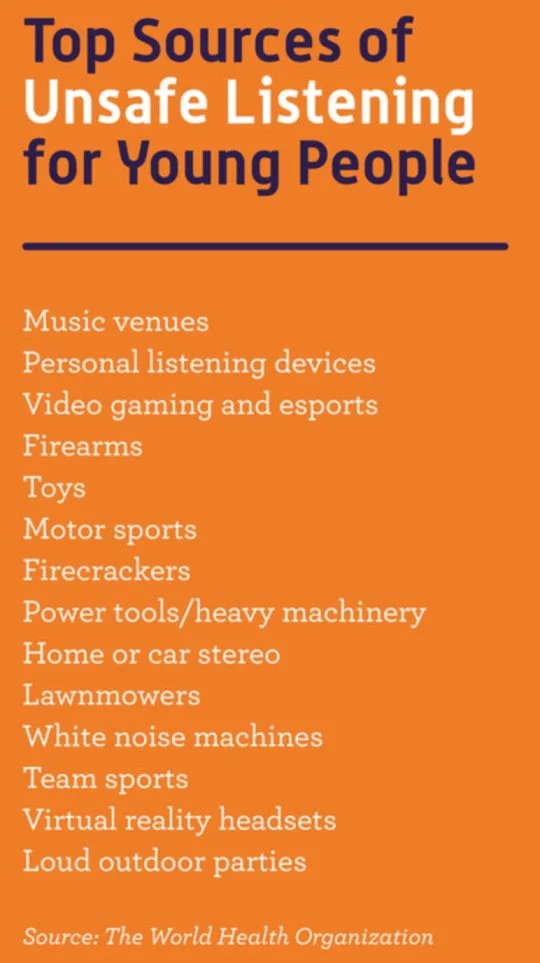
Most people don’t realize how often we encounter unsafe sound levels, so understanding “how loud is too loud” is essential. Hearing is measured in decibels (dB) on a logarithmic scale with a time–intensity trade-off. In other words, the louder the sound, the shorter the amount of time you can be around it safely.
Loud sounds can cause permanent damage to hearing. The main hearing organ, the cochlea, located in the inner ear, contains tiny hair cells that act as the sound receptors sending signals to the brain. When exposed to loud sounds, these hair cells become damaged, which can lead to hearing loss and/or tinnitus. The damage is irreversible.
The impacts of loud sounds can be immediate, but it is more common that damage to the auditory system is gradual, often going unnoticed or ignored until the symptoms become more obvious.
When thinking about exposure to loud sounds, it is important to take a life-course perspective. That is, the health behaviors developed in childhood and adolescence can shape habits into adulthood.
There is strong evidence from other areas of public health—such as nutrition and physical activity—that early exposure to healthy habits matters and can have lifelong impact. The same applies to hearing. If we want people to protect their hearing later in life, we need to begin teaching safe listening practices early in life.
Over the past decade the three main sources of recreational sound exposure the WHO has focused on—and for which it has produced global safe listening standards—are: loud venues and events (such as concerts, clubs); personal listening devices (such as smartphones); and video games and esports.
Recently, we have identified additional, sometimes overlooked sources of loud sound exposure that may affect many young people worldwide.
I am particularly interested in white noise machines and what the safe listening level is. Research on white noise machines and hearing is still quite limited, but it is plausible that they could impact hearing, particularly because young children and babies often listen to them for long periods of time (while sleeping) and because they can reach rather high sound levels.
Studies from around the world show that roughly 25 to 65 percent of young people regularly engage in activities that exceed safe listening thresholds. And these exposures accumulate—not just throughout the day, but across a lifetime. Research, which is ongoing, suggests that there is quantifiable hearing damage (hearing loss and/or tinnitus) from recreational sound exposure among children and adolescents.
Here are recommendations in the WHO’s global standards and other WHO resources:
Follow the 60/60 rule (no more than 60 percent volume for no more than 60 minutes at a time).
Lower the volume in general; noise-canceling headphones can help reduce the need to turn sound up because of competing background noise.
Use hearing protection in noisy environments.
Limit time in loud activities.
Monitor safe listening levels—some devices now provide automatic warnings when a listening environment is unsafe.
Pay attention to early warning signs such as tinnitus or difficulty understanding speech in background noise.
Check your hearing, either through an app or a hearing care provider.
And for parents: Actively educate children about safe listening and model these behaviors early.
It can be hard to judge loudness accurately by perception alone. A sound level meter app is a simple, valuable tool that can be used to measure sound levels and estimate safe exposure time. These apps can help translate concepts like decibels, sound dose, and time-intensity tradeoffs into something practical and actionable.
The evidence continues to grow, but the conclusion is clear: Reducing exposure to loud sound—especially early in life—is one of our most effective strategies to prevent avoidable hearing loss.

Lauren Dillard, Ph.D., Au.D., is an assistant professor at the Medical University of South Carolina and a consultant with the World Health Organization’s Ear and Hearing Care Programme.
This article is adapted from Dillard’s presentation at a webinar hosted by HHF partner Quiet Communities, with Sherilyn M. Adler, Ph.D., from Ear Peace Save Your Hearing Foundation, and HHF’s Yishane Lee. Watch the panel discussion on how to promote healthy hearing among young people at youtube.com/watch?v=c2Gt0l8yuHY.
The Latest Blog Posts




A person becomes hard of hearing, caregivers and families start raising their voices, no one likes shouting at another person, the conversations decline.