
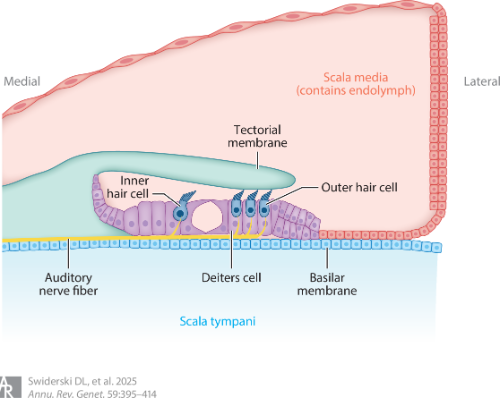
Illustration: A cross section of the cochlear duct with emphasis on the sensory epithelium. Credit: Swiderski, Wilson, Raphael/Annual Review of Genetics
In a detailed overview in the Annual Review of Genetics, Yehoash Raphael, Ph.D., and coauthors show that hair cell regeneration is ready for advanced gene analysis. A member of Hearing Health Foundation’s Hearing Restoration Project, Raphael describes the next steps: using powerful modern sequencing technology in order to map gene activity and gene regulation during hair cell regeneration in fish and birds as well as in mammalian balance organs.
Illustration: A cross section of the cochlear duct with emphasis on the sensory epithelium. Credit: Swiderski, Wilson, Raphael/Annual Review of Genetics
In a paper in JAMA Otolaryngology–Head & Neck Surgery, Hearing Health Foundation (HHF) board member Nancy M. Young, M.D., and team show that an AI model can predict how well young deaf children will develop speech after cochlear implantation with about 92 percent accuracy by analyzing brain MRI scans taken before surgery. The tool outperforms traditional methods and could help target patients needing intensive speech and language therapy.
Former Emerging Research Grant (ERG) scientists Ross Maddox, Ph.D., and Melissa Polonenko, Ph.D., and team published a study in PLOS Biology showing that our ability to tune in to one voice in a noisy room comes from the brain’s cortex, not from lower auditory pathways like the brainstem or auditory nerve. HHF is grateful to our longtime partner Royal Arch Research Assistance, who generously funded both Maddox in 2013 and Polonenko in 2023–2024.
A study on how California ground squirrels’ hearing adapts to low or high elevation draws from 1980s research conducted by past Emerging Research Grants scientist Kenneth R. Henry, Ph.D., a professor emeritus at the University of California, Davis.
Plus:
A quiet activist is using videos to promote science fact over noise fiction.
A music industry professional shares a practical reference on how to protect our first instrument: our hearing.
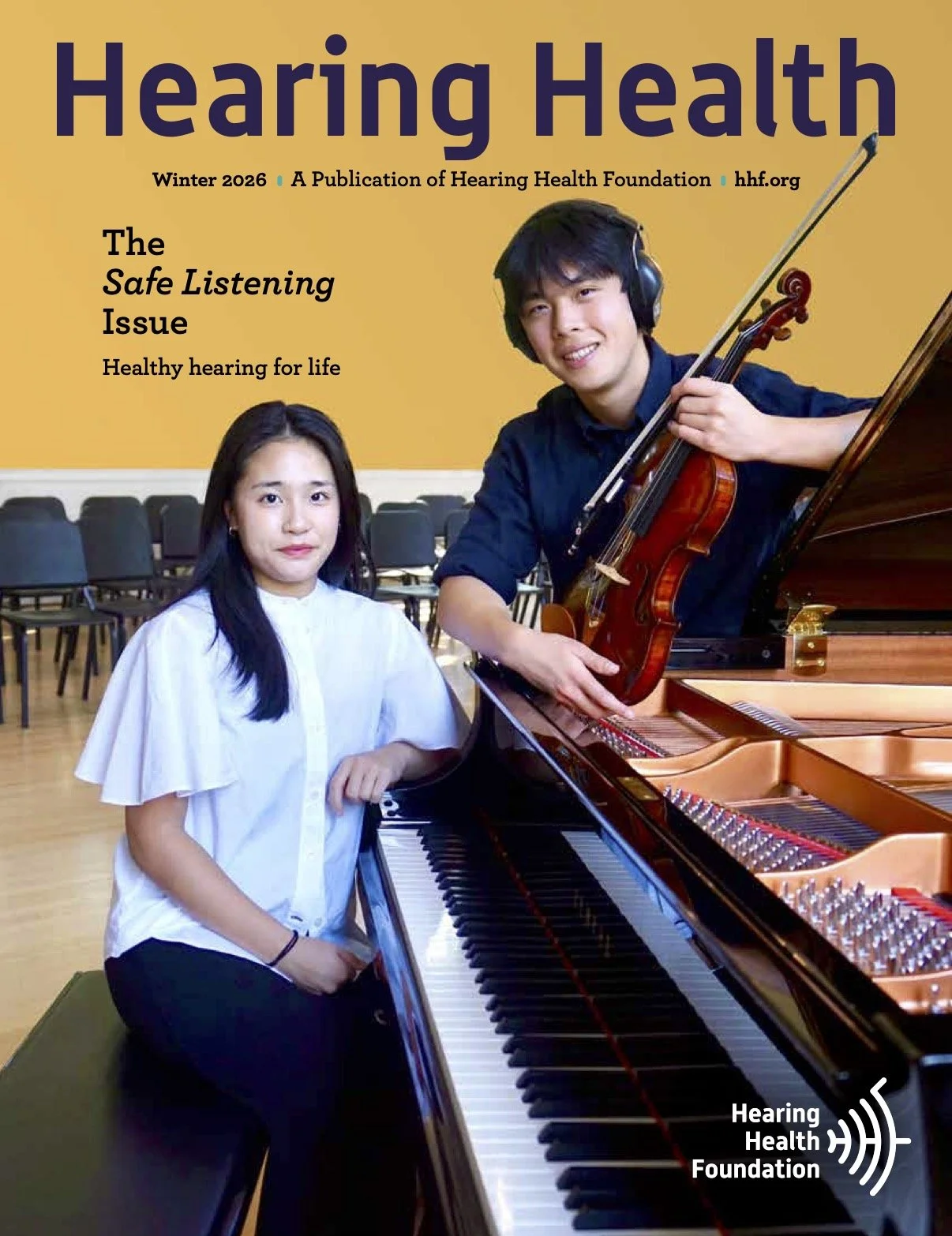
The Winter 2026 Issue of Hearing Health Magazine Is Online
Click here to read the issue, or if you’ve signed up for a free print subscription, it will arrive in mailboxes by the end of the month.
The cover story by two high school musicians seeking to raise awareness of safe hearing habits is also available here.
Around the Web:
Hearing healthcare 2025 review: the year in headlines (HearingTracker) and hearing technology and hearing health: a look back at 2025 (BIHIMA)
Want this hearing aid? Well, who do you know? (WIRED), why more adults should embrace hearing aids (AARP), and I got hearing aids in my 50s—I wish I’d gotten them sooner (The Times)
Babies as young as 7 months now have access to “transformative” cochlear implants (CNN) and single-sided deafness and cochlear implants (Hearing Health & Technology Matters)
Hearing assistive technology makes noisy spaces easier to navigate (AARP) and AI headphones automatically learn who you’re talking to—and let you hear them better (University of Washington)
Tinnitus triggers your body’s “fight or flight” response (ScienceAlert)
The other screen time risk we rarely hear about (MedPage Today)
We are hardwired to sing—and it’s good for us, too and humans could have as many as 33 senses (The Conversation), plus blinking less could signal the brain is working harder to listen (Concordia University),
Your Android phone can warn you about important sounds you can’t hear (Make Use Of), my experience with the QC Earbuds Ultra 2 for everyday noise reduction (NoisyWorld), and I’m a headphone reviewer, these audio hearing glasses work better than I expected (CNET)
HearUSA and Hearing Aid Project partner to expand access to free hearing care nationwide (Hearing Health & Technology Matters)
Products and services are not endorsed by Hearing Health Foundation. Links provided are for informational purposes only and may require registration or subscription. Links to time-sensitive events may expire.
