
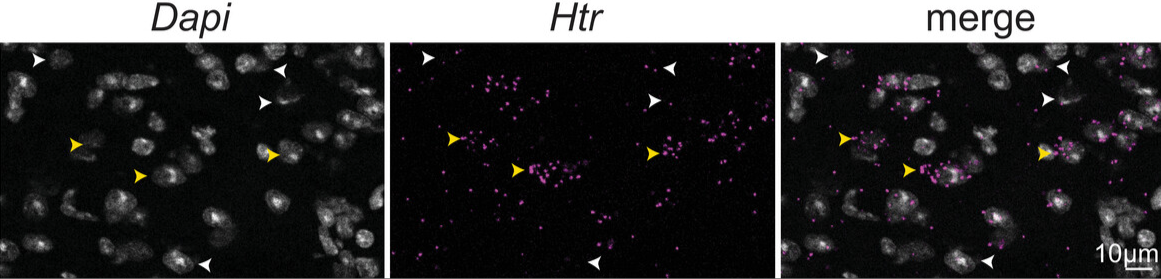
Examples of serotonin receptor expression. Cells are considered positive (yellow arrow) if they show three or more puncta (bright spots), while those with fewer are considered negative (white arrow). Credit: Galindo, Nazir, Silveira/Journal of Comparative Neurology
While serotonin is well-known for regulating mood and sleep, a new study by 2026 Emerging Research Grants (ERG) scientist Marina Silveira, Ph.D., reveals that it also acts as a sophisticated volume control for hearing by both enhancing and suppressing sound signals. Serotonin can “turn up” the gain on important auditory information while simultaneously “turning down” background noise, helping us to better understand auditory disorders. Silveira is generously funded by Royal Arch Research Assistance.
2025–2026 ERG scientist Bruna Mussoi, Au.D., Ph.D., details the complexity behind why hearing in noise becomes more challenging with age. Mussoi’s grant is generally funded by Mike Miles.
2012–2013 ERG scientist Lina Reiss, Ph.D., hosted an internship in her lab last summer that included undergraduate Michael Bennie, who shared his experience applying his computer science skills to the field of audiology.
AI model predicts language development in children with hearing loss: new research by HHF board member Nancy M. Young, M.D.
Your hearing can get worse as you age, here’s how to protect it with tips from 2019 ERG scientist Dunia Abdul-Aziz, M.D.
Research webinar this coming Monday, April 6, 5pm ET: Timothy Balmer, Ph.D., will present on “The Brain’s Built-In Noise Cancellation.” A 2017 and 2022–2023 ERG scientist, Balmer’s current 2025–2026 grant is generously funded by the Salice Family Foundation. Register for the hour-long webinar here.
Plus:
A drummer with hearing loss can enjoy music again, thanks to technology and his friends’ support
The popular HBO show “The Pitt” spotlights healthcare accessibility gaps
A $1,000 mistake was the wakeup call to stop pretending to be able to hear
Auracast adoption means inclusive listening is finally going universal—for everyone plus 10 steps to “Auracasting” your community from Hearing Tracker
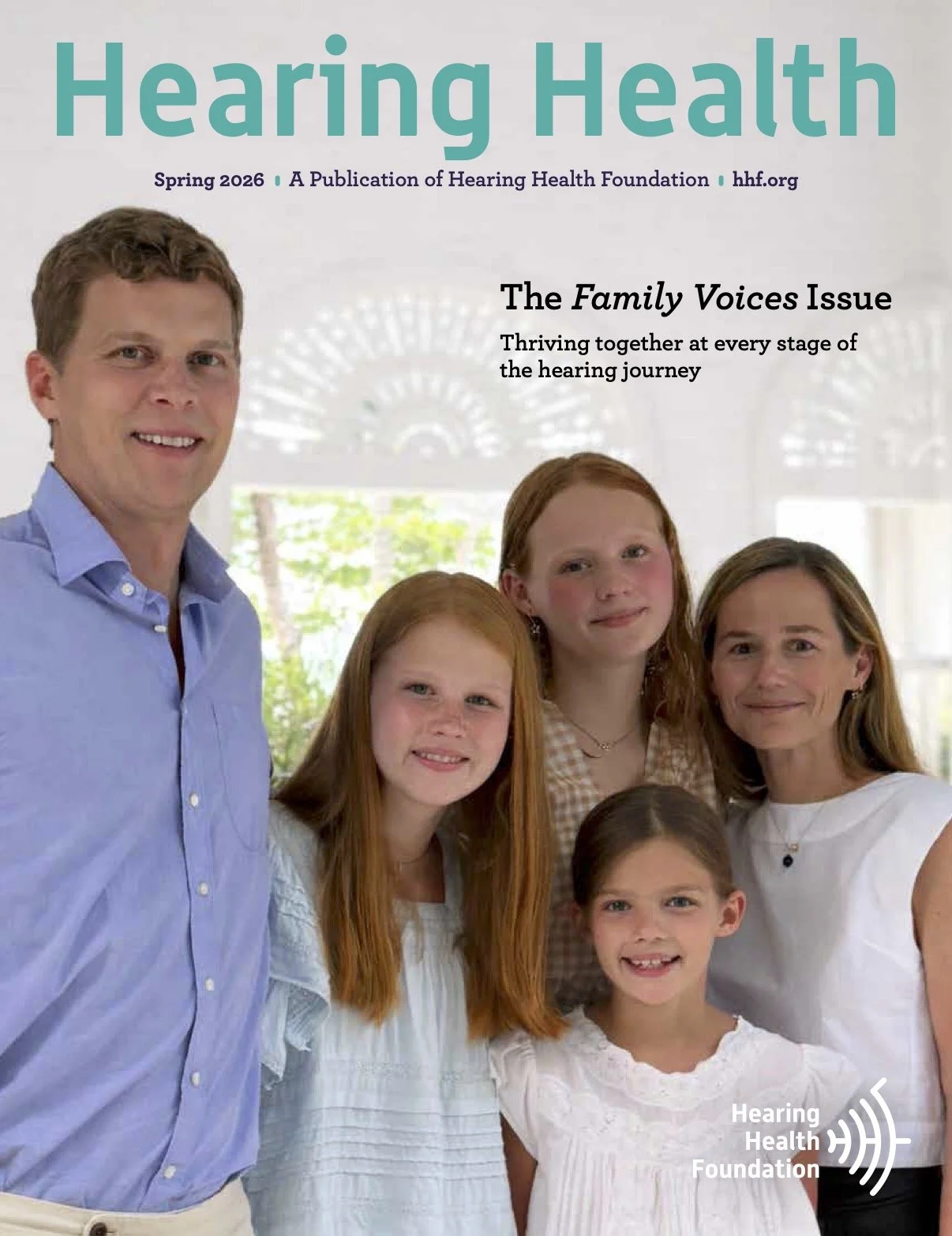
No matter our age, hearing loss is less a defining trait than it is just a part of our identity. The range of family voices in this issue—online now and arriving in subscribers’ mailboxes by the end of the month—are sparking greater awareness, advocacy, and connection. Read online now.

Your Legacy Gift Matters
A generous $1 million estate gift from Shirley Jean Lane launches the next phase of HHF’s planned giving matching challenge. Your legacy gift (such as a bequest or beneficiary designation of a retirement fund or life insurance policy) will be matched. Click here to get answers to your frequently asked questions about planned giving.
Around the Web:
The connection between hearing loss and cognitive decline: current perspectives (ENT & Audiology News) and hearing loss is often called a dementia risk factor—here’s what the research really shows (The Conversation)
Properly using audio devices and hearing protection to mitigate hearing loss (The Hearing Review) and Gen Z permanently losing hearing thanks to 12 hour a day earbud use (WFMZ)
Why I study American Sign Language (Her Campus) and why subtitles aren’t enough: the growing demand for ASL in entertainment (CNET)
Why does chronic back pain make everyday sounds feel harsher? Brain imaging study points to a treatable cause (CU Anschutz)
At 56, I woke to silence: the strange, sudden loss that changed everything (The Guardian) and Deaf parents discuss “biggest challenges” and misconceptions about raising hearing children (People)
Nearly 1 in 5 with tinnitus reduce work or leave jobs (The Hearing Review) and noise sensitivity can be difficult to diagnose and even harder to treat (Discover)
How the brain handles the “cocktail party problem” (MIT) and deepfake detection: Your brain hears the difference even when you can’t (Neuroscience News)
Can cell therapy restore hearing loss? (BrainPost) and how conversation works—and why people with hearing loss rely more on their powers of prediction (The Conversation)
Music provides great value to the brain (Psychology Today), think closing your eyes helps you hear better? Think again (SciTechDaily), and global experiment supports Darwin’s century-old hunch about auditory aesthetics (PsyPost)
How dolphins communicate (The Conversation) and ancient fish may have used lungs to hear underwater (Earth.com)
Trouble hearing TV dialogue? The right soundbar can help (Wirecutter)
Products and services are not endorsed by Hearing Health Foundation. Links provided are for informational purposes only and may require registration or subscription. Links to time-sensitive events may expire.
