
By Bruna Mussoi, Au.D., Ph.D.
As people get older, many begin to struggle with understanding speech in noisy places like restaurants, family gatherings, or busy streets. Even when their standard hearing tests look typical, older adults often say they “can hear but can’t understand.” Clinicians and scientists know this struggle all too well, and we have long searched for the biological reasons behind it.
One possible explanation is cochlear synaptopathy, also called hidden hearing loss. This refers to damage in the connections between the sensory cells in the hearing organ (the cochlea) and the hearing (auditory) nerve—damage that does not show up on regular hearing exams but may affect how clearly sound is transmitted to the brain.
My study explored whether this “hidden” damage could help explain why aging makes speech-in-noise listening harder. We examined how well younger and older participants with typical hearing understood speech as the noise level changed, and how strongly their hearing nerve and structures up to the brainstem responded to sound.
As published in the journal Ear and Hearing in February 2026, my research confirmed what many older adults experience daily: They can understand speech, but need it to be a little louder than the background noise.
Younger and older adults improved at similar rates from lower levels of noise—meaning that both groups benefited equally from better listening conditions. But older adults needed a head start: lower levels of background noise to reach the same accuracy.
Recordings from the auditory system showed another age-related change: Older adults had weaker responses from the auditory nerve, a hallmark pattern that researchers often associate with cochlear synaptopathy. This suggests that the very first stage of sound processing—the initial nerve firing—weakens with age.
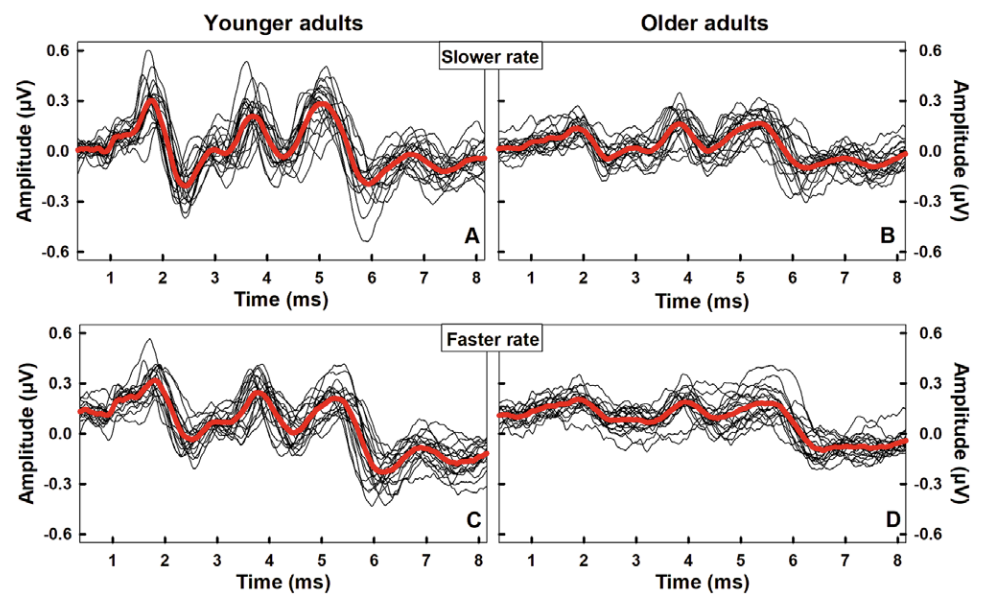
The individual ABR waveforms (black lines) and average ABR waveforms (thick red lines) are shown in response to slow sounds (top row) and fast sounds (bottom row). Comparisons between the younger (left) and older (right) age groups highlight how aging affects the brain's ability to process rapid auditory information. ABR (auditory brainstem response) is an objective recording of the electrical activity generated by the auditory nerve and brainstem in response to sound. Credit: Mussoi/Ear and Hearing
The surprise was that these two changes do not seem to be connected. Even though older adults had weaker auditory nerve responses, this did not predict how well they understood speech in noise.
This challenges the idea that hidden hearing loss contributes to age-related communication difficulties. Instead, it suggests a more complex picture, one where multiple factors—such as neural aging in the brainstem or brain, and of thinking skills—may interact to affect everyday listening ability.
For people experiencing difficulties, and for clinicians seeking answers, this means we may need broader, more holistic approaches to understand and treat age-related hearing challenges.

Bruna Mussoi, Au.D., Ph.D., is an associate professor at The University of Tennessee Health Science Center. Her 2025–2026 Emerging Research Grant is generously funded by Mike Miles. Mussoi’s paper, “Age-Related Changes in Speech Recognition Performance-Intensity Functions and Auditory Brainstem Responses,” was published in Ear and Hearing in February 2026.
The Latest Blog Posts




A simple, universal visual warning system (like a red, yellow, or green noise-level indicator at a concert venue, racetrack, or theme park) instantly conveys danger, warning, or safety to people of all ages. Combined with access to basic foam earplugs and insertion instructions, a simple prompt can transform behavior.