
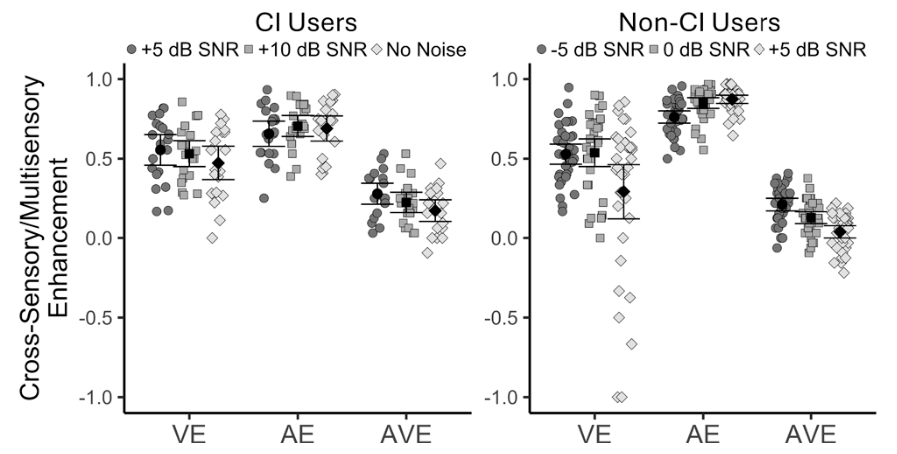
These charts compare the speech perception among middle-aged and older adults using cochlear implants (CI) and those not using them. Credit: Dias et al./Ear and Hearing
Because most new cochlear implant recipients are older adults, it is important to understand how aging cochlear implant users use visual information to support speech understanding, especially in noisy environments. Emerging Research Grants (ERG) scientist James W. Dias, Ph.D., found that the ability to integrate what is seen with what is heard becomes increasingly important with age, especially for cochlear implant users. Dias’s 2022–2023 grant was generously funded by the Meringoff Family Foundation.
2022–2023 ERG scientist Matthew Masapollo, Ph.D., examined how disrupting auditory feedback affects the control of two key speech articulators—the tongue tip and the jaw—and shows how auditory feedback sharpens speech, with implications for CI users.
Dias was one of dozens of funded researchers, past and present, we were glad to see at the Association for Research in Otolarngology MidWinter Meeting in February. See a recap here including awards for HHF board member Anil K. Lalwani, M.D., and Hearing Restoration Project member Ksenia Gnedeva, Ph.D. Lalwani also heads our Council of Scientific Trustees, which oversees our ERG program.
Plus:
We are celebrating World Hearing Day all month! (See more links in Around the Web below.)
Now through March 13 all gifts are matched dollar for dollar by our generous donor Carol Salmanson, with non-cash gifts matched 1.5X!

Research Webinar
The Brain’s Built-In Noise Cancellation
Monday, April 6, 5pm ET | 2pm PT
While many studies have focused on how sound signals travel up through the brain, researchers like ERG scientist Timothy Balmer, Ph.D., have been uncovering how top-down signals improve hearing function at the lower levels. Balmer’s 2025–2026 ERG grant in the area of Ménière’s disease is generously funded by the Salice Family Foundation. He has also received prior ERG grants from an anonymous donor and from the Les Paul Foundation. Register for the hourlong webinar here.

Your Legacy Gift Matters
A generous $1 million estate gift from Shirley Jean Lane (left) launches the next phase of HHF’s planned giving matching challenge. Your estate gift (such as a bequest or beneficiary designation of a retirement fund or life insurance policy) will be matched. Click here to get answers to your frequently asked questions about planned giving.
Around the Web:
World Hearing Day normalizes me (Psychology Today), “invisible millions” with hearing loss missing from mainstream media (Yahoo! Finance), and are long hours with headphones harming ear health in working professionals? (Health and Me)
New episodes of “Peppa Pig” will bring attention to hearing loss in kids (Parents) and Bad Bunny’s sign language interpreter on the halftime show and Making Puerto Rico proud (Variety)
I should be deaf by now, here’s why I’m not (Katherine Bouton), I lost my hearing but found my voice (Oprah Daily), and our daughter’s deafness is part of who she is—there’s nothing to fix (The Times UK)
Stop cleaning your ears wrong (Popular Science)
Hearing aids didn’t boost memory tests but dementia risk dropped (Science Daily) and cognitive decline is often linked to hearing loss: This may be why (Medical News Today)
Newborns may sense musical rhythm from birth (Earth.com)
In a world that’s noisier than ever, my mission to shut out the din (Vogue UK) and I asked audiologists if my earbuds are damaging my ears (CNET)
Tinnitus harms 1 in 5 careers, survey finds (HealthDay), 40% of musicians suffer from tinnitus and auditory distress (Neuroscience News), Pete Tong on aging, all-nighters and hearing loss (The Guardian)
The coolest new tech for hearing loss (New York Post), the best noise-canceling headphones (Wirecutter), need a new hearing aid, what’s it going to cost? (Clear Health Costs), “my life is infinitely better with hearing aids” (WAAY TV), and two questions to ask every patient before fitting hearing aids (The Hearing Review)
A hidden reason inner ear cells die—and what it means for preventing hearing loss (Biophysical Society)
First U.S. patient to receive new cochlear implant system is making steady progress (NYU Langone)
Products and services are not endorsed by Hearing Health Foundation. Links provided are for informational purposes only and may require registration or subscription. Links to time-sensitive events may expire.
