
By James W. Dias, Ph.D.
Understanding speech in everyday life often requires combining what we hear with what we see, such as a speaker’s facial movements. Previous research has shown that older adults with typical hearing rely more on this combination of auditory and visual information than younger adults, which helps compensate for age-related declines in hearing and vision.
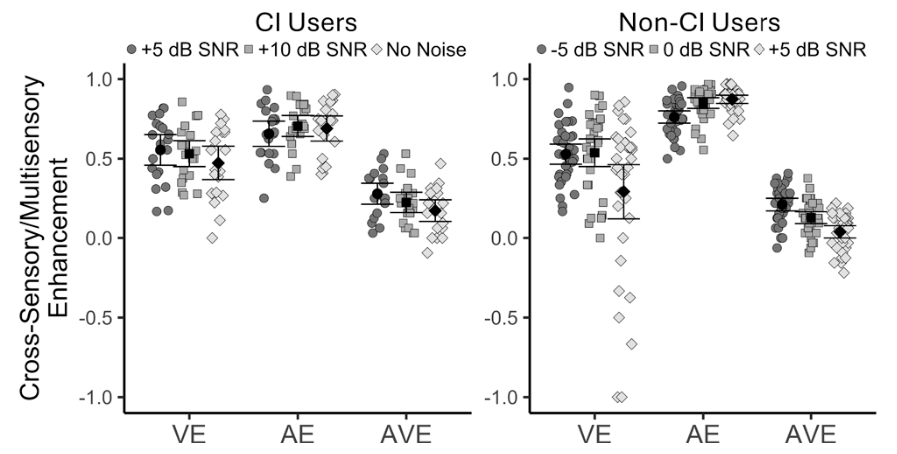
These charts compare the speech perception among middle-aged and older adults using cochlear implants (CI) and those not using them. The groups were compared across various noise levels to assess how much better people understand speech with visual enhancement, audio enhancement, or combined. The results show that auditory-visual enhancement provides the greatest overall boost to speech understanding for both the CI and non-CI groups. Credit: Dias et al./Ear and Hearing
Because most new cochlear implant recipients are older adults, it is important to understand how aging cochlear implant users use visual information to support speech understanding, especially in noisy environments.
In this study, we compared middle-aged and older adults who use cochlear implants with age-matched adults who do not have implants. Participants completed a speech identification task in which they listened to and/or watched a speaker say words presented either through sound alone, vision alone, or both together.
Speech was presented in quiet and in background noise. We measured how much benefit in speech understanding was gained when sound and vision were combined.
For both groups, the benefit of combining auditory and visual information increased with age. Older cochlear implant users showed especially strong benefits from audiovisual speech, helping participants achieve speech understanding closer to that of older adults without implants despite ongoing hearing limitations.
As we published in Ear and Hearing in December 2025, these findings suggest that the ability to integrate what is seen with what is heard becomes increasingly important with age, especially for cochlear implant users.
Successful cochlear implant use in older adults may therefore depend not only on auditory hearing but also on how effectively visual speech information is used. Supporting audiovisual communication strategies may be an important way to improve communication outcomes and quality of life for older adults with cochlear implants.


James W. Dias, Ph.D., is a 2022–2023 Emerging Research Grants scientist generously funded by the Meringoff Family Foundation. An assistant professor at Medical University of South Carolina, he is the lead author of the paper “Audiovisual Speech Perception in Aging Cochlear Implant Users and Age-Matched Non-Implanted Adults,” which appeared in Ear and Hearing in December 2025.
The Latest Blog Posts



Our Emerging Research Grants program is the leading seed funding opportunity for early stage researchers. ERG also includes Expanded and Focused Discovery Awards, which are grant opportunities in specific topics (such as central auditory processing disorder, hyperacusis, Ménière’s disease, and tinnitus) that are open to eligible investigators at any career stage.