
By Nicole T. Jiam, M.D., and Stephanie M. Younan, MPH
One of the hardest conversations in cochlear implant care happens before surgery, when a patient asks how well they will hear a year from now.
The honest answer has always been that we do not know. Outcomes among adults who receive an implant vary enormously, and the measures we collect during the candidacy evaluation, such as hearing thresholds and word scores in the ear to be implanted, turn out to tell us very little about what comes next.
We wanted to find out whether the answer may arrive sooner than we thought. We looked back at 530 implanted ears from adults treated at our center between 2018 and 2024, tracking their word recognition scores at one, three, six, and 12 months after activation, along with data from their processors showing how many hours a day the device was actually worn. Our results were published in The Laryngoscope in August 2026.
Three findings stood out:
1. Improvement is front-loaded.
In the first two months after activation, patients gained an average of about 4.4 percentage points on word recognition every month. Between six and 12 months, that rate fell to roughly 0.1 points per month, about 35 times slower.
This was not simply a matter of high scorers running out of room to improve; the pattern held when we restricted the analysis to patients scoring well below the ceiling. The brain does most of its adapting to the new electrical signal early, which means the first three months are the window where rehabilitation and support are likely to matter most.
2. Patients fall into recognizable performance groups, and those groups are already visible at one month.
We identified three trajectories, which we described as lower, moderate, and higher performing. What separated them was the level they started at after activation, not how steeply they climbed afterward. Everyone climbed at about the same rate.
Notably, preoperative word scores and hearing thresholds did not distinguish these groups at all.
3. The one-month word score predicted the one-year result far better than anything measured before surgery.
This explains roughly 45 percent of the variation in 12-month outcomes compared with 3 percent for the preoperative score. A one-month score of 44 percent or higher identified patients who would go on to reach a functional level of speech understanding at one year with high confidence.
The finding we most want to underline is the one about device use. Hours of daily wear did not drive how much a patient improved. But the pattern of use over time did matter. Patients who started with low wear time and increased it by six months did just as well at one year as those who wore their processor consistently from the start. Patients whose use declined did measurably worse. A slow start is not a verdict.
That is the spirit in which we hope the one-month checkpoint is used. It is a signal for who may need more support, not a ceiling on what anyone can achieve.
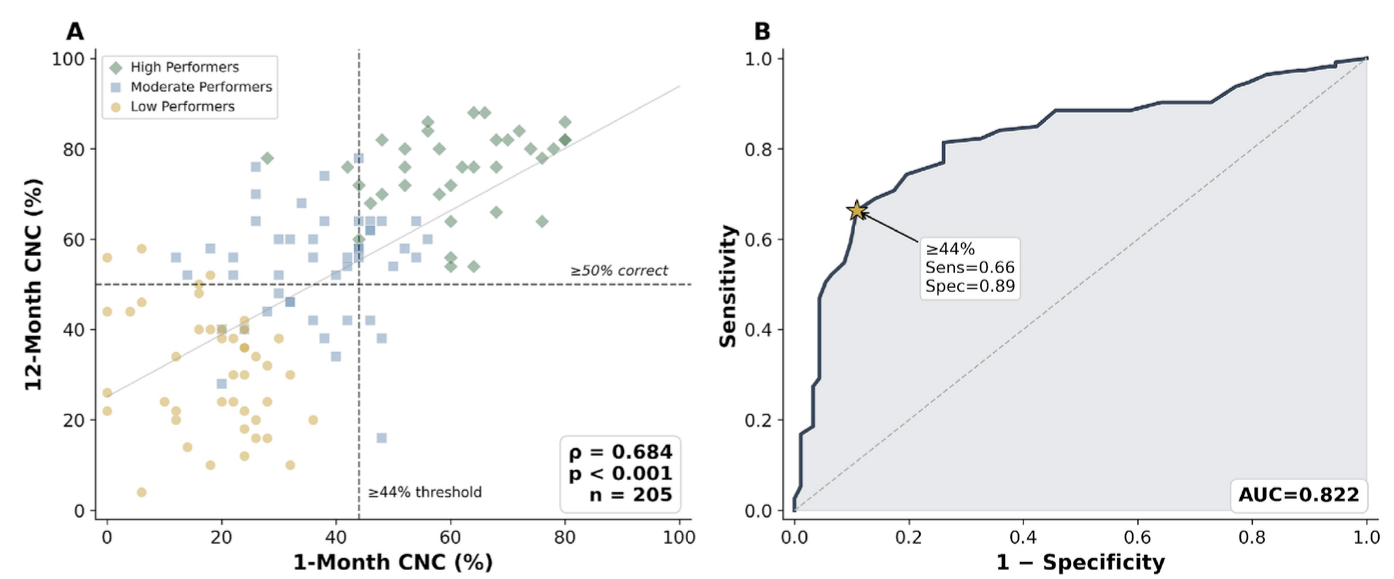
Scoring at 44 percent or better on word recognition at one month is a strong sign of long-term success, accurately predicting good one-year hearing outcomes (≥50 percent recognition) with 82 percent overall accuracy. This 44 percent threshold acts as an early checkpoint for audiologists, correctly identifying 66 percent of long-term successful patients and 89 percent of those who will need extra support and tailored rehab plans. Notably, scoring below 44 percent at one month is an early warning, not a final prediction. Patients who stay actively engaged with their therapy through the first six months can still achieve strong functional hearing. Credit: Younan et al./The Laryngoscope
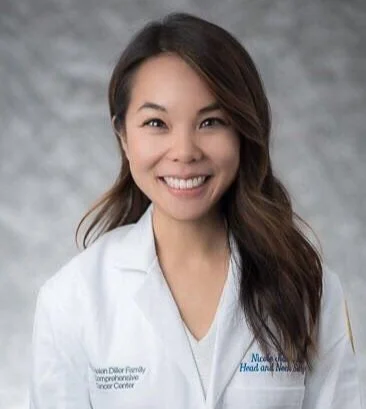
Nicole T. Jiam, M.D. (left, top), is a neurotology and skull base surgeon at the University of California, San Francisco. A 2024–2025 Emerging Research Grants scientist, she is the recipient of an Elizabeth M. Keithley, Ph.D. Early Stage Investigator Award, generously supported in part by Susan and Steve Kaufman.

Study coauthor Stephanie M. Younan, MPH (left, below), is a fourth-year medical student at the University of California, San Francisco. She received an MPH from Columbia University and a B.S. in physiological sciences from the University of California, Los Angeles.
The team’s paper, “Performance Phenotypes and Early Prognostic Benchmarking After Adult Cochlear Implantation,” was published in The Laryngoscope in August 2026.
The Latest Blog Posts



Hearing Health Foundation (HHF) is very pleased to announce the addition of four new members to our Board of Directors: Andreas H. Eckhard, M.D., Steven D. Rauch, M.D., Konstantina Stankovic, M.D., Ph.D., FACS, and Daniel J. Tollin, Ph.D.