
By Matthew Masapollo, Ph.D.
Speaking may feel effortless, but it relies on intricate and precise coordination of the tongue, jaw, and other articulators. A longstanding question in motor neuroscience is how much we rely on hearing our own voice to guide these movements while speaking. Do we mostly plan movements in advance, or does the brain continuously use auditory feedback to fine-tune articulation in real time?
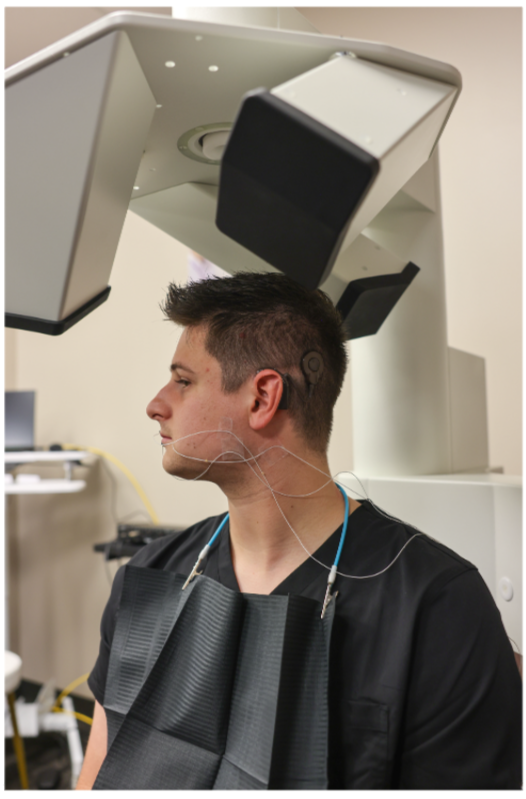
We are assessing speech movements in cochlear implant users, like the patient here, under the following conditions: 1) speech processors ON vs. OFF; and 2) with and without the oral sensory nerve blocked. These comparisons allow us to examine how auditory feedback and oral sensory input influence articulatory control.
Our study examined how disrupting auditory feedback affects the control of two key speech articulators: the tongue tip and the jaw. Participants with typical hearing produced simple speech sequences while their hearing was either unaltered or masked by background babble noise. Using motion-tracking technology, we recorded tongue and jaw movements in real time as speakers made speech sounds. Our results appeared in the Journal of Speech, Language, and Hearing Research in February 2026.
Masking auditory feedback had a clear and selective effect. When speakers could not reliably hear themselves, control of the tongue tip became less precise, showing more variable movements.
In contrast, jaw movements remained stable. Importantly, this effect was strongest during the critical part of the movement when the tongue shapes the speech sound, while later movements were unaffected for both articulators.
Our findings suggest that the brain continuously uses auditory feedback to stabilize speech movements, but not all articulators rely on it equally. Feedback is particularly important for articulators like the tongue, whose flexible movements require more sensory guidance, while the more rigidly moving jaw depends less on hearing.
More broadly, this work highlights how ongoing sensory feedback contributes to speech. For individuals with long-term hearing loss or severely degraded auditory input, the lack of reliable auditory feedback represents a challenge many orders of magnitude greater than the temporary masking used in this study.
Understanding how the brain normally uses feedback helps explain why speech can be less precise in these populations and may inform approaches for therapy, cochlear implant training, or other interventions aimed at supporting communication.

A 2022–23 Emerging Research Grants scientist, Matthew Masapollo, Ph.D., is an assistant professor of communication sciences and disorders and the principal investigator at the Speech Motor Control Lab at University of Oklahoma Health Sciences.
His paper, “Precision of Tongue Control for Task-Relevant Articulatory Goals Diminishes Without Real-Time Auditory Feedback,” was published in the Journal of Speech, Language, and Hearing Research in February 2026.
The Latest Blog Posts



Our Emerging Research Grants program is the leading seed funding opportunity for early stage researchers. ERG also includes Expanded and Focused Discovery Awards, which are grant opportunities in specific topics (such as central auditory processing disorder, hyperacusis, Ménière’s disease, and tinnitus) that are open to eligible investigators at any career stage.