
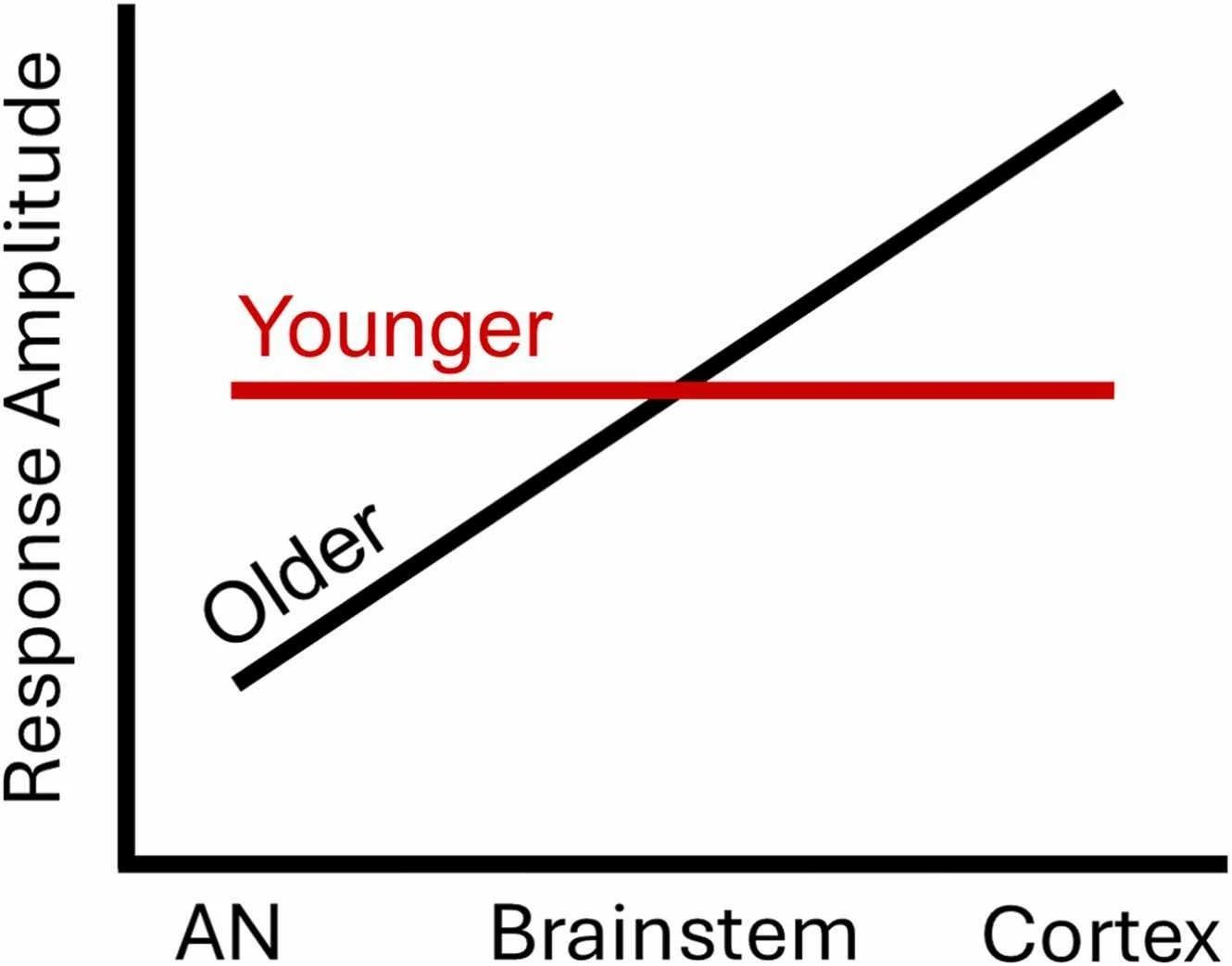
The study’s data support a pattern of central gain in older adults from the auditory brainstem to the auditory cortex. The weaker auditory nerve (AN) signals in older adults lead to typical-sized responses in the brainstem and stronger than normal responses in the auditory cortex. Credit: Fabrizio-Stover et al./Neurobiology of Aging
A common age-related hearing difficulty is understanding speech in noisy environments. Emerging Research Grants (ERG) scientists James Dias, Ph.D., and Carolyn McClaskey, Ph.D., and team found that as people age, the brain shows an amplified response (“central gain”) to compensate for weaker signals from the auditory nerve.
But this is linked to poorer brain health and more difficulty understanding speech. The brain’s attempt to boost sound may actually make listening harder.
Dias’s 2022–2023 grant was generously funded by the Meringoff Family Foundation, and McClaskey’s 2023–2024 grant was generously funded by Royal Arch Research Assistance.
Playing with a band in Seattle, singing in Nashville, building a soundscape app: Read about our 2026 first-year ERG scientists’ backgrounds and inspirations in “Meet the Researcher.”
Plus:
Congrats to HHF Council of Scientific Trustees head and board member Anil K. Lalwani, M.D., for receiving the ARO Innovator Award in Clinical Science and Hearing Restoration Project member Ksenia Gnedeva, Ph.D., for receiving the Geraldine Dietz Fox Young Investigator Award!
Midlife hearing loss may be an early marker of brain aging and dementia risk, particularly for those with a genetic predisposition, says a new JAMA Network Open report coauthored by board member Sharon Kujawa, Ph.D. Both Lalwani and Kujawa are also past ERG scientists.
Hearing loss at the holidays and digital hearing tools to boost connections

What Makes Us Different
With the giving season underway, HHF is grateful for our community of supporters that help us fund the most innovative hearing and balance science. Thanks to you, our researchers are investigating better treatments and cures and making a real impact on advancing discoveries.
Please join us this giving season with a 1:1 match—now extended to December 31!
Around the Web:
10 reasons people still aren’t getting hearing instruments (The Hearing Review), how you can support your hearing aids (Hearing Health & Technology Matters), and Expert Choice Awards for hearing aids (HearAdvisor)
Type 2 diabetes associated with hearing loss (McKnight’s), the global burden of hearing loss and its comorbidity with chronic diseases: a comprehensive analysis from 1990 to 2021 (Scientific Reports), and facing hearing loss and cancer (Cure)
Listening to music has a surprising impact on dementia risk (ScienceAlert) and high blood sugar, hearing loss, and lower level of education account for the largest share of preventable dementia cases in the U.S. (AARP)
The molecular symphony behind hearing’s precision (Wiley) and your body’s hidden reaction to musical rhythm involves your eyes (PsyPost)
Understanding how hearing organs develop (Northwestern) and infants born with hearing loss show disruptions in brain design (EurekAlert)
Has birds’ mysterious “compass” organ been found at last? (Nature)
One in eight teens shows signs of hearing damage by 18 (The Hearing Review) and tinnitus is somehow linked to a crucial bodily function (ScienceAlert)
A field guide to captions (Katherine Bouton) and teleaudiology explained: pros and cons to know (AARP)
8 tips for holiday air travel with hearing loss (HLAA) and hearing hacks for the holiday season (Living With Hearing Loss)
Products and services are not endorsed by Hearing Health Foundation. Links provided are for informational purposes only and may require registration or subscription. Links to time-sensitive events may expire.
