
Scientists at the University of California, Davis, including past Emerging Research Grants scientist Kenneth R. Henry, Ph.D., studied California ground squirrels (Otospermophilus becheeyi) to understand how animals adapt their hearing and behavior to different environments.
Credit: Tromborg, Coss, and Henry/Behavioural Processes
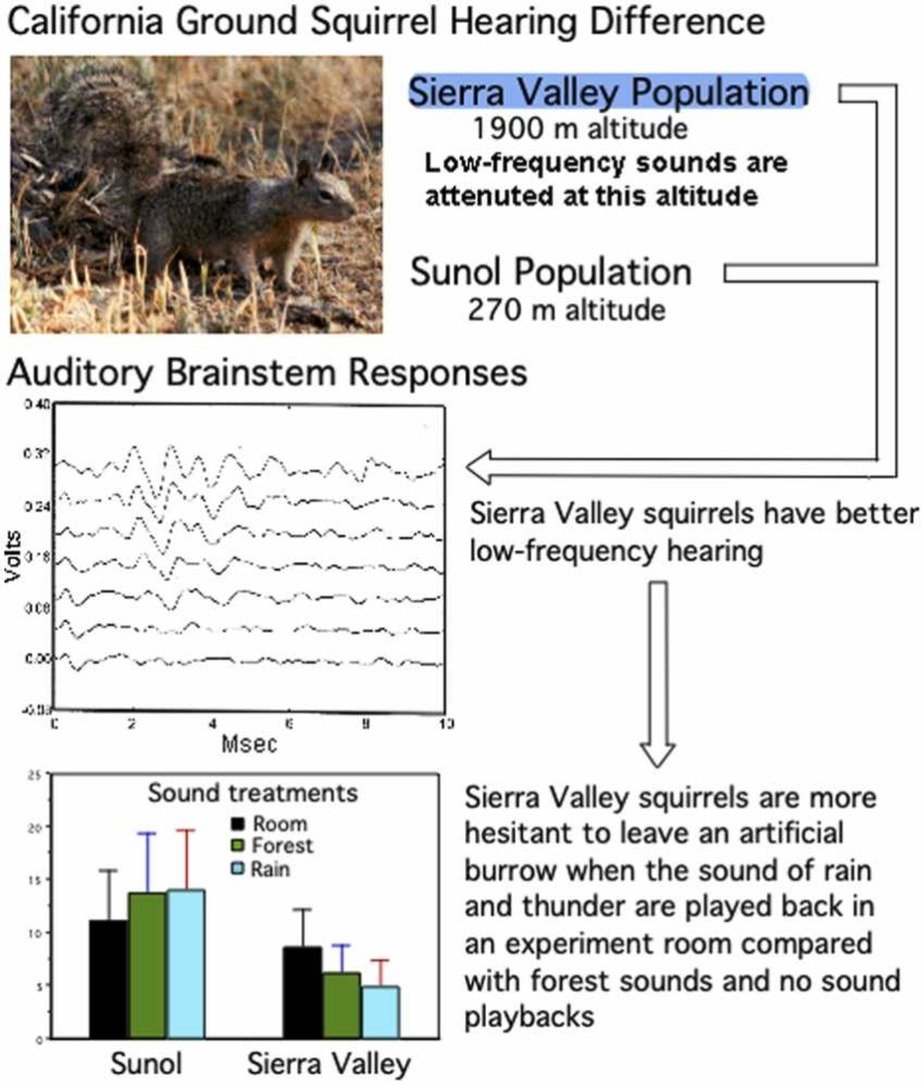
They compared two squirrel populations that live at very different elevations: one from Sierra Valley in the mountains (about 1,900 meters above sea level) and one from the lower-elevation Sunol region (about 270 meters). Genetic evidence suggests these populations split from a common ancestor during the late Ice Age, giving them time to adapt to local conditions.
In the first experiment, scientists assessed how well the squirrels’ ears and brains responded to sounds by measuring their auditory brainstem responses, which records neural activity triggered by sound. Mountain-dwelling squirrels showed better sensitivity to low pitched sounds below 4 kilohertz than squirrels from lower elevations, while both groups heard higher pitched sounds similarly.
This difference may be important in mountainous environments, where wind, rain, and terrain can interfere with sound and make low frequency cues harder to detect.
The second experiment looked at behavior. Squirrels were placed in a laboratory setting with nest boxes and exposed to different sound environments: general room noise, forest sounds, and simulated rainstorms. During rain sounds, the high-altitude squirrels were much less likely to leave their nest boxes to explore than the low altitude squirrels.
This suggests high-altitude squirrels may be more cautious when weather conditions make sounds harder to interpret.
As published in the journal Behavioural Processes in the issue dated February 2026, these findings show that the Sierra Valley squirrels’ improved ability to hear low frequency sounds is likely a sensory adaptation to life at high elevations, where weather and thin air can reduce how well sound travels. The study highlights how hearing and behavior can evolve together to help animals survive in challenging acoustic environments.
This is adapted from the abstract of the paper “Adaptive variation in the acoustic sensitivity of California ground squirrels (Otospermophilus beecheyi) living in higher- and lower-elevation habitats,” published in Behavioural Processes in February 2026. The study’s coauthor is former Emerging Research Grants scientist Kenneth R. Henry, Ph.D., who is a professor emeritus at University of California, Davis, and whose papers from 1982 and 1986 are cited.
The Latest Blog Posts





Hearing Health Foundation (HHF) is very pleased to announce the addition of four new members to our Board of Directors: Andreas H. Eckhard, M.D., Steven D. Rauch, M.D., Konstantina Stankovic, M.D., Ph.D., FACS, and Daniel J. Tollin, Ph.D.