
In a detailed overview in the Annual Review of Genetics (November 2025 issue), Hearing Restoration Project member Yehoash Raphael, Ph.D., and coauthors discuss the challenges and future directions of the field of hair cell regeneration, pointing toward the use of genomics and epigenetics to decode gene expression and its epigenetic regulation.
Genomics is used to read the exact transcriptomes—the list of specific genes that are active or "expressed"—in different cells at different times. Epigenetics controls the regulation of gene expression, deciding whether a gene is strongly active, weakly active, or completely locked off.
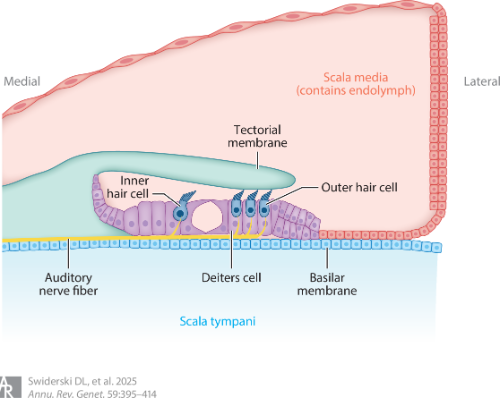
This illustration shows a cross section of the cochlear duct with emphasis on the sensory epithelium. Credit: Swiderski, Wilson, Raphael/Annual Review of Genetics
Cochlear hair cells are highly specialized epithelial cells in the inner ear that are essential for converting sound vibrations into the electrical signals the brain interprets as sound. In mammals, these epithelial cells are not replaced when lost, leading to permanent hearing loss.
This inability to self-repair epithelial layers is a biological rarity. Most epithelial tissues in the body possess a robust capacity for regeneration. In addition, while the mammalian cochlea cannot regenerate its hair cells, non-mammalian vertebrates such as birds and fish exhibit a remarkable ability to do so.
The regenerative capability is not fully absent in mammals, however, as the sensory organs responsible for balance show some regenerative potential. This suggests that the genetic and molecular machinery for regeneration is not entirely foreign to the mammalian system and ways to activate it need to be identified and serve as guidelines for designing regenerative therapies.
This loss of regenerative ability likely occurred as mammals evolved and the mammalian cochlea became more complex. That said, the clear divergence between species offers a pathway for investigation: by identifying what separates the systems that can regenerate from those that cannot, researchers can begin to understand the molecular barriers that need to be overcome.
Studies using genetic tools (transgenesis) and developmental biology have revealed some of the key signaling molecular players that govern the development of hair cells and their neighboring supporting cells. These discoveries have provided candidates for manipulating the system to induce regeneration.
Gene transfer technology using viral vectors showed proof of principle for the ability to induce the conversion (transdifferentiation) of supporting cells to new hair cells. However, the outcomes have been inconsistent and the hair cell-like cells that were produced were of low quantity and poor quality.
The next step in this field is the use of powerful modern sequencing technology in order to map gene activity and gene regulation during hair cell regeneration in fish and birds as well as in mammalian balance organs. The fields of genomics and epigenetics, which study the complete set of an organism's genes and the regulatory layers that control them, can help reveal the deep regulatory logic that governs cellular identity and behavior and point to future therapeutic avenues. Still, rebuilding a perfect new cochlea to restore hearing remains a formidable challenge.
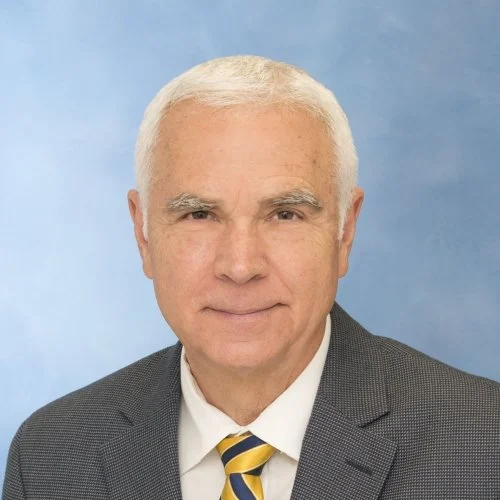
This is adapted from the paper, “The Field of Hair Cell Regeneration Is Ready for Input From Genomics and Epigenetics,” in the 2025 issue of the Annual Review of Genetics. Yehoash Raphael, Ph.D., is a member of the Hearing Restoration Project and a past Emerging Research Grants scientist. Raphael is a professor emeritus of otolaryngology–head and neck surgery at the University of Michigan Medical School.
The Latest Blog Posts




A simple, universal visual warning system (like a red, yellow, or green noise-level indicator at a concert venue, racetrack, or theme park) instantly conveys danger, warning, or safety to people of all ages. Combined with access to basic foam earplugs and insertion instructions, a simple prompt can transform behavior.