
It took 20 years but Les Paul, who was born 111 years ago on June 9, 1915, forever changed music with his invention.
By Sue Baker
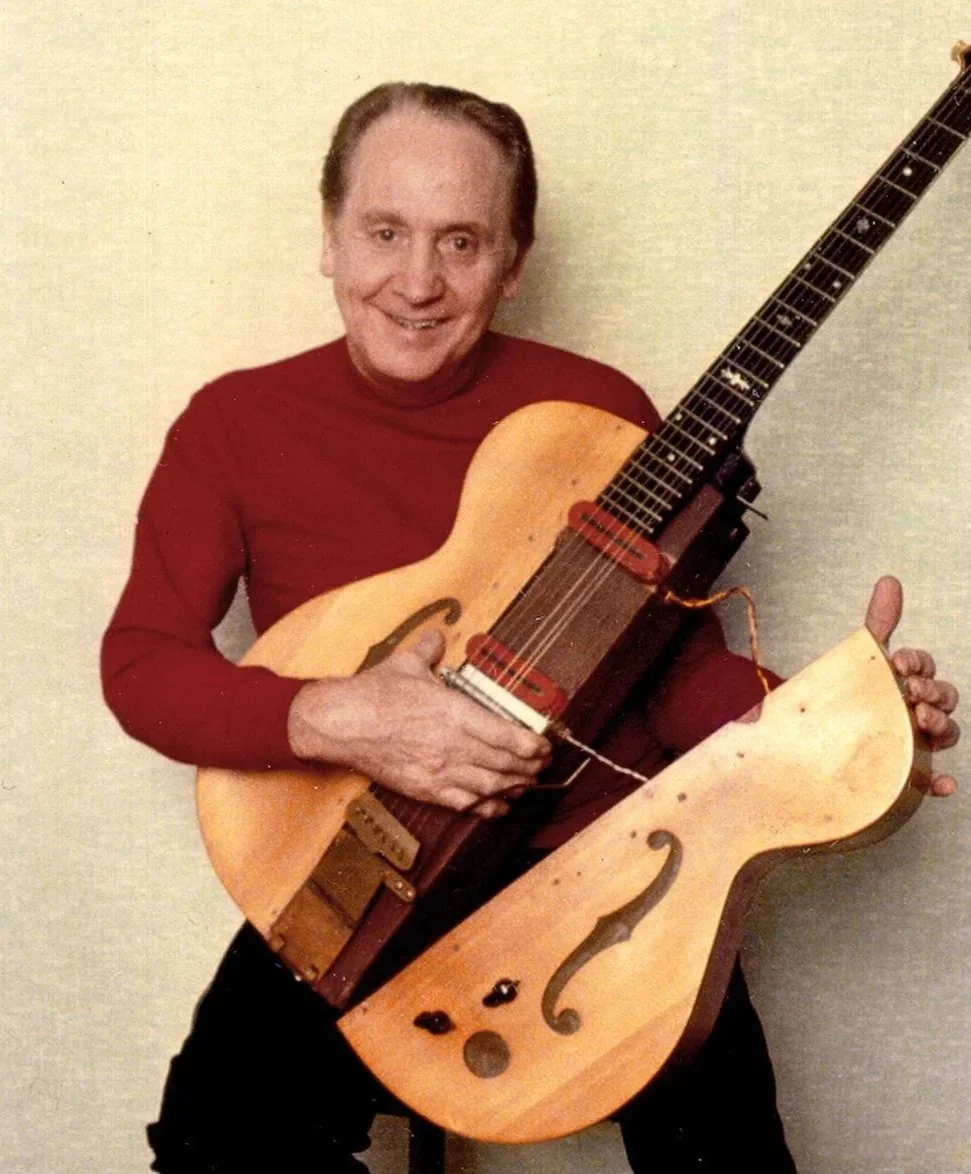
Les Paul with an early version of his solid body guitar.
There were no solid body electric guitars in 1931. About that time, teenager Lester Polsfuss decided his guitar would sound better if its body was solid. No hole in the body. No wooden “box” vibrating. Just the guitar strings vibrating.
Lester, later known as Les Paul, stuffed tablecloths, socks, and even his shorts into his acoustic guitar. Nope. That didn’t work. Next he filled his guitar with plaster of Paris. Result: He needed a new guitar!
He wanted the densest material possible for his guitar so that just the guitar strings would vibrate and vibrate for a long time. Les lived across the street from a railroad track and the Fox River. In the 1930s, train workers would cut damaged pieces of rail and discard them under the bridge spanning the river.
Aha! What could be denser than a piece of train rail? Les convinced his friends to load a two-foot piece of discarded rail and a couple of spikes into a borrowed wagon and haul it to his house. He placed the microphone from his mother’s candlestick telephone on the rail, stretched a guitar string between two spikes, and attached it to his mother’s radio.
The sound was perfect! Nothing vibrating except the string and it was crystal clear. As Les was fond of saying, “You could pluck the string, go out for lunch, and the string would still be vibrating when you got back.”
He shouted, “Ma! Ma! You’ve got to see what I just created.” In fact, it was a solid body electric guitar! It was primitive—very primitive—but it was the beginning.
Les’s mother walked into the room, took one look at the rail, and said, “The day you see a cowboy on a horse playing that….” and she walked out of the room. Les was crushed to hear this response from his mother, who typically was always encouraging. But the 16-year-old knew he was on to something.
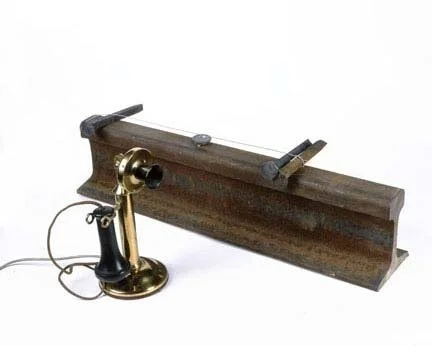
Les Paul fashioned this rail guitar, placing the microphone from his mother’s telephone on the rail.
Life happened and Les kept thinking about the wonderful sound and sustain of his rail guitar. Ten years later, he was working in New York City. On Sundays the Epiphone Guitar Company permitted Les to use its factory workshop. That sound—he had to find a way to replicate the marvelous sound of his rail guitar, but it had to be lighter than a piece of steel.
He used a 4x4 piece of wood, attached a guitar fret board and a couple of handmade pickups, and electrified it. He had taken the next step, an important step. He played his “Log” at a club in the city. The sound was wonderful, but the audience was not responding. Why couldn’t they hear the amazing sound? Maybe the Log looked too strange.
Back to the factory. Les sawed an old acoustic guitar in half and attached the “wings” to the Log. He took the Log with wings to the same club and played the same songs. Voilà! The audience was mesmerized.
Since Les always played Gibson guitars, he set off to show the people at Gibson his futuristic guitar, the guitar that would change the world of music. That was 1942.
The response: “Get the guy with the broomstick out of here.” Les wasn’t taking that. He kept going back to Gibson, telling them that solid body electric guitars were the future.
Ten years. That is how long it took Les to convince Gibson to modify his primitive idea into one of the most iconic solid body electric guitars ever.
As Les said, “Set your sights on where you want to go in your life, make up your mind you’re going to do it no matter what, and start digging. Give yourself a definite direction, stick to your purpose, and more often than not, you’ll get there.”

Sue Baker and Les Paul
A friend of Les Paul, Sue Baker is the program director of the Les Paul Foundation. We thank the Les Paul Foundation for their longtime support of tinnitus research through the Emerging Research Grants program.
The Mahwah Museum in New Jersey is hosting a 111th Birthday Celebration on June 7, 2026, from 2 to 4pm, featuring “The Les Paul & Mary Ford Tribute Show” with Tom and Sandy Doyle. Tom Doyle was Les Paul’s personal guitar tech for over 45 years.
The Iridium in New York City is hosting a weeklong "Les Paul Birthday Week" running from June 9 through June 15, 2026. The historic venue, which Les Paul called home for a decade, will feature world-class performers Raul Midón and Robben Ford with the Oz Noy Organ Trio.
Julie Palkowski from the Les Paul Foundation and Vincent James from Keep Music Alive celebrate Les Paul's 111th birthday by sharing fun facts, video, and trivia highlighting Les Paul's Top 10 Lifetime Accomplishments in a virtual event June 11, 2026, at 7pm ET.
And a free, family-friendly Guitar Town Music Festival for Les Paul’s birthday will feature music, history, food/drink, and, of course, guitars, in Les Paul’s hometown of Waukesha, Wisconsin, in Cutler Park, from 12 to 8pm on June 13, 2026.
The Latest Blog Posts




A person becomes hard of hearing, caregivers and families start raising their voices, no one likes shouting at another person, the conversations decline.