
By Lizzie and Lyle Ross
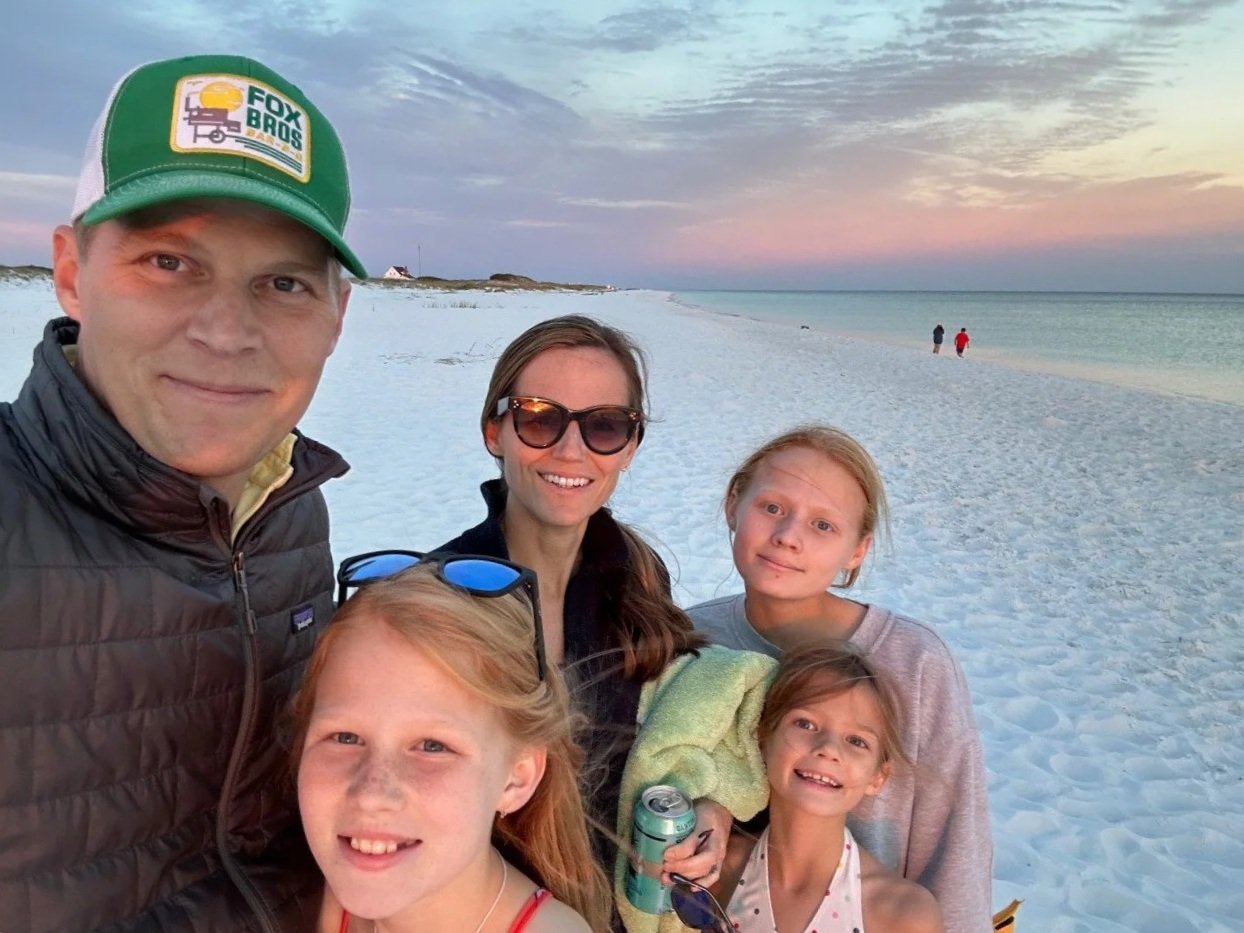
The family moved from California to Georgia to attend the Atlanta Speech School. Lucile thrived and was mainstreamed within 18 months at age 3.
Our older daughter, Becca, was born in 2010 in San Francisco. Her newborn hearing screening came and went without a second thought. So when our second daughter, Lucile, was born 18 months later at the same hospital, we assumed the experience would be identical.
It wasn’t.
When the nurses came back and told us Lucile hadn’t passed her hearing screening, they reassured us it was common. It could be fluid in the ears, a false alarm. We came back a week later. One ear seemed to pass, the other didn’t—but “barely,” they said. We still were told not to worry.
We scheduled a follow-up for a more comprehensive test, the ABR (auditory brainstem response), which is done while the infant is asleep. That appointment was two or three weeks later at an audiology clinic.
That’s when they told us the results showed profound hearing loss in both ears.
There’s no graceful way to receive news like that. We had no family history of hearing loss. Our first reaction was disbelief—this couldn’t be right. On top of that, the way the diagnosis was delivered left us reeling. For the clinic this was probably something they tell parents every day, but for us it was a total shock. We walked out stunned, scared, and just swirling with questions.
Navigating a New World
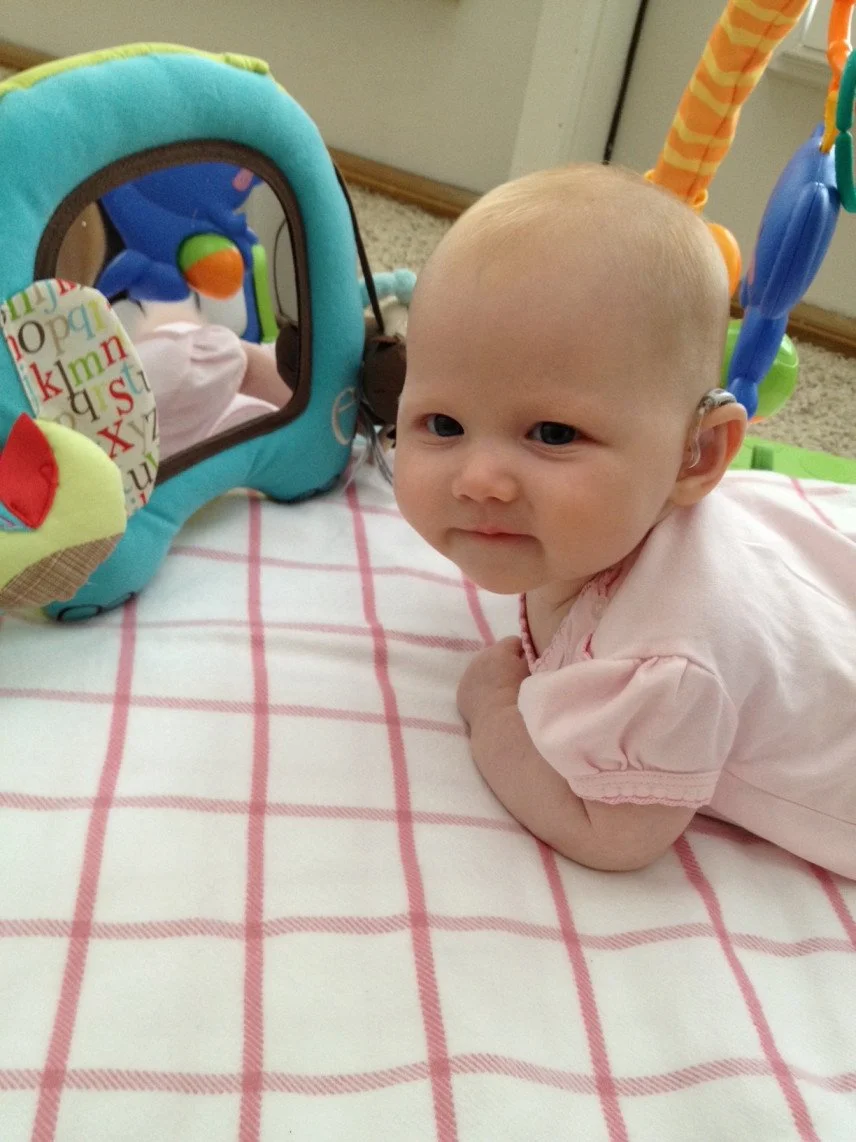
Lucile wore hearing aids before cochlear implant surgery in both ears at age 1.
Our pediatrician where we lived in Marin County recommended that we go down to Stanford. At Lucile Packard Children’s Hospital (we liked that the name was also Lucile), we had follow-up appointments and were paired with doctors who helped us understand what was going on.
We dove in and started learning and researching everything. It was so helpful that our doctor at Packard, Kay Chang, M.D., said to us, “I know this is devastating news for you, but your daughter has been born in the absolute best time in human history to have this diagnosis of profound hearing loss.”
Lucile was fitted with hearing aids at a few months old. They were so big on her, cute with zebra stripes. Since she had some residual hearing, the idea was to provide any sound input to her brain.
Later we did some genetic testing to try to determine a cause for the hearing loss, but we fell in that category of “unexplained.” There wasn’t anything during the pregnancy that we were aware of that could have caused a hearing loss, and there wasn’t anything conclusive about it being hereditary. (Like our oldest daughter, our youngest daughter was born with typical hearing.)
The Decision
Within the first few months we were being counseled to consider cochlear implant surgery at age 1, which in 2012 was the youngest allowable age for implantation. (Now infants as young as 7 months can get the surgery.)
The doctors said we’d miss a critical period of brain development if we waited. We needed to make a decision now if communication was to be auditory-verbal. But brain surgery on a baby! It was a big decision.
Through Packard we connected with families going through the same process. We met other parents deciding whether to get cochlear implants for their children, and we spoke with everyone we could. It was a community we didn’t know existed, and it became our network of support.
A friend’s father had gotten the surgery and he explained in detail what it was like before and after the surgery. We knew step by step the process of what Lucile would be experiencing.
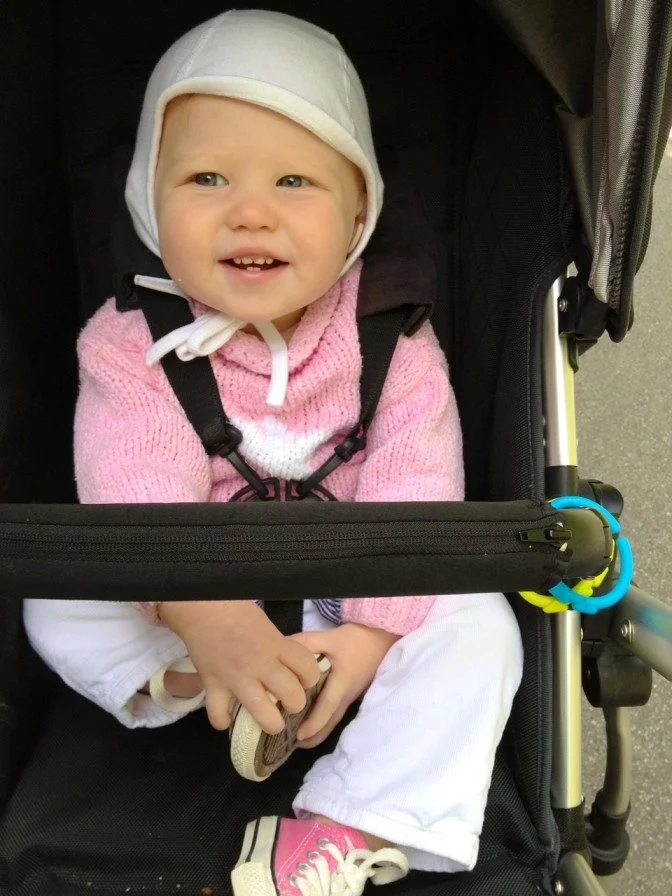
As a toddler Lucile frequently wore a bonnet to help keep the cochlear implants in place.
Ultimately, when she was 10 months old, we decided that getting cochlear implants was the best option. While we waited, those two months were filled with early intervention therapy—talking to her constantly, exposing her to sounds, engaging her brain.
We did wonder whether we should wait for better technology. What if there’s some other development? But Dr. Chang advised us, “You’ve got to be in the present. This is the best of what we have now.”
Lucile had the surgery about a week after her 1st birthday, at Stanford. Both implants were done at the same time. This is how little we knew about this world at the time, though: We honestly thought it was going to be outpatient surgery, and showed up without an overnight bag!
Afterward we were grateful we were able to do both ears at once. It’s a five-hour surgery and doing one ear and then the other would have been double the time and two rounds of general anesthesia.
The activation was in early June, a few weeks after the surgery. One of our friends was having a baby, so we always say that this child’s birthday is the same as Lucile’s hearing birthday.
We were expecting—because people told us—that the activation may not take immediately. But it worked. We have videos of our 1-year-old sitting in the highchair with little snack cups of Cheerios to keep her occupied while they were doing the activation. The snack cups make a clicking sound—and all of a sudden Lucile looks up, hearing the sounds. It was just amazing to see.
After the activation Lucile started listening, language, and speech therapy through a program at Stanford called BabyTalk with weekly meetings with a therapist through a tablet. The program helps maximize language development for cochlear implant patients in the crucial first three years of life.
School Options
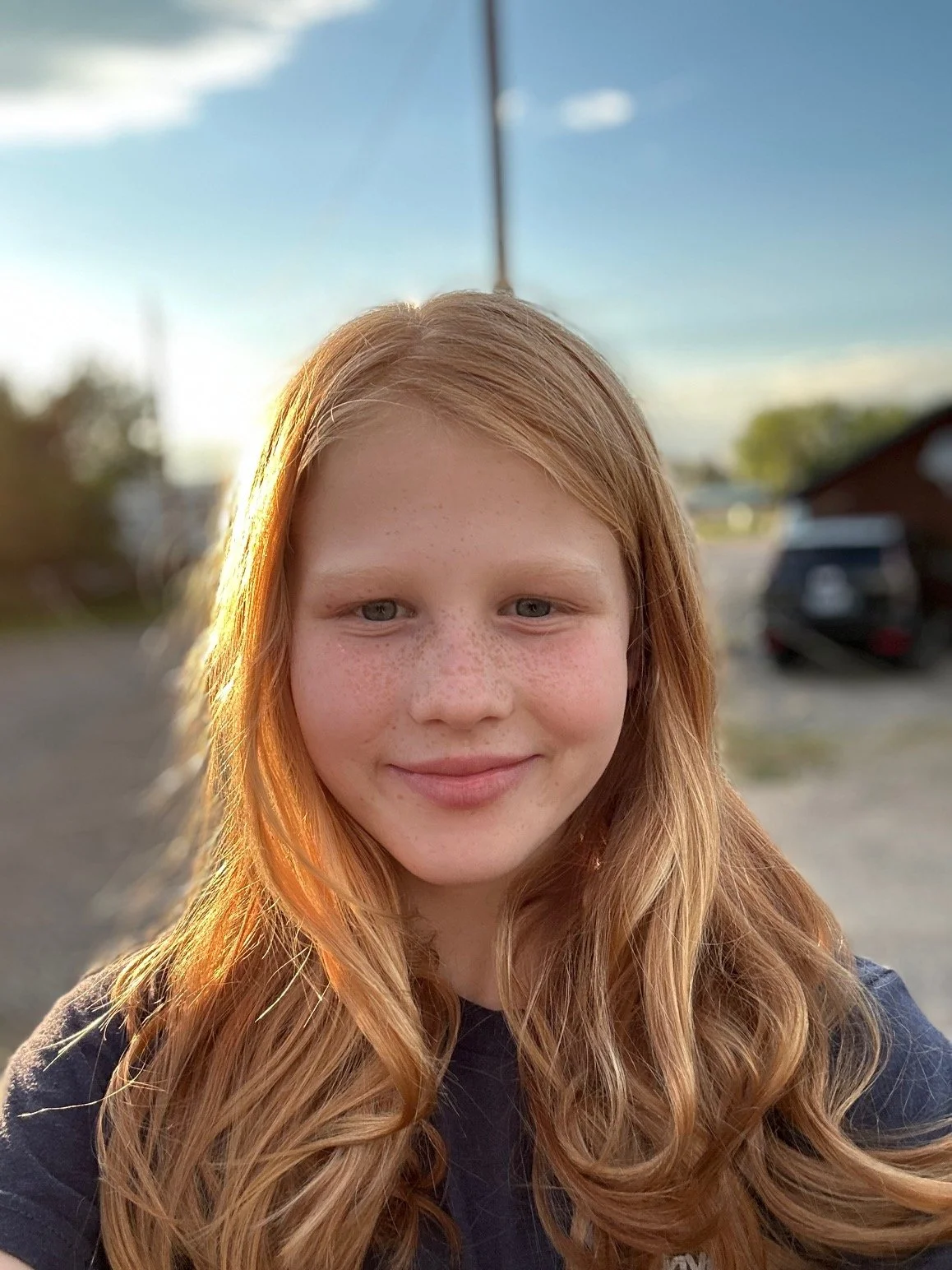
Now a young teenager, Lucile takes French, plays sports, and navigates the world with confidence.
While all of this was happening, we were also deciding next steps. Should we move south closer to Redwood City where there was a special school (Weingarten Children’s Center), or do we move back east because we have family in North Carolina and Georgia? We didn’t know if Lucile was going to need a school for children with hearing loss for two years or 10 years, but we needed to plan for it.
Lizzie’s sister is a teacher and told us about the Atlanta Speech School. We learned it was a pioneer in the field. Founded in 1938, it was the first school in the South that taught auditory-verbal communication. In the ’40s and ’50s this meant teaching lipreading. We toured the school and liked it, so we decided to move, as it also worked out with Lyle’s work.
The summer after she turned 2 years old, Lucile started at the Katherine Hamm Center, their preschool for kids with hearing loss (named after the founder). She was enrolled full-time in the program for 2-year-olds, and by the second half of that school year, she was going one day a week to the mainstream preschool that is also on campus. The next year, in the threes, she started doing two days a week mainstream, and by the end of that year she was full-time mainstream.
We always joke that we moved across the country for the special school, and within 18 months she was excelling, on par with typical-hearing peers. The Atlanta Speech School was a wonderful experience for us, and we couldn’t have had a better outcome.
Today, Lucile is 13 and in seventh grade. She takes French, plays sports, goes to summer camp, and navigates the world with confidence. Most people don’t even realize she wears cochlear implants.
When she was little a lot of parents would say to us, “Oh, she has such good manners. She looks you right in the eye.” They didn’t realize she was just very much focused on their faces and lips as they were talking!
Even now, we’ll meet parents at school who can’t believe she can’t hear. They say, “But she talks and listens.” And even when she doesn’t have her devices on, like at a pool party, she is able to speak and respond because she can read lips extremely well.
Looking back, the hardest part wasn’t the decision making, the technology, or even the surgery—it was the uncertainty. If there’s one thing we wish we’d known at the beginning, it’s this: Everything will be okay.
More than 90 percent of children born with hearing loss are born to parents with typical hearing, so most families start this journey knowing nothing.
But what happens is that you find your community, trust the process, and focus on the present. And we are grateful every day for the doctors, educators, advocates, and community who helped us all along the way.
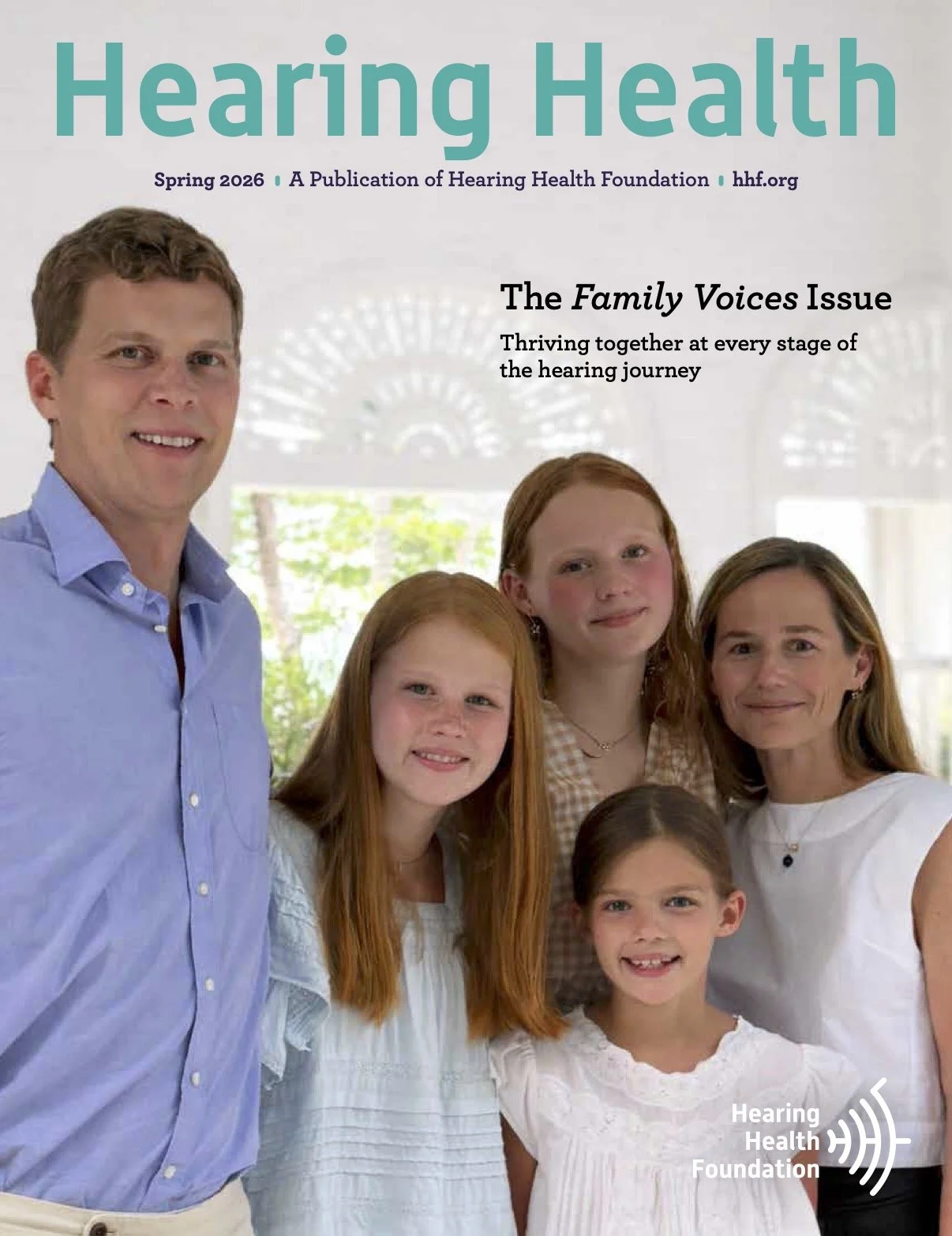
The Ross family lives in Georgia. Lucile also shares her story here. Both stories appear in the Spring 2026 issue of Hearing Health magazine.
The Latest Blog Posts
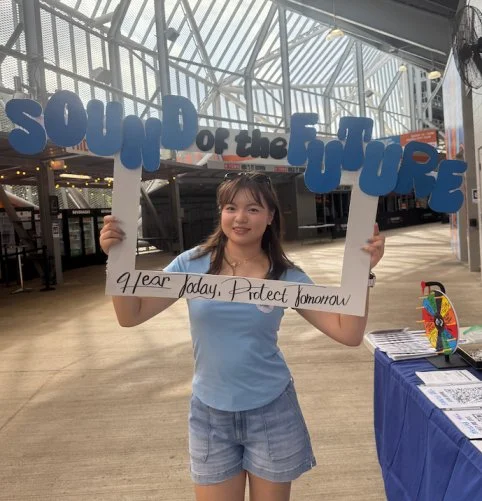



A simple, universal visual warning system (like a red, yellow, or green noise-level indicator at a concert venue, racetrack, or theme park) instantly conveys danger, warning, or safety to people of all ages. Combined with access to basic foam earplugs and insertion instructions, a simple prompt can transform behavior.