
By Benjamin J. Seicol, Ph.D., and Megan Beers Wood, Ph.D.
We know that very loud sounds hurt. Standing on the street between two tall buildings while an ambulance drives by with its siren going full blast can be quite painful to hear, in our personal experience. But how does this pain happen?
To help answer this question, we wanted to develop a way to measure whether a mouse experiences pain-related behavioral changes while listening to sound.
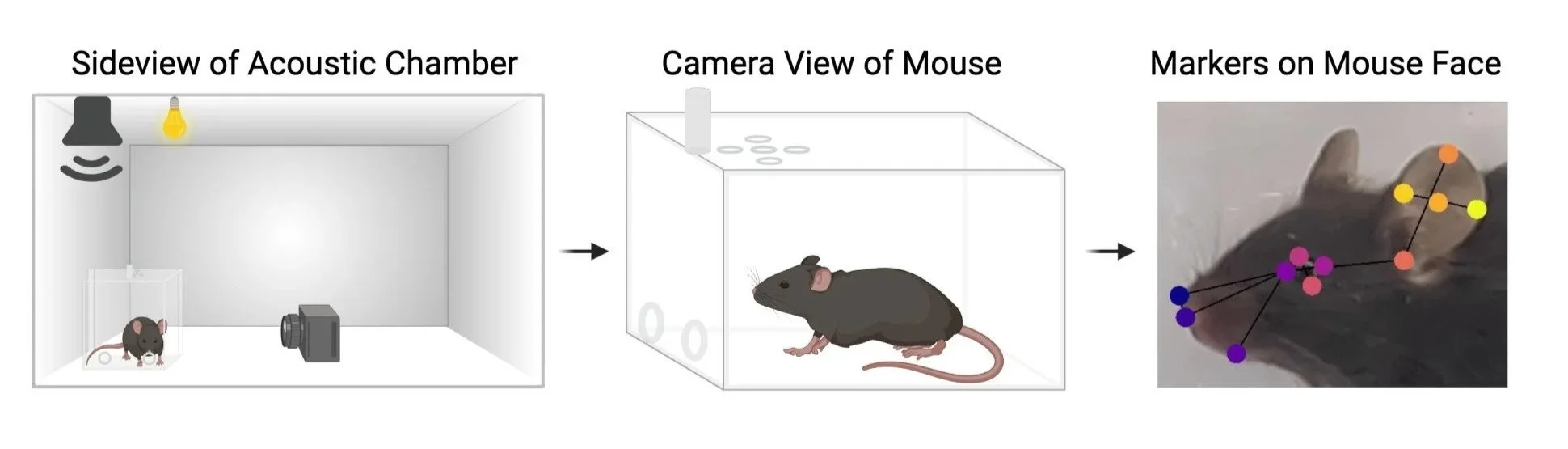
Instead of doing it manually, the team trained a deep neural network to recognize a mouse’s face and place points on it in every frame of video in order to follow the mouse’s facial expressions and movement over time.
There are a few ways to measure pain in animals and one of them is facial grimace. This is a stereotyped set of facial expression changes that happen when an animal is grimacing in response to something painful. All mammals do this, and we also know that animals generally move less when they are in pain.
We sought to create a pain behavior measurement inventory by videotaping mice while they were experiencing pain (for example, a migraine) and tracked changes in their facial expressions and overall movement. In every video frame, we tracked specific points in the face that we could use to map the animal's facial expressions and movement.
In the past, each point used to measure the facial expression would need to be placed manually on each frame of video, which takes a very long time. Instead, we trained a deep neural network to recognize a mouse’s face and place points on it in every frame of video. This is called markerless pose estimation. We were then able to use those data to follow the mouse’s facial expressions and movement over time.
We found that the mice experiencing a painful migraine showed significant behavioral changes involving both their face and their movement. This finding represents the beginning of an inventory-based pain scale for measuring pain in mice using the composite scores from two distinct behavior domains (i.e., grimace and movement).
Next, we played sounds at various levels for the mice and again catalogued their facial expressions and overall movement. At sound levels above 100 decibels (the sound level of a gas leaf blower), the mice showed significant behavioral changes associated with pain. We then tested mice that could not hear and found that they did not respond to loud sounds in the same way.
This control experiment shows that the hearing organ must be intact for sound to produce pain-related behavior. This may seem obvious, but it’s important to understand that the pain you experience does not come only from your eardrum or outer ear. Our results were published in eNeuro in August 2026.
We plan to use this behavioral assay to study pain-related behavior after noise exposure and in mouse models of human hearing disorders characterized by increased sound sensitivity (for example, hyperacusis). We hope that by using open-source software and a single camera, this technique can be used by other labs in the hearing and pain research fields. Ultimately, we would like to distinguish between sound that is perceived as excessively loud (loudness hyperacusis) and sound that is perceived as painful (pain hyperacusis).
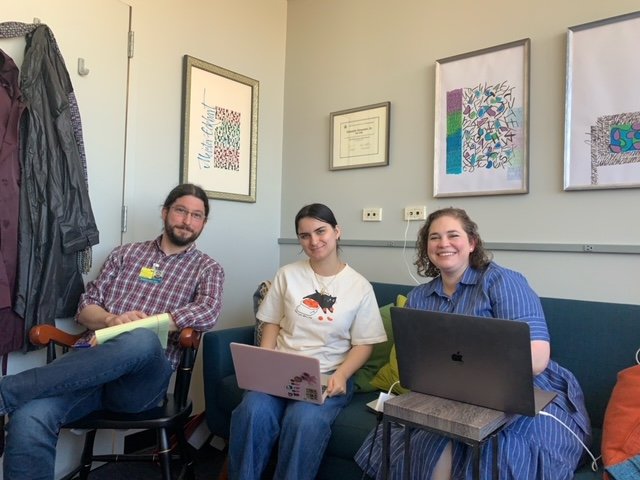
Benjamin J. Seicol, Ph.D. (on the left in the photo), is a postdoctoral fellow at Johns Hopkins School of Medicine.

Megan Beers Wood, Ph.D. (on the right in the photo), is an assistant professor at the Vanderbilt University School of Medicine, where she oversees the Hearing Response Mechanisms through Observations of Neuro-Immunity in the Cochlea (HARMONIC) Laboratory. Her 2022–2023 Emerging Research Grant was generously funded by Hyperacusis Research. Read more about her research and background in our Summer 2025 cover story.
Amelie Valles-Jane (in the center in the photo), another coauthor on the paper, is a senior at Johns Hopkins University studying neuroscience.
The team’s study, in the lab of Elisabeth Glowatzki, Ph.D., “Machine Learning Guided Video Analysis Identifies Sound-Evoked Pain-Related Behaviors from Facial Grimace and Body Cues in Mice,” appeared in eNeuro in August 2026.
The Latest Blog Posts



Hearing loss began affecting how I saw myself. There is a word in Chinese that describes how I felt: 自卑 (zìbēi), a feeling of insecurity and inferiority that makes you shrink yourself around other people.