
A new study suggests that variants of a single gene may alter inner ear development decades before symptoms begin.
By Paula Robles-Bolivar, Ph.D., Andreas H. Eckhard, M.D., and Divya A. Chari, M.D.
Ménière’s disease is a chronic inner ear disorder that causes episodes of vertigo, fluctuating hearing loss, tinnitus, and ear fullness. Although the condition has been recognized for more than 150 years, its underlying causes remain poorly understood. Ménière’s disease is increasingly recognized not as a single disease, but rather a syndrome with diverse etiologies that produce similar symptoms.
In our study published in JAMA Otolaryngology–Head & Neck Surgery in April 2026, we investigated whether a rare inherited disorder called X-linked hypophosphatemia (XLH) could provide new clues about a specific subtype of Ménière’s disease.
XLH is caused by variants in the PHEX gene, located on the X chromosome, and causes abnormalities in bone and phosphate metabolism. Some individuals with XLH also develop hearing and balance problems similar to Ménière’s disease, raising the question: Could the same genetic defect that affects the bone and kidneys also influence the inner ear?
To answer this question, we recruited adults with XLH from centers in the United States and Switzerland and performed comprehensive hearing, vestibular, imaging, and genetic evaluations. We focused on a subtype of Ménière’s disease associated with underdevelopment (hypoplasia) of the endolymphatic sac, a structure that plays an important role in regulating fluid balance within the inner ear. This Ménière’s disease subtype, termed MD-hp, tends to affect both ears (bilateral) and occurs predominantly in males.
Our results were striking. Six male patients in our cohort of 34 individuals met the criteria for bilateral MD-hp, a prevalence far greater than would be expected by chance alone. All affected men carried loss-of-function variants in the PHEX gene and demonstrated imaging evidence of endolymphatic sac hypoplasia. In contrast, female patients with XLH generally exhibited milder hearing abnormalities and did not develop the full MD-hp phenotype.
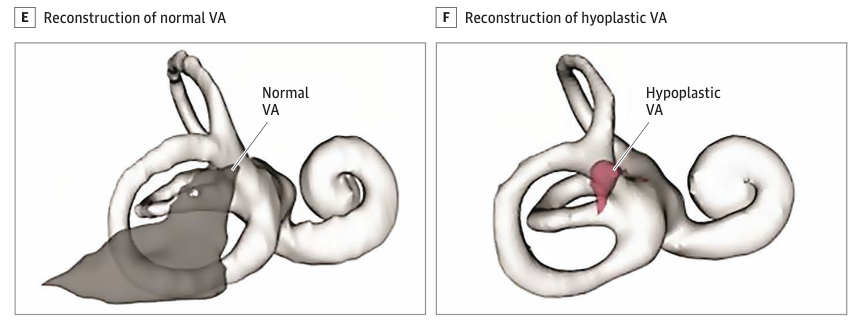
Imaging from a male patient with XLH and Ménière’s disease reveals an underdeveloped fluid pouch in the inner ear. A standard CT scan measurement shows an unusually wide “exit angle” that confirms this underdevelopment, illustrated via 3D reconstruction of a typical bony channel called the vestibular aqueduct (VA) on the left, compared with one that is abnormally shaped on the right. Credit: Robles-Bolivar et al./JAMA Otolaryngology–Head & Neck Surgery
These findings support a developmental gene-dosage model in which reduced PHEX activity during inner ear development leads to endolymphatic sac hypoplasia and lifelong susceptibility to Ménière’s disease. This is analogous to other developmental disorders in which quantitative reductions in gene function determine anatomical malformation risk and disease expression.
In the future, imaging and genetic testing may help identify individuals at increased risk before symptoms begin, creating opportunities for earlier monitoring and intervention. More broadly, our study provides evidence linking variants of the PHEX gene with inner ear abnormalities and the development of a subtype of Ménière’s disease.

Divya A. Chari, M.D., is a physician and surgeon at Mass Eye and Ear, where she is also an investigator in the Eaton-Peabody Laboratories and Jenks Vestibular Laboratories. Chari is a 2024 Emerging Research Grants (ERG) recipient, generously funded by an anonymous donor, and it was renewed for a second year in 2025, generously funded by Karen I. Coley.
Paula Robles-Bolivar, Ph.D., is a postdoctoral fellow at Mass Eye and Ear/Harvard Medical School, and Andreas H. Eckhard, M.D., is an assistant professor of otolaryngology–head and neck surgery at Harvard Medical School and co-director of the Otopathology Laboratory at Mass Eye and Ear. The three colleagues are among the coauthors of the paper, “Association of PHEX Gene Dosage With Meniere Disease and Related Audiovestibular Phenotypes in X-Linked Hypophosphatemia,” published in JAMA Otolaryngology–Head & Neck Surgery in April 2026. Another coauthor is former ERG scientist Sharon G. Kujawa, Ph.D., a professor of otolaryngology–head & neck surgery at Harvard Medical School and a member of HHF’s board of directors.
The Latest Blog Posts





Hearing Health Foundation (HHF) is very pleased to announce the addition of four new members to our Board of Directors: Andreas H. Eckhard, M.D., Steven D. Rauch, M.D., Konstantina Stankovic, M.D., Ph.D., FACS, and Daniel J. Tollin, Ph.D.