
My lifelong duet with a hearing loss becomes an orchestra.
By Pam Parfitt
I have a sensorineural hearing loss, which runs in my family. I now have a severe loss and wear my hearing aids every waking hour of the day. I also have diplacusis, tinnitus, and musical ear syndrome, which is a combination of unwanted music in your head and tinnitus together.
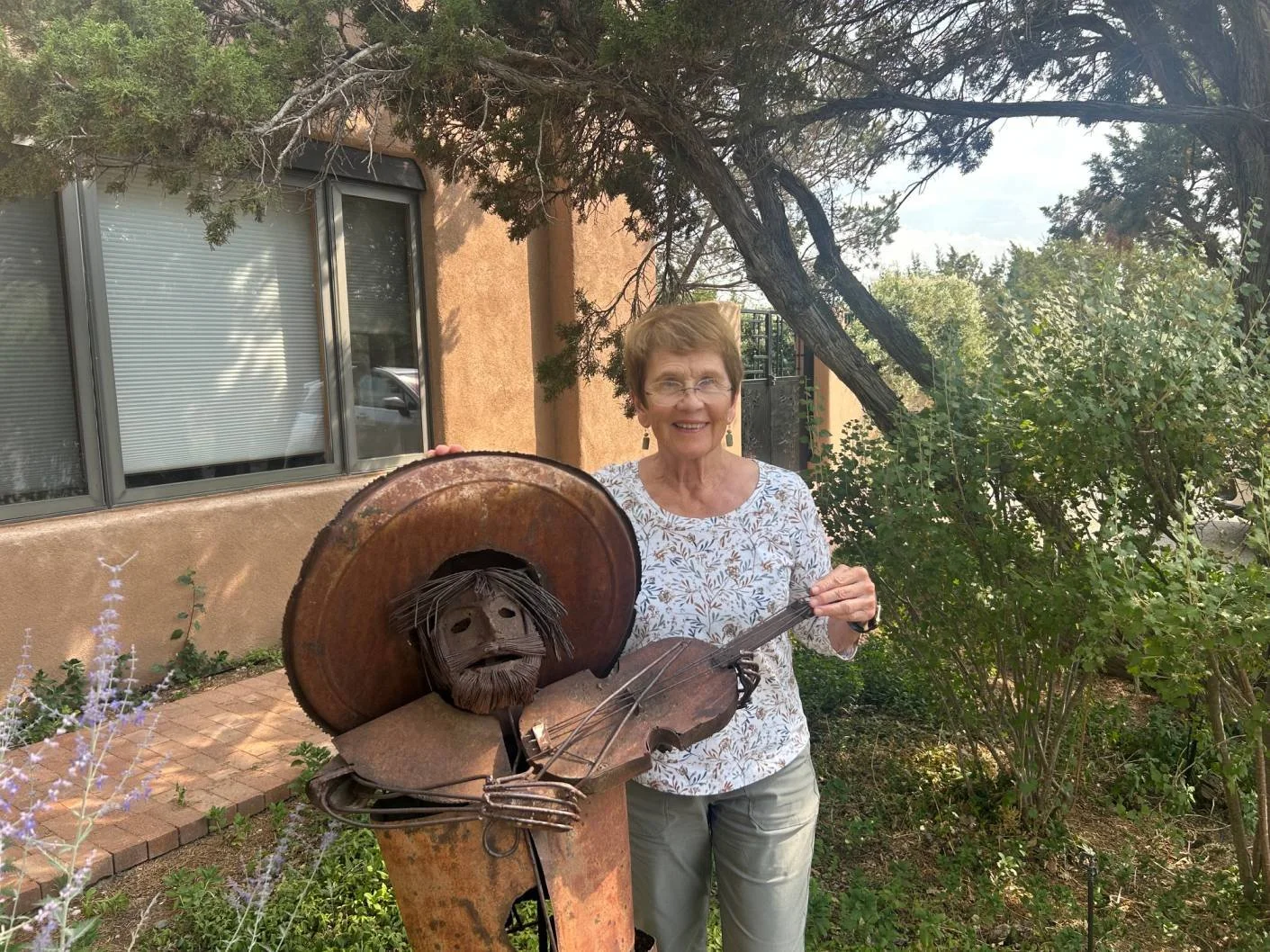
Now 81, Pam poses with a mariachi player statue that is in front of what used to be her violin school in New Mexico.
My father wore hearing aids back in the days when hearing aids were a box on a lanyard around your neck with wires that plugged into both ears. My grandfather was the same so I grew up knowing that I might develop hearing loss at some time in my life.
In elementary school an audiologist came periodically to check everyone’s hearing so I quickly learned to fake my hearing tests. I wasn’t struggling in school so when the tester moved her hands to test for a new tone, I automatically raised my hand signaling that I heard the tone even when I didn’t.
The first time I knew for sure and admitted that I had the family “problem” was in college. I still wasn’t struggling in class or social situations, but one day my roommate asked if I would please get a different alarm clock because the loud ticking was driving her crazy. My reaction was “what ticking?” I had to put the clock next to my ear to hear it while my roommate could stand in the hallway outside the room and still hear it!
I managed to teach school and enjoy conversations until I was 30. At that time, I began struggling to hear at work and knew that it was time for hearing aids. I only wanted one so I could hide it by pulling more of my hair to that side of my head.
This went on until my early 40s when I finally realized that hearing was more important than my vanity and got two hearing aids. Besides, I was starting to play classical music again after having fun with fiddle tunes in a small Colorado mountain town before moving to Santa Fe, New Mexico.
I started to play in the Santa Fe Community Orchestra and thought I was doing fine until one day the conductor said, “First violins, listen to the seconds!” Uh-oh, which second violins was he talking about? Then, I knew that orchestral playing was off the table for me as I couldn’t process all of that sound in a meaningful way.
I did keep playing the violin for my own pleasure and even entered a local banjo and fiddle contest for fun. I played an advanced version of a famous fiddle tune which was noticed by a local Suzuki violin teacher. Weeks later she spotted me at the supermarket and we started to talk.
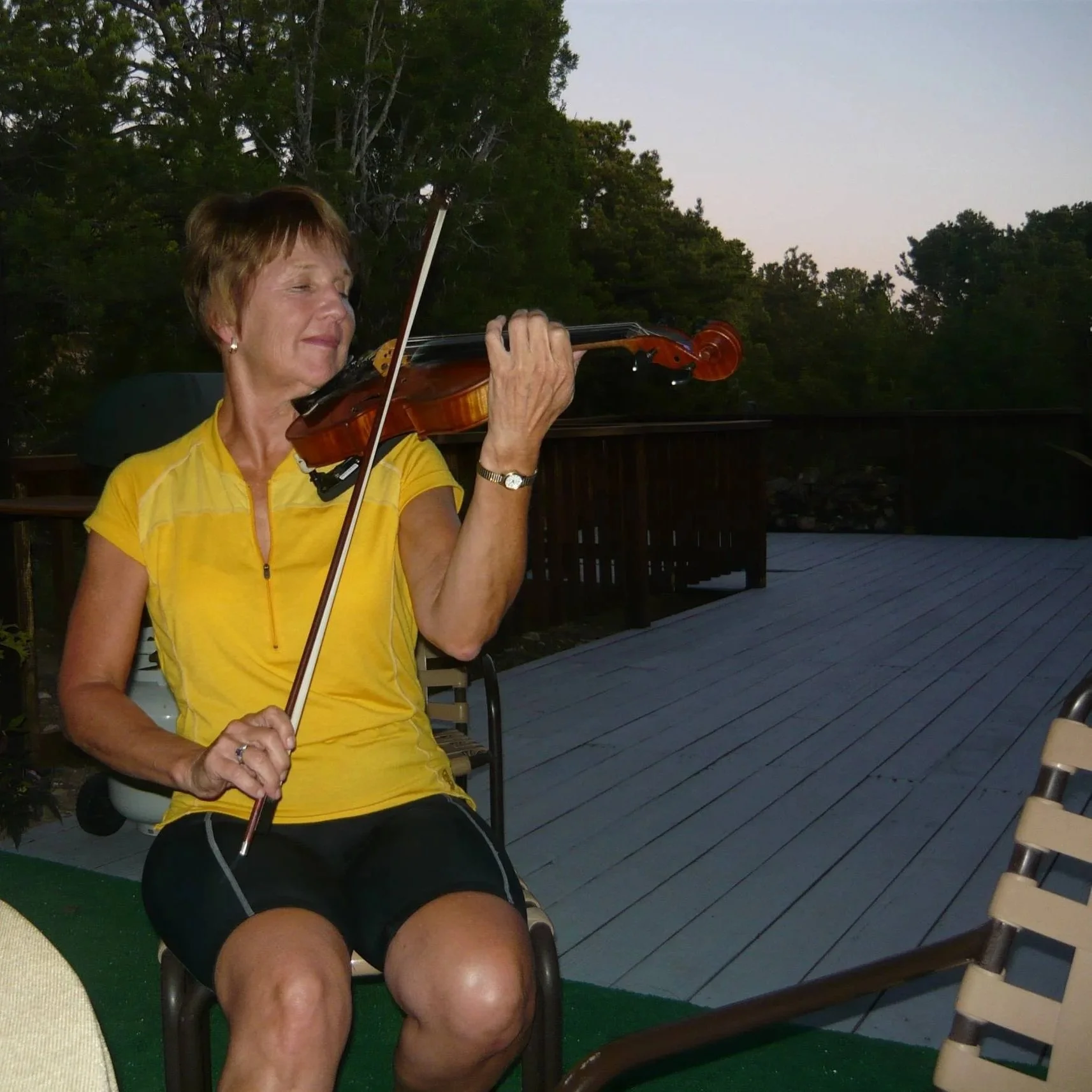
Pam has been playing the violin, also called a fiddle, for decades, like here in her bike shorts after a ride.
The teacher said she and her students had been at the contest and that she recognized me as a classically trained violinist. I admitted as much and she wanted to know if I was interested in becoming a Suzuki violin teacher since there was high demand in Santa Fe and not enough teachers. Additionally, she told me that a world-famous teacher-trainer was hosting a week of training in Albuquerque and that I should come to see what it was all about.
I fell in love with what was a transformative music education for me. Children as young as 3 were playing together in groups and older children were performing at a high level without music or stage fright as the teacher-trainees watched and took notes.
I observed for five days and knew that I wanted to learn how the necessary musical skills were embedded in simple melodies and gradually increased in complexity into an advanced repertoire. At the end of the last day, I approached the newly certified and first New Mexico Suzuki teacher-trainer and asked if she would take me on as a student. She agreed.
The rest is history because I had no trouble hearing one student at a time or everyone playing the same repertoire together in group lessons and concerts. I happily began teaching students starting with 3 to 4 year olds and their families for years. As the students got older the repertoire became more advanced and required the use of higher and higher positions on the violin.
This was not a problem until one day I noticed that the note C two octaves above middle C didn’t sound quite right. I couldn’t tell if I was playing it in tune. I told myself that one funky note was manageable until a couple of years later when I realized that more and more notes weren’t making sense.
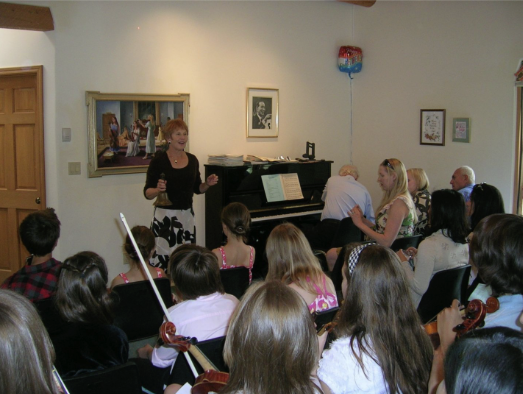
Pam’s Suzuki violin school started with students as young as 3 and 4 years old playing by ear.
I went to my audiologist and explained the problem which was a big one for a musician and teacher. He tested me by playing the same tone in each ear and asked if the tone was the same or different. I perceived the tones as being the same as long as they were lower than C6 (High C).
Above that my right and left ears didn’t agree. I sometimes heard them as different notes! The audiologist told me that I had diplacusis and that there was no cure for it. Diplacusis is perceiving the same sound at a different pitch or tone in each ear.
I was deeply saddened and in tears. I called my teacher-trainer who lived nearby and was told by her husband, who was then the conductor of the Albuquerque Youth Symphony, to come right over. I explained that I wouldn’t be able to teach advanced repertoire and that the scope of my teaching and the fate of my Santa Fe Suzuki Violin School was unknown.
In 1994 there were no orchestras in the Santa Fe public schools. The Albuquerque Youth Symphony and Albuquerque public school programs were the only orchestral programs around and they wouldn’t accept students from Santa Fe.
I realized that having grown up in the Los Angeles public schools in the 1950s, I knew exactly what an orchestral program—starting in elementary school, through middle school, and into high school—needed to look like. I could still keep my Suzuki school, pass my advanced students to other teachers, and devote my time to starting an orchestra. This fit perfectly into my plans for getting my students to play as well while reading music as they already did playing by ear.
We held auditions and discovered there were no student viola, cello, or bass players in town. Woodwinds and brass came from school marching band programs and adults filled in. The Albuquerque Youth Symphony came and sat side by side with us for our first concert in December 1994. The history of the Santa Fe Youth Symphony is another story, but suffice it to say that after 30 years of growth it merged as an equal partner with the professional Santa Fe Symphony in 2024!
Teaching and being the founder of a fledgling and ever-expanding youth symphony program kept me happy and busy for 10 years. However, I began to lose more and more hearing as I aged. In 2010 at 65 I retired and closed my school. It was a loss but I found new ways to challenge myself.
For example, when I was growing up my family didn’t think it was “ladylike” to engage in sports, so I decided at retirement that if I couldn’t play music, I would play sports! Yes, I took up golf, cycling, and snowshoeing. I was already a skier having lived in Colorado.
Retirement and sports were wonderful except for one thing. I began to notice a kind of roar in my head when things were quiet and a high pitch in my ears off and on. Tinnitus was my constant companion and soon the roar evolved into rhythms as well. I found an app on my phone that sounded similar and found it was useful in calming the tinnitus when it was especially distracting.

Pam says this is a photo of her waiting to hit a golf ball until an earworm in her head finishes a phrase.
In addition, my mind still had the need to hear the music I had been teaching for the past 24 years so “earworms” crept into the mix. Sometimes when I was playing golf the “worm” was so dominant that I had to wait until the next phrase to hit the ball in time to the music.
If I heard music that I was deeply emotional about, the earworm would play over and over for days or even weeks. It became too difficult to listen to any familiar music so I stopped completely except in certain circumstances with excellent sound systems connected to a hearing loop.
Diplacusis also made it almost impossible to enjoy listening to familiar music such as on the radio or TV. Having gone to hear an opera with familiar arias and hearing none due to my advancing diplacusis, I decided to only go to the Santa Fe Opera to hear new operas with no expectation as to what they would sound like.
Fast forward a few years and now my hearing loss is severe with diplacusis, tinnitus, earworms and musical ear syndrome (MES) 24/7. My brain now makes up music with a drone tone mostly in the key of D, pounding rhythms, melodies, and harmonies often in different keys.
It is horrific, loud, and all consuming if I am not engaged in deep conversation, a page turner of a novel, counting my steps while walking/hiking, concentrating intensely while playing a sport, or playing puzzles on my phone. Being connected to my TV via Bluetooth so I can watch all manner of interesting programs and movies is a godsend for blocking out MES. I cannot sleep and take medication in order to control this mess!
Once in a while the tones, rhythms, and fragments of melodies and harmonies all come together in the same key and can be quite beautiful. I don’t have any control over how long this original “music” will last before devolving into chaos, but I look forward to a time it might come again, usually once or twice a year.
Still, my life is meaningful because I have become a hearing advocate and educator. Everywhere I go I am looking for ways to make Santa Fe more accessible for people with hearing loss. I am deeply gratified when business owners, festival planners, hospitals, senior living communities, churches, and theaters “get it.” I am a community resource for them and provide information about how they can be more inclusive and accessible. Many people/groups want to be inclusive but just don’t know how to go about it. I try to make it easy for them.
I will also say that attitude is everything. I strive to turn lemons into lemonade. Once my partner and I were staying in a European hotel that was so small that we had to put our suitcases on the bed in order to walk around. At first, we were disappointed and uncomfortable but quickly realized that if we had been camping, a tent this size would have felt like the Taj Mahal. We pretended we were camping and had a great week in our “tent.”
Another way I look at my situation is to think about a saying I once heard: “If you can’t be happy with what you have, be happy for what hasn’t befallen you!” Oh my, things could be a lot worse!
My last saying that I use for attitude adjustment comes from this saying, “If you don’t enjoy the snow, you will have less joy in your life and still the same amount of snow!” This translates into: “If you don’t enjoy the hearing that you have, you will have less joy in life and still the same amount of hearing loss.”
Pam Parfitt lives in New Mexico.
The Latest Blog Posts



Our Emerging Research Grants program is the leading seed funding opportunity for early stage researchers. ERG also includes Expanded and Focused Discovery Awards, which are grant opportunities in specific topics (such as central auditory processing disorder, hyperacusis, Ménière’s disease, and tinnitus) that are open to eligible investigators at any career stage.