
For this mom, late in life diagnoses turned years of confusion into a clearer sense of self and deeper connections.
By Lisa Giles
I will never forget the day a few years ago when I sat in therapy, revisiting what my younger self experienced when I couldn’t hear. I felt compassion for that young, confused, and lost girl—hard of hearing, not treated, not acknowledged. I was surprised there were no tears. Later in the session, my therapist said something that made the floodgates open.
I don’t remember what he asked, but it was apparent the loss—the overall loss, not just hearing loss—didn’t stop when I got hearing aids.
Over the years, I compensated for hearing loss in different situations by masking—pretending I heard when I didn’t. I learned when to smile, when to laugh, and when to look concerned. But it’s exhausting, and there is sadness and grief around what I miss while masking.
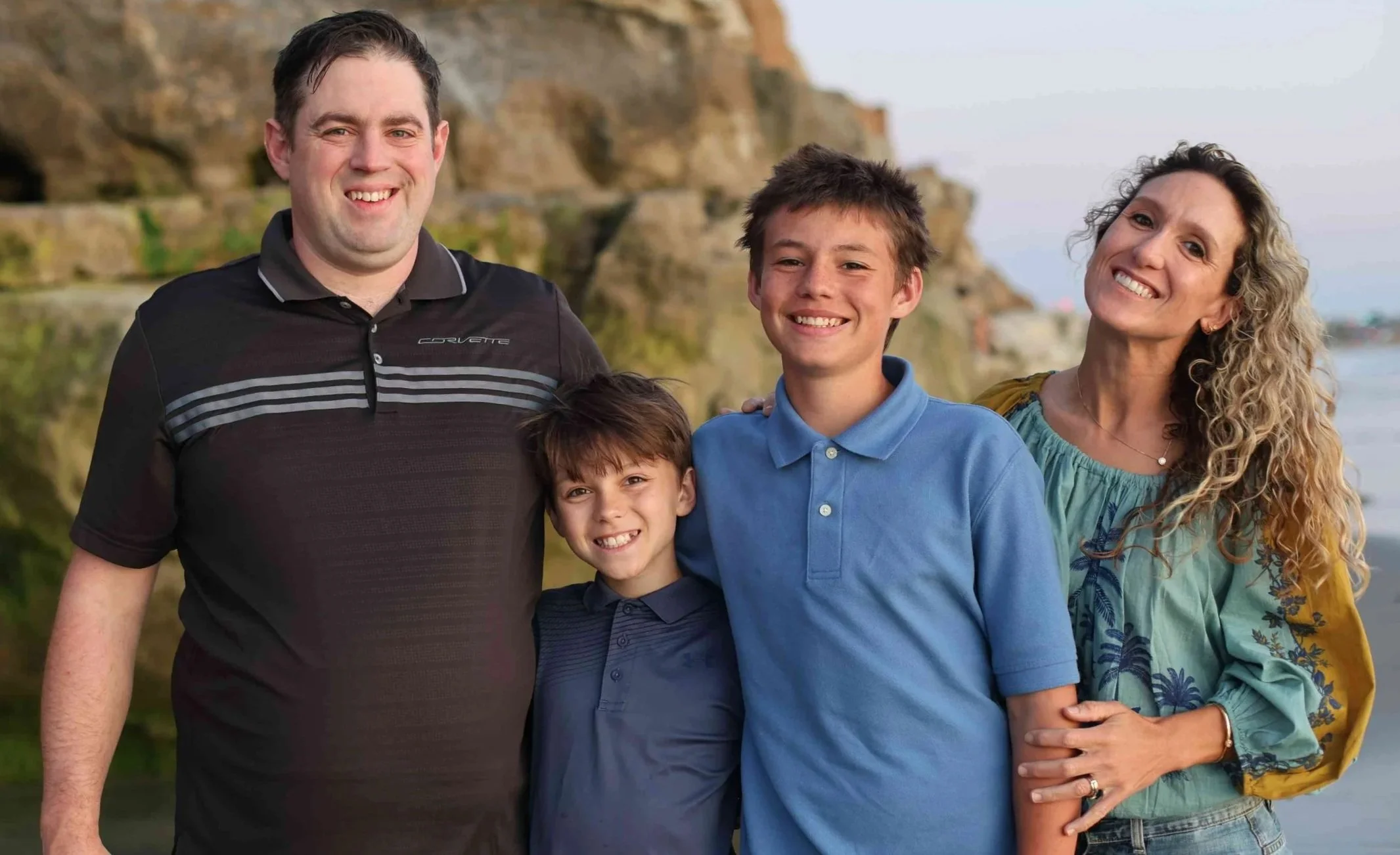
Lisa Giles and her family live in California.
The reality is that I am still hard of hearing. I miss out on moments of connection. My husband has a quiet voice, so I often miss what he says. When my kids were younger and didn’t enunciate as well, I missed cute things they said.
I have overheard moms talk about loving carpooling because they get to hear their kids interact with friends; they also learn about the happenings on the soccer field and playground and in the classroom.
Carpooling was something I never did, for a few reasons. The first is because I get overwhelmed easily and knew I would find it stressful. I also feared messing up or being late. I worried about other parents getting upset with me.
But it was more than that. Knowing I might miss something special, something I so badly want to hear, would hurt.
When I’ve looked back at my childhood pictures, I see a look of confusion on my face: aloof and at the same time hyperfocused on figuring out what was going on. I was not diagnosed with moderately severe sensorineural hearing loss till the age of 19.
Even so, I remember the feeling as I put my hearing aids in for the first time: amazement and gratitude mixed with sadness and grief. Hearing aids help, but I still miss a lot every single day.
Hearing loss impacts the whole family due to my sensory sensitivities. When I was diagnosed with both ADHD and autism in my late 30s, it became another missing piece as to why life has always felt so hard for me, even though I have a very blessed life.
I am now 41 years old. I have been married for 16 years and have two boys, ages 13 and 11.
In 2025 I published a book titled “Misunderstood.” It’s part memoir, part self-help, and part advocacy. It’s about how being AuDHD (ADHD and autistic) and hard of hearing shaped my experience of being misunderstood by others.
I’ve realized that part of being misunderstood was that I sometimes misunderstood—or simply didn’t hear—what was going on around me.
“Honey, did you remember to pay the rent yesterday?”
He answers yes. Or no. I don’t know which.
“Did you say yes?”
He answers again. Still not clear. Yes? No?
“Okay… well, if not, could you drop it off on the way to work?”
“I SAID YES.”
This is a very common interaction, and my ADHD brain thinks he’s going to be mad at me. I don’t want to get in trouble for guessing wrong.
It’s also a bit of a bummer that we can’t talk in bed once I take my hearing aids out.
It’s not easy for my family, either. My sons and my husband get frustrated with repeating themselves. I know it’s hard for them, especially when I agree to things and I don’t know what I am saying yes to. It feels like a betrayal.
Frustration often mixes with sadness. Not being able to hear my peers whispering is one thing, but not being able to hear what my kids say even now—as they are older with more complex stories to share—when I drive them to school is a whole other thing.
On the way to school one day the familiar sadness struck hard. Tears streamed down my face. My son looked over and chuckled (out of love, of course).
“Mom, why are you crying?”
I answered through sobs, “I love you guys so much… and I so badly want to hear everything you say.”
My younger son was trying to tell me something that had happened at school the day before, and I missed it. Which friend? What happened? How did it affect him? Is he upset?
I knew he talked to me that morning. I even remember responding. But sometimes I respond with what seems like the right answer based on pieces I catch. I fill in the gaps. I string sentences together and try to get all the parts to fit, to keep up with conversations. It is exhausting, and even though I try so hard, I often still get it wrong.
Moments like this happen in so many places—at dinners, birthdays, the pool, the hot tub. Little pieces of conversation slip past me.
While I often can’t hear things, there are some sounds, like my son’s yo-yo and my husband’s phone pinging with updates from the Bears game, that can dysregulate me in a heartbeat. It’s hard for people to understand, and it is hard to explain. It’s one of the contradictions that I walk the world with.
Neurodivergence coupled with me being hard of hearing makes our house interesting, special, and often comical. There is never a dull moment. It reminds me of the game “Telephone” I played as a kid. Someone says a word, the next person repeats what they heard, and by the end of the line, the message is often hilariously different.
In our house, things can get a little like that. What I think I heard isn’t quite what was said. Hearing loss doesn’t just affect me; it affects all of us. It isn’t that something’s wrong with me—it’s simply part of our family, just like ADHD and autism, shaping who we are together. It’s part of what makes our family us.
Based in California, Lisa Giles is a licensed marriage and family therapist who specializes in Internal Family Systems therapy, helping patients find clarity, validation, and self-compassion. She also provides collaborative consultation to psychotherapists learning the model. Find her book, “Misunderstood: My Journey to a Diagnosis of AuDHD That Explains Nearly Everything,” on Amazon.
The Latest Blog Posts



Hearing loss began affecting how I saw myself. There is a word in Chinese that describes how I felt: 自卑 (zìbēi), a feeling of insecurity and inferiority that makes you shrink yourself around other people.