
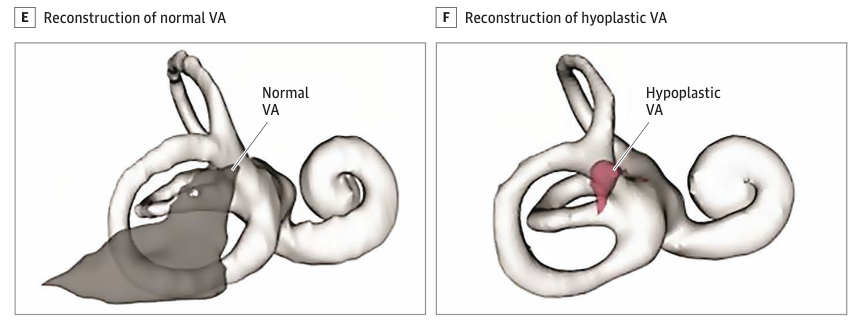
Image: A 3D reconstruction of a bony channel called the vestibular aqueduct (VA) on the left, compared with one that is abnormally shaped on the right. Credit: Robles-Bolivar et al./JAMA Otolaryngology–Head & Neck Surgery
What if a rare bone disorder could help explain why some people develop Ménière’s disease? A new study from Emerging Research Grants (ERG) scientist Divya A. Chari, M.D., and team suggests that variants of a single gene may alter inner ear development decades before symptoms of fluctuating balance and hearing loss begin. Future imaging and genetic testing may help identify individuals at increased risk. (Recent research by Penn Medicine also links developmental genetics to adult vestibular conditions.)
Chari’s 2024 ERG grant was generously funded by an anonymous donor and renewed for a second year in 2025, generously funded by Karen I. Coley. The paper’s coauthors include HHF board member and 1999 ERG scientist Sharon G. Kujawa, Ph.D.
Researchers including Jennifer Stone, Ph.D., a member of HHF’s Hearing Restoration Project, studied genetically altered mice to determine the function of type I hair cells compared with type II hair cells in balance organs. They found that peripheral type I hair cells are essential for a vestibular reflex and for some tasks requiring balance and motor coordination. Stone received ERG funding in the 1990s and 2000.
The first gene therapy for hearing loss was approved earlier this year, a milestone development aided in part by discoveries made decades ago in the lab of Lawrence Lustig, Ph.D., a 2002 ERG scientist.
Research by 2020 and 2022 ERG scientist Pei-Ciao Tang, Ph.D., has helped create a model for the human inner ear, built on a chip.
Plus:

Planned Giving Matching Challenge
Your legacy gift supports the top-tier scientists in Hearing Health Foundation’s research programs, the Hearing Restoration Project and Emerging Research Grants. Right now your planned gift to HHF—such as a bequest or beneficiary designation of a retirement fund or life insurance policy—will be matched with our $1 million match challenge.
Around the Web:
10 things doctors want you to know about hearing aids (TIME), the best smartphone apps for hearing loss (HearingTracker), and hearing aids are getting smarter—and more accessible than ever (Technology.org)
A 12-year study just found a hidden risk factor in people with hearing loss (MindBodyGreen), sleep apnea and hearing loss (American Journal of Epidemiology), anxiety and hearing loss, and diabetes and hearing loss (National Council on Aging)
Bringing portable hearing readiness technology directly to the service member (Walter Reed), new VA pilot program would test OTC hearing aids for veterans (HearingTracker), and 47 Senate lawmakers oppose VA disability rule on sleep apnea, tinnitus (Military.com)
Musicians on tinnitus: “Hearing health isn’t something we should take for granted” (PRS for Music), study uncovers factors contributing to tinnitus (American Dental Association), people who hear “the hum” are facing low-frequency tinnitus (Neuroscience News), prevention, detection, and rehabilitation of noise‑related hearing disorders (Canadian Audiologist), concussion symptom history linked to increased odds of tinnitus (HealthDay), and magic mushroom compound could offer a new approach to treating chronic tinnitus (ScienceAlert)
Effective use of hearing aids may help reduce dementia risk in older adults (MedicalXpress), protect your hearing, protect your brain (U.S. Army), older brains work harder to stay upright, with nearly 50 percent longer delay (MedicalXpress), and survey reveals hearing health as longevity blind spot (The Hearing Review)
Research highlights sex-based hormonal influences on hearing, pointing toward more personalized auditory care (The Hearing Review), newborn hearing screenings made easier (American Academy of Audiology), and EarBase, a national database of the organs of hearing and balance (USC Information Sciences Institute)
Products and services are not endorsed by Hearing Health Foundation. Links provided are for informational purposes only, may require registration or subscription, and may expire.
