

Legendary musician Les Paul spent his whole life looking for the perfect sound. Ironically, for a good portion of his life he had to pursue his passion for sound while wearing hearing aids.

Hearing Loss Is My Superpower
Despite receiving a cochlear implant at age 22 months, and being mainstreamed into my local public school district from kindergarten, by late middle school into high school I had became bitter and resentful about my dependence on hearing technology. I saw it as a burden.
Hair Cell Eulogy
People don’t seem to understand the damage they’ll incur
The way that birds’ songs, music, voices, all become a blur -
When the ears are not protected from loud music, shotgun blasts;
The birdsong they heard yesterday may have been their last...
Doing My Best
My hearing loss appeared suddenly, at age 61, when I woke up for work unable to hear in my right ear. With no history of difficulty hearing, I was completely stunned. Did I, I wondered, damage my ear with loud music in my headset yesterday?
A Woman's Canine Ears
My sensorineural hearing loss was diagnosed at around age 4, well before newborn hearing screenings were commonplace, in 1954. “Barbie needs to see your face when you talk, Mommy,” my sister announced one day, cluing my parents into a possible hearing problem.
Comfortable
Being uncomfortable can be nerve-wracking, strange, and sometimes scary. For my brother, Alex, 14, being uncomfortable is all of these things. Born with a hearing loss, Alex has felt uncomfortable so many times in his life it’s impossible to count them all.
Ears On Fire
A noise injury worsens readily. For hyperacusis sufferers such as myself, quiet makes the condition better; noise makes it worse. Among sufferers this is indisputable, but medical practitioners bizarrely treat quiet as harmful.
Becoming a Champion
At this point I can say Ménière's disease and my initial negative experiences in undergraduate school have impacted my life for the better. Ménière's is a lonely condition but it’s forced me to become much more self-reliant.
Flying My Way
My longtime fascination with all things aerospace inspired my desire to work with computers for a living. But, at times, my hearing and vision loss caused some turbulence.
Making Friends and Influencing People
By Kathi Mestayer
Lorrie Moore, the author of “Who Will Run the Frog Hospital?” was in town in Williamsburg, Virginia, giving a reading at Tucker Hall at the College of William and Mary. My friend Susan had invited me, and I actually remembered the author’s name and knew that book was somewhere on my shelf, so I said yes.
My husband Mac had read the book, and was sure I would like it. I managed to find it on our jumbled bookshelves, which are kind of in alphabetical order (for fiction, at least). And it was short, only 147 pages! Before long, I realized that I had already read it, too. Not because I remembered anything, mind you, but because my marks and scars were present pencil lines in the margins, and a few dog-eared pages. Mac never marks up a book, or dog-ears the pages, and it drives him crazy when I do. So, it’s usually easy to tell whether I’ve read a book. In this case, I was probably walking that fine line with my fine lines.
I got 33 pages into the book, and it was lively stuff. One passage I had circled (in ink!) was, “She inhaled and held the smoke deep inside, like the worst secret in the world, and then let it burst from her in a cry.” I love revisiting a book, like a stone skipping over water, hitting the high spots thanks to my notes.
So when the day of the reading arrived, I went to listen to Lorrie Moore read her favorite passages in her own voice.
Wishful Thinking
When I got to the lecture hall, I sat by Susan, who was fortunately in the second row, near the aisle. Someone introduced Lorrie Moore. I couldn’t hear most of that, but it didn’t really matter. Then she got up to read, holding a big, thick book (her latest), with a microphone clipped to her lapel.
I couldn’t hear a word of it. It seemed as though she was muttering softly, but I’m not a good judge of that. I leaned over and whispered to Susan that I was having trouble hearing and was going to sit in the front row. Well, Susan outed me immediately, and informed the guy who had introduced Lorrie that she wasn’t audible. While I tried to surreptitiously move to the very center of the front row, he asked Lorrie to hold the lapel mic in her hand, so it could be closer to her mouth.

She did that for a few minutes, but it got awkward when she needed to hold the book, too. And when she held the mic in her hand, it was so close to her mouth that her speech was distorted, with the P’s and T’s sounding like balloons popping. Tiny balloons, but enough to muddy her speech. For me.
So, at the suggestion of a young man on my right, she put the mic back on her lapel, but closer to her face. She asked, “Can everyone hear me now?” I didn’t turn around to see the response behind me, but it was clear that she got some no’s because she started playing around with the mic and saying, “How about now?” And, “Now?”
That was when one of the professors leapt over the front two rows, got on the stage, took the big, regular-mic holder (which was empty), bent it around to the front of the lectern, and clipped the tiny lapel mic to it. Okay. It was closer to her mouth, and she could use her hands for other things.
Let the reading begin. Again.
This time, she read for about 20 minutes, and I still couldn’t hear clearly enough to know what she was mumbling into the mic, with the P’s and T’s popping again due to its proximity to her mouth. I sat there patiently, not wanting to be disruptive again, and thought about other things, in between the audience’s intermittent chuckling. To my credit, I did not get my phone out to check my email.
After she was done, and the Q&A period started, I slunk out of the room, as quietly as possible. Others were doing the same, so I felt a little less rude. The next day, I got an apologetic email from Susan.
Not Just Me
A couple of days later, I was in a gift shop downtown, and a young woman behind the counter asked if I had been at the reading the other night in Tucker Hall. I said yes. Turns out, she was sitting right behind me. When I mentioned that I had a really hard time hearing in that space, she replied, “Oh, I HATE that room! It’s the worst one on campus! I can never hear in there.”
The good news is that, the next time Susan invited me to a reading, she made a point of saying they had gotten the good mic back up and running. And, in fairness, making an entire campus of classrooms and other spaces hearing-friendly will take time, money… and attention. In fact, I’ve already managed to get an FM system installed in two auditoriums in another building on campus. So, slowly, the system is getting better, one complaint at a time.
I think of that passage I ink-circled, about inhaling smoke like a big secret and letting it burst forth. Advocating to hear can put you in the spotlight, uncomfortably, especially in a group situation, but we should let our needs burst forth to help others who are no doubt in the same situation.
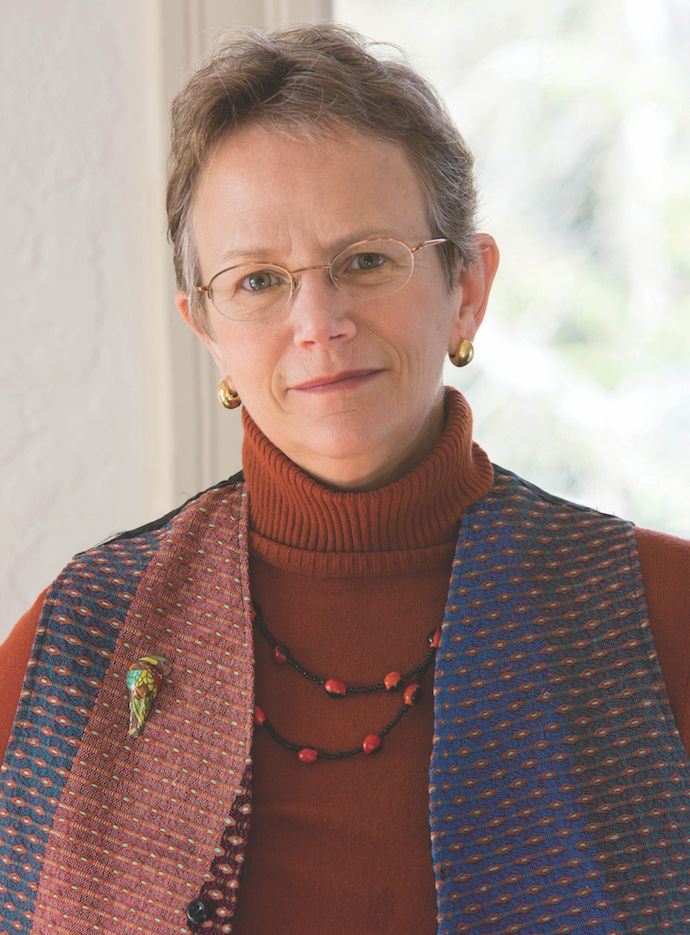
Kathi Mestayer is a staff writer for Hearing Health magazine.