
By Nicolle Cure
Living with Ménière’s disease, vestibular migraines, hearing loss, tinnitus, and hyperacusis has reshaped my life in ways I never expected. There was a time when the dizziness, pressure in my ears, ringing, and brain fog felt completely disorienting. In the beginning, I thought this was something I had to fight or fix immediately.
Eventually I discovered something different: Living with chronic illness is about adapting to a new rhythm with your body. Here’s what I’ve learned.

Diagnosed with Ménière’s disease nine years ago, Nicolle has learned to cope, in part through her art practice.
Listening can be exhausting, but listening to your body can be restorative.
When you live with hearing loss or tinnitus, conversation requires much more effort than people realize. My brain is constantly filtering sound, filling in missing pieces, and trying to focus through background noise.
What feels like a normal conversation to others can feel like a mental marathon. It’s a form of fatigue that is rarely visible from the outside. So I know now that my brain quickly gets overwhelmed in social environments. After a few hours of interaction, my brain simply needs quiet to reset.
For many people, resting can feel unproductive. Chronic illness changes that perspective completely. Rest becomes part of how the body repairs and recalibrates. Learning to respect that need is an important shift.
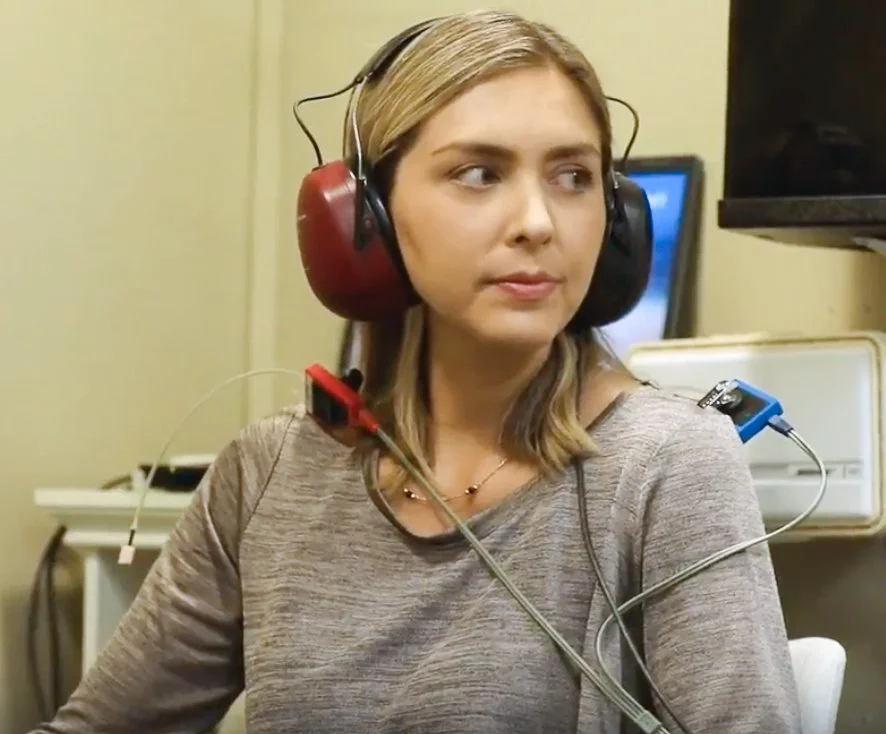
Nicolle says this photo is “from the early days, when I was practically living in the audiologist’s office.”
These days I also can recognize patterns and signals that might trigger symptoms. Small changes in pressure, fatigue, or balance are early warnings. This awareness helps me respond before symptoms escalate. Your body becomes a source of information rather than confusion.
I know that my vestibular system has recalibrated over the years, between vestibular therapy, learning to identify triggers, knowing when to step away from overwhelming situations, and always having my earplugs on hand. All of those things together have helped me get to where I am today.
Speak up for your needs.
Navigating chronic illness often requires speaking up for your needs. Whether it’s with doctors, workplaces, or social situations, self-advocacy becomes important. Learning to communicate boundaries and limitations is part of protecting your health. I know now that I need to be vocal with the people around me about what I am going through.
Not every doctor understands vestibular disorders or invisible, chronic illnesses. If a doctor dismisses your symptoms, minimizes your experience, or makes you feel like your condition is “not that serious,” it’s important to move on. The best doctors combine expertise with kindness, patience, and ethical care. You deserve to be listened to and taken seriously.
Some family and friends simply cannot relate to experiences they have never had. Chronic illness can reveal those gaps in understanding. While this can be frustrating, accepting that not everyone understands can be a form of peace.
Manage stress by finding a sanctuary for the mind.
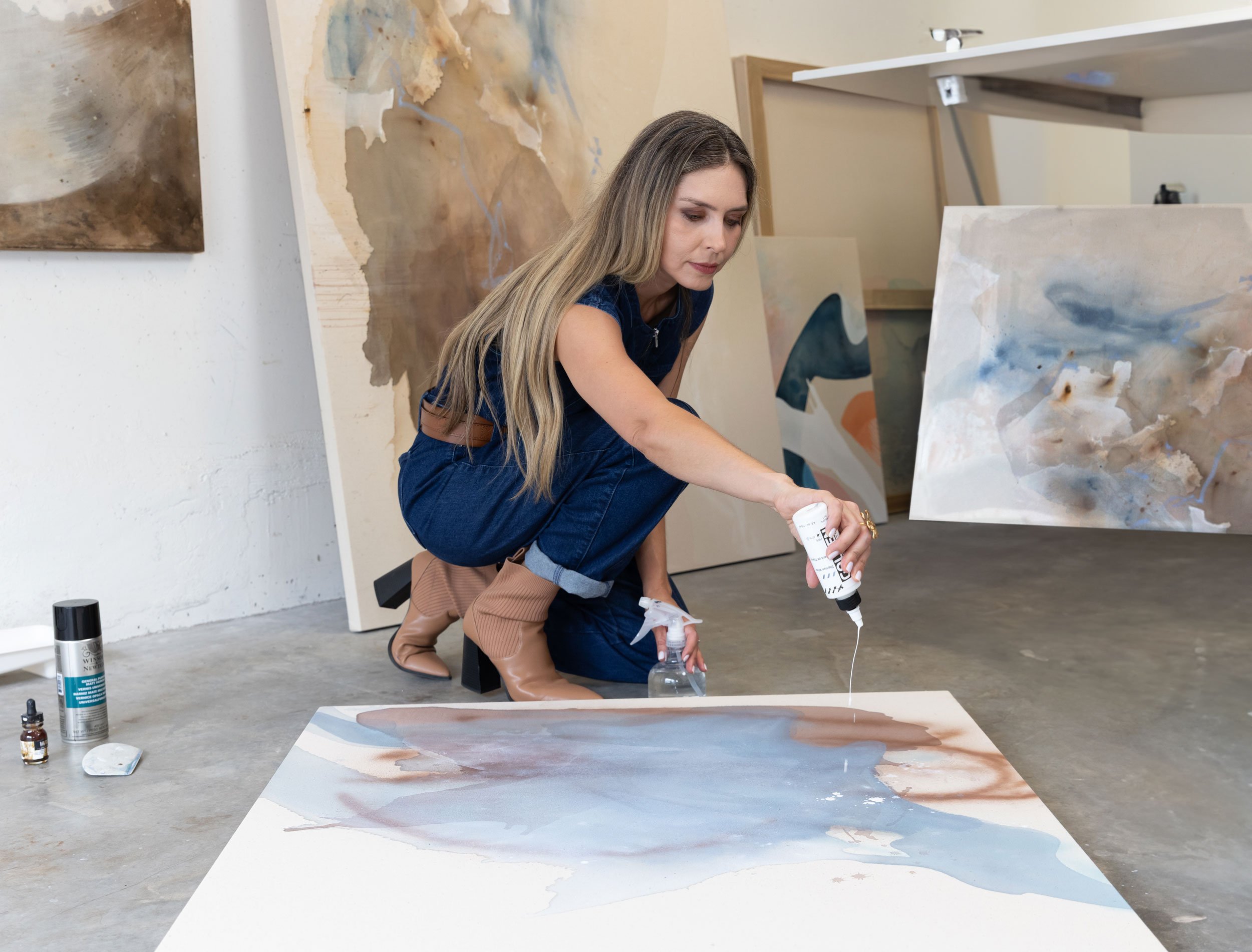
Making art has been Nicolle’s sanctuary.
Stress management is something I continue to work on every day. For me, painting has been one of the spaces where my nervous system can truly relax. But it was a process to be able to fully return to it.
At my worst, I couldn’t stand at my easel for more than a few minutes. I was always so dizzy and nauseated. Returning to a consistent studio practice has felt like reclaiming a huge part of myself. My creative practice allows my mind to focus on something calming and meaningful, moving away from the noise of symptoms.
Finding any activity that soothes or distracts your mind from negative loops can help reduce stress. Whether it’s a hobby, a quiet walk, or a specific task, finding that sanctuary is vital for mental relief.
Small victories can help develop a steady resilience.
Chronic illness inevitably changes how you see yourself and your life. At first that shift can feel disorienting. It took time, but I gradually realized that I am still the same person—simply shaped by different experiences. Now, after living through severe symptoms, even small improvements feel significant.
Recently I went to the theme parks in Orlando and rode roller coasters. No dizziness, no nausea, just fun! For anyone who hasn’t dealt with daily vertigo attacks, constant dizziness, and everything that comes with a vestibular condition like Ménière’s, that might sound small. For me, it was a huge victory.
Hyperacusis had made the most basic tasks really painful. Blowdrying my hair, doing the dishes, even the sound of faucet water hitting the sink were all sources of real pain. I went a long time without being able to do any of that comfortably. Being able to do those things now without pain is something I genuinely do not take for granted.
Supermarkets and big stores were overwhelming in a way that is hard to describe. The stimulation inside would hit so hard that getting from the store door to my car felt like a mission. At one point I had a handicap pass because the vertigo was so severe I couldn’t trust myself to make it to the parking lot safely. Now I still notice the noise and the chatter and multiple conversations happening around me, but the pain and the dizziness that came with it are so much more manageable.
I still live with tinnitus and mild hyperacusis (no pain but I still feel annoyed by certain sounds and noise in general). I have good days and harder ones. But all these victories remind me how far I’ve come, and I feel so lucky and blessed for all the progress I have made.
Community is the ultimate lifeline.
I used to think I had to navigate this onset alone, but I found my footing thanks to Hearing Health Foundation (HHF) and the Vestibular Disorders Association (VeDA). In addition to these nonprofit organizations, the many support groups I joined on Facebook became a lifeline. Strangers quickly became friends, and we committed to moving forward together, supporting one another through the moments when our equilibrium felt most fragile.
If you’re reading this and you’re living with Ménière’s disease, tinnitus, vestibular migraines, or another chronic health condition, please know that much of what you’re experiencing is shared by others navigating similar paths. It’s okay to be vocal about it. But it’s also okay if you don’t want to share every part of your health journey with others. Either way, know you are not alone. We are in this together.
And if you happen to be reading this without personally living with these conditions, thank you for taking the time to learn more about them. Many of these conditions are difficult to see from the outside, and even a little understanding can make the world feel more supportive for the people navigating them.
Based in Miami, Nicolle Cure is a Colombian-American artist whose work, widely collected internationally, explores the intersection of sound, emotion, and visual form. In 2017 she experienced a sudden unilateral hearing loss and a diagnosis of Ménière’s disease, a chronic condition affecting both hearing and balance. She shared her hearing and balance loss journey as the cover story of the Winter 2019 issue of Hearing Health and in the Life Rebalanced Chronicles docuseries by VeDA. For more, see nicollecure.com, where this story was adapted from, and find her on Instagram at instagram.com/nicollecure_art.
The Latest Blog Posts



Hearing Health Foundation (HHF) is very pleased to announce the addition of four new members to our Board of Directors: Andreas H. Eckhard, M.D., Steven D. Rauch, M.D., Konstantina Stankovic, M.D., Ph.D., FACS, and Daniel J. Tollin, Ph.D.