
Zinc ions (Zn²⁺) play an important role in how neurons communicate and process information in the brain. However, directly measuring fast changes in zinc dynamics in living animals has been difficult because existing fluorescent sensors are not sensitive or stable enough.
As published in ACS Sensors in March 2026, we developed a new biosensor called hpGRISZ (high-performance green indicator for synaptic Zn2+). This sensor is a bright, green fluorescent protein engineered to respond strongly and reliably when zinc is present. It is designed to detect the brief bursts of zinc that are released outside neurons at synapses during neural activity.
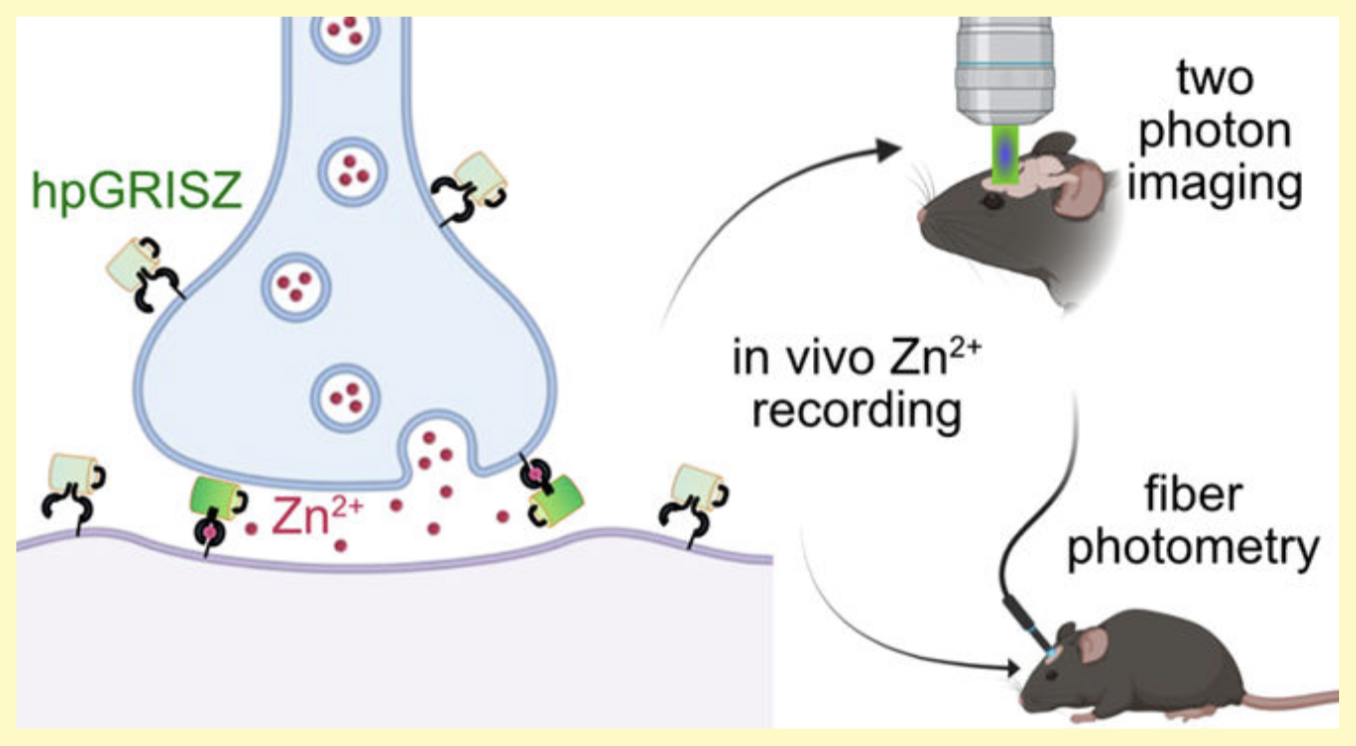
This graphic summarizes how the new biosensor can track when zinc is released in real time in a live mouse model. Credit: Zhang et al./ACS Sensors
We comprehensively characterized hpGRISZ in vitro, in mammalian cells, and in vivo. A version of the sensor that is attached to the cell membrane was able to localize to the surface of neurons under normal physiological conditions, where it remained stable and highly responsive. This allowed us to record zinc signals using multiple imaging techniques, including wide-field microscopy, two-photon imaging, and fiber photometry, even in awake mice.
Using hpGRISZ, we were able to visualize zinc release and signaling across different brain regions and neural circuits. We discovered that zinc signaling is directly involved in how the brain processes sound in the auditory cortex during sound processing and in the amygdala during aversive responses.
Overall, hpGRISZ provides a powerful new tool for studying when and where zinc is released at synapses, enabling us to better understand how zinc contributes to communication between neurons and to the function of brain circuits in living animals.
Furthermore, because hpGRISZ works with many different imaging approaches, it can be easily combined with other powerful neuroscience tools, including optogenetics, electrophysiology, and behavioral testing. This flexibility makes it especially valuable for studying how zinc signaling contributes to brain disorders.
Abnormal zinc activity at synapses has been linked to conditions such as Alzheimer’s disease, depression, epilepsy, schizophrenia, and traumatic brain injury, but scientists still do not fully understand how these changes affect disease progression. By allowing researchers to monitor zinc levels in specific brain regions in real time, hpGRISZ could help reveal early warning signs of neurological disease and provide a way to track how patients respond to new treatments.


This is adapted from the abstract of and discussion in the paper “An Ultraresponsive Green Biosensor for Robust in Vivo Imaging of Synaptic Zinc Dynamics” published in ACS Sensors in March 2026. Coauthor Manoj Kumar, Ph.D., is a 2025–2026 Emerging Research Grants scientist, generously funded by Hyperacusis Research. He is an assistant professor at the University of Pittsburgh. (Kumar was also a 2022–2023 ERG scientist, generously funded by Royal Arch Research Assistance.)
The Latest Blog Posts





Hearing Health Foundation (HHF) is very pleased to announce the addition of four new members to our Board of Directors: Andreas H. Eckhard, M.D., Steven D. Rauch, M.D., Konstantina Stankovic, M.D., Ph.D., FACS, and Daniel J. Tollin, Ph.D.