
What Are the Causes of Ménière’s Disease?
Even though the exact causes of Ménière’s disease are not clearly known, symptoms are believed to arise from the buildup of fluid in the chambers of the inner ear.
According to the National Institute on Deafness and Other Communication Disorders (NIDCD), the disorder is physically caused by a buildup of a fluid called endolymph in the compartments of the inner ear, called the labyrinth. The labyrinth contains the organs of balance (the semicircular canals and otolithic organs) and hearing (the cochlea).
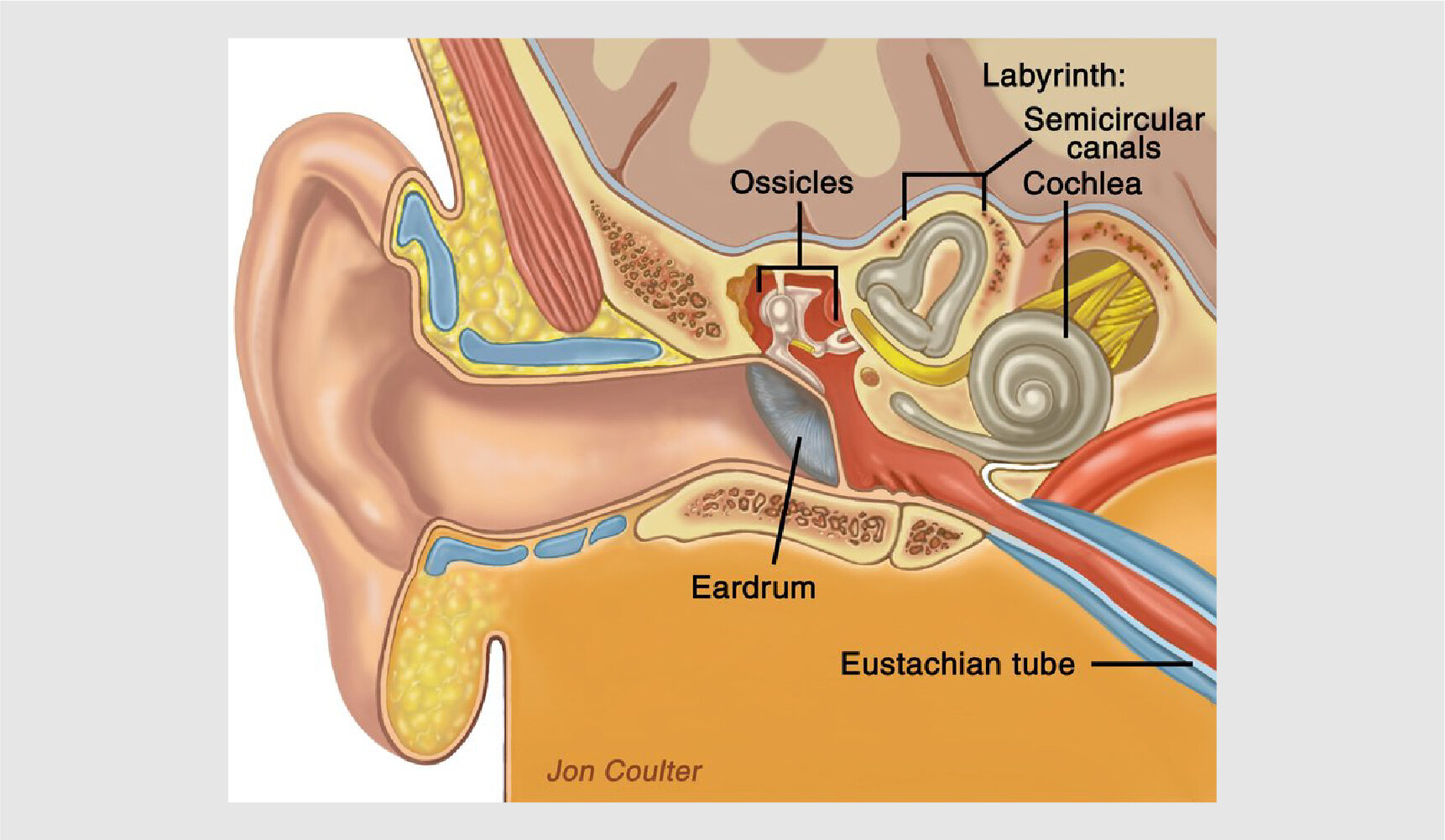
The labyrinth has two sections: the bony labyrinth and the membranous labyrinth, the second of which is filled with endolymph which, in the balance organs, stimulates receptors as the body moves. The receptors then send signals to the brain about the body’s position and movement. In the cochlea, fluid is compressed in response to sound vibrations, which stimulates sensory cells that send signals to the brain.
This excess fluid–beyond the normal amount of fluid that exists in the cochlea–affects both balance and hearing. The cause of the fluid buildup is not yet completely understood.
Some researchers believe it is related to the same blood vessel constrictions that lead to migraine headaches; others say it might be due to an autoimmune condition, a viral infection, an allergic reaction, or head trauma. Ménière’s disease appears to have a hereditary component, so there may be a gene variant connected to the regulation of endolymph fluid.
Is Ménière’s Disease Connected With Migraine?
At the 2025 Ménière’s Disease Symposium, Jeffrey Sharon, M.D., of the University of California, San Francisco, shared:
• Migraine affects 10-15 percent of the global population and shows surprising connections with vestibular disorders, with more than half of Ménière’s disease patients meeting criteria for migraine, suggesting a relationship that dates back to Prosper Ménière’s original observations in 1861.
• Research shows biological links between migraine and vestibular function through CGRP (calcitonin gene-related peptide), a neuroinflammatory peptide expressed in the vestibular periphery that affects balance in animal models, with preliminary clinical trial data showing CGRP-blocking drugs may reduce dizziness symptoms.
• There are multiple lines of evidence connecting migraine and Ménière’s disease: epidemiological overlap, shared symptoms and triggers, correlation in symptom laterality, potential pathophysiological mechanisms involving trigeminal nerve innervation of inner ear blood vessels, and genetic patterns in affected families. This suggests that exploring migraine medications as treatments for Ménière’s disease is warranted.
Is Ménière’s Disease an Autoimmune Condition?
At the 2025 Ménière’s Disease Symposium, Andrea Vambutas, M.D., of Northwell Health, New York, shared:
• A challenge to traditional classifications of Ménière’s disease is that it may exist on a continuum with autoimmune inner ear disease, with some cases potentially being autoinflammatory rather than autoimmune in nature.
• Research shows different cytokine profiles among patients, particularly finding that corticosteroid-responsive patients have high TNF levels that drop with treatment, while corticosteroid-resistant patients have low TNF but high IL-1 levels and may respond to anakinra (an IL-1 receptor antagonist).
• A phase two clinical trial using anakinra for corticosteroid-resistant Ménière’s disease patients is being conducted, with preliminary results showing promising signals, building on their earlier research that found a 70 percent response rate in autoimmune inner ear disease patients treated with anakinra, according to her team’s August 2025 paper in Otology & Neurotology, that notes: “We are currently conducting a phase two placebo-controlled trial to determine the efficacy of anakinra in these corticosteroid-resistant AIED patients.”