
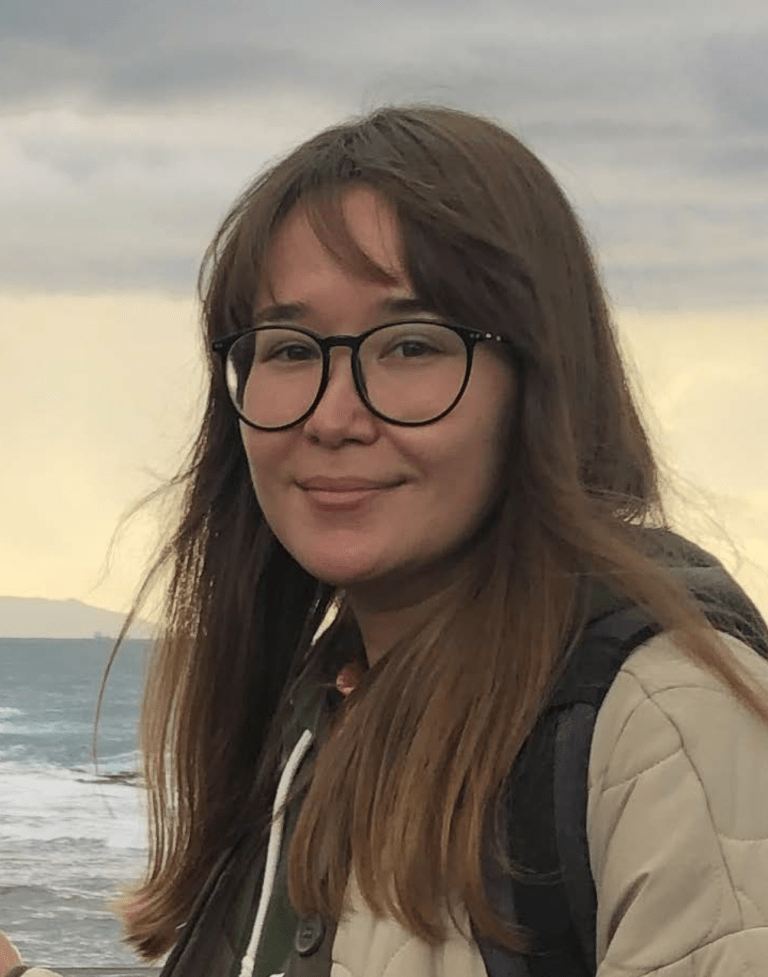
Marina Kabirova, Ph.D.
The University of Chicago
Meet the Researcher
Marina Kabirova, Ph.D., received her master’s degree from Peter the Great St. Petersburg Polytechnic University in Russia and her Ph.D. in molecular neuroscience from Ariel University in Israel, followed by short research position at the Hebrew University of Jerusalem. She is now a postdoctoral scholar in the lab of Ruth Anne Eatock, Ph.D., at the University of Chicago. Kabirova is a 2027 Emerging Research Grants scientist, generously funded by the Meringoff Family Foundation.
The Research
Age-related disruption of calcium homeostasis in vestibular sensory cells
Falls are a major health concern for older adults, and problems with balance are one of the main reasons they occur. Our sense of balance relies on sensory cells in the inner ear, called vestibular hair cells, that detect head movements and communicate this information to the brain. As we age, some of these cells are lost, but their function may begin to change long before that. We want to understand what happens during this earlier stage, when it may still be possible to protect hair cells' function.
Our project focuses on calcium, which plays an essential role in how vestibular hair cells work. These cells need calcium to sense movement and communicate with the brain, but they also need to carefully control how much calcium is present and where it goes. We think that this control may become less effective with age, gradually interfering with the cells’ ability to provide accurate information about head movement.
To study this, we will compare young and old mice at several levels. First, we will study individual vestibular hair cells to understand how their calcium signals and electrical activity change with age. We will then use specialized imaging methods to directly observe calcium activity in many hair cells at the same time. This will allow us to see how strongly the cells respond to a given mechanical stimulus and how well their responses are synchronized across the population. Finally, we will use behavioral tests of balance to examine whether changes in hair cell function are associated with impaired vestibular function in older mice.
By finding out what starts to go wrong in vestibular hair cells as they age, we hope to better understand why balance declines in older adults. In the long term, this knowledge could help identify ways to protect the inner ear and prevent or reduce age-related balance problems.
Long-term goal: The longer-term goal of this project is to identify changes in vestibular hair cells that contribute to age-related decline in balance and determine which of these changes could potentially be targeted by future treatments. In particular, we are interested in whether aging disrupts the cells’ ability to control calcium and whether restoring this control could help preserve their function.
One potential future strategy is gene therapy. For example, if important calcium-binding proteins decline with age, restoring their levels could help protect the function of aging sensory cells. Ultimately, our findings could provide a foundation for treatments that address age-related balance problems before extensive and irreversible loss of vestibular hair cells occurs.
The Project’s Genesis
The idea for this project grew naturally from my previous research. During my master’s work, I studied disruptions in calcium balance as one possible contributor to neuronal dysfunction in Alzheimer’s disease. This gave me a long-standing interest in how cells regulate calcium and how this regulation can change with age and disease.
When I joined Dr. Ruth Anne Eatock’s laboratory and began studying sensory hair cells of the vestibular inner ear, I became interested in what happens to these cells as we age. I was surprised by how little is known about vestibular hair cell function changes during aging. At the same time, our lab uses calcium imaging, which gives us a way to directly observe calcium signals in hair cells. It seemed like a natural opportunity to bring together my previous interest in calcium regulation, the lab’s expertise in vestibular physiology, and a method particularly well suited to studying these changes. This connection led to the central question of the project: Does calcium regulation change as vestibular hair cells age, and could these changes contribute to age-related decline in balance?
I first fell in love with biology in school, when we started learning genetics. Before that, biology felt mostly descriptive to me. We learned how plants and animals were built and how different systems worked. Then we got to Mendel and genetics, and I was amazed that there was actually math in biology. I found that incredibly exciting, and it completely changed my interest in biology.
At the time, however, becoming a scientist myself did not seem like a realistic possibility. I did not know any scientists, and research felt like something done by people very far from my own world. My interest in biology eventually led me to study biotechnology, and later, during my master’s degree, I finally had the opportunity to work in a research laboratory. That experience showed me that I could not only learn about science, but actually do it myself. So I fell in love with biology first, and then I slowly found my way to making it my career.
A Grandfather’s Noise Exposure
When I first started working in the hearing and balance field, I did not think I had a personal connection to these conditions. As I learned more, however, I began to recognize how common they are, including among people close to me. My grandfather, for example, had significant hearing difficulties, and we often had to speak very loudly for him to hear us. When I later learned about noise-induced hearing loss, I thought about his many years working in logging, where he was regularly exposed to very loud noise. I cannot know what caused his hearing loss, but learning about the effects of long-term noise exposure made me see his experience differently. My work has definitely made me more aware of the many factors that can affect hearing and balance throughout life, as well as the things we can do to protect them. It has also made me more attentive to hearing and balance difficulties in everyday life that I might not have recognized before.
One of the most memorable moments in my career happened at the Society for Neuroscience meeting in 2021, when I was finishing my Ph.D. and looking for postdoctoral positions. Through conversations with scientists and potential mentors, I began to see how the skills and experience I had developed could be applied to new scientific questions.
Meeting Ruth Anne was the moment when things really clicked. The vestibular system was completely new to me, but I immediately found the questions fascinating, and my electrophysiology background was a great fit for the work in her lab. That meeting eventually led to my current postdoctoral position and introduced me to the field in which I now hope to build my independent career. It was one of those moments when my previous experience, skills, and interests suddenly came together and the next step in my career became clear.
I come from a family with many teachers, so if I had not become a researcher, I probably would have become a teacher as well. Teaching has always felt very natural and meaningful to me, and it is something I have been able to keep as part of my life even as a scientist through teaching and mentoring students. In a way, I was lucky to find a career that allows me to do both.
Balancing on a Boat
Outside the lab, I enjoy playing tennis, singing in a choir, and sailing. I became interested in sailing after moving to Chicago. Living next to Lake Michigan gave me the opportunity to try it for the first time, and it quickly became one of my favorite activities outside the lab. I started taking sailing classes and recently passed my skipper exam, which I am very excited about. I love being on the water and the combination of learning practical skills, working with a crew, and having to adapt to changing conditions. Whenever people I sail with learn that I study the vestibular inner ear, they immediately start asking me questions about seasickness, since it is such a common problem on the water. It is always fun to see my research suddenly become very relevant outside the lab.
One thing people may find surprising is how international my life is. I grew up and started my education in Russia, moved to Israel for my Ph.D., and later came to the United States for my postdoctoral research. I also love traveling and have visited more than 30 countries. Experiencing different countries and cultures has become an important part of who I am, both personally and professionally.
In five years, I hope to be leading my own research group studying the physiology of the vestibular inner ear. I want to understand how this remarkable sensory system works under normal conditions and what changes with aging. Over the longer term, I hope to build a research program that connects fundamental vestibular physiology with questions that are directly relevant to human health. In ten years, I would like my lab not only to help explain why vestibular function declines, but also to identify mechanisms that could eventually be targeted to preserve or restore balance function.
