
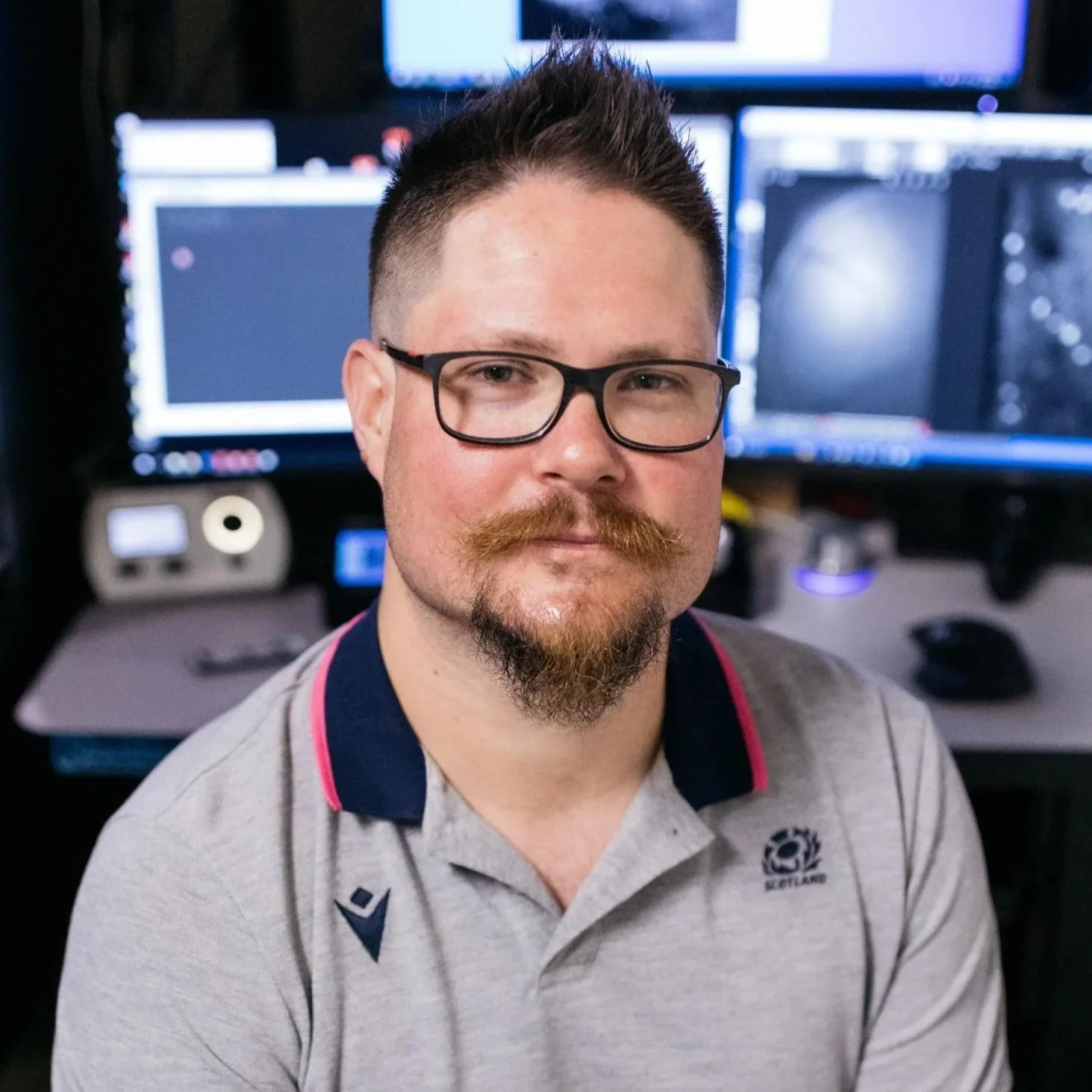
Ross S. Williamson, Ph.D.
University of Pittsburgh
Meet the Researcher
Ross S. Williamson, Ph.D., is an assistant professor in the departments of otolaryngology, neurobiology, and bioengineering at the University of Pittsburgh School of Medicine. He is a 2027 Emerging Research Grants scientist generously funded by Royal Arch Research Assistance. He was also a 2020 and 2022 ERG scientist.
The Research
Active corticofugal control of sound localization in noise
Locating sounds in a noisy environment is essential for everyday communication, and it is a task we accomplish with our bodies as much as with our ears. Listeners naturally turn their heads and orient toward a sound source, and these movements change the signal arriving at each ear from moment to moment, giving the brain additional information about where the sound originated.
Exposure to loud noise permanently damages the connections between the inner ear and the auditory nerve, degrading the fine detail required to separate competing sound sources. The result is that many people report considerable difficulty following a conversation in a crowded room despite a typical audiogram, a core complaint in central auditory processing disorder. Almost everything known about how the brain computes sound location, however, comes from experiments in which the head is held still, eliminating the very movements listeners rely on in natural settings.
This project asks how noise-induced hearing loss disrupts active listening, and which neural circuit is responsible. We have developed a task in which mice move freely around an arena surrounded by speakers, searching for a target sound while a competing distractor sound plays simultaneously. Video tracking allows us to measure the strategies they use: pausing to scan the head from side to side, correcting an initial trajectory with a sharp turn, or spiraling gradually toward the target.
Comparing these strategies before and after noise exposure will reveal whether noise damage degrades not only what an animal hears, but how it searches. We will then examine the descending pathway connecting auditory cortex, which identifies the features of a sound, to the superior colliculus, a midbrain structure containing a map of space that issues commands to orient the head and body. We hypothesize that this pathway converts sound features into a direction to turn, and that noise damage dysregulates it. We will record from the pathway during behavior, suppress it in typical-hearing mice to determine whether this reproduces the deficit, and activate it in noise-exposed mice to determine whether the deficit can be reversed.
Long-term goal: My laboratory’s overarching goal is to understand how descending pathways from the auditory cortex shape the way sound is processed throughout the brain, and how those pathways are altered by peripheral injury. This project extends that program into behavior: Rather than asking only how neural responses change after noise damage, we ask how those changes disrupt what a listener actually does in a complex acoustic scene. Over the next several years I want to build a complete account of the sensorimotor loop for hearing, linking cochlear damage, through central gain changes, to the specific orienting behaviors that break down in real-world listening. If specific orienting behaviors, such as how often and how effectively someone scans or reorients while searching for a sound, reliably track underlying circuit dysfunction, then head- and body-movement patterns could serve as accessible behavioral readouts of a deficit that current clinical tests miss. Movement is far easier to measure in a clinic than neural activity.
The Project’s Genesis
This project came from a collision between an old result and a new frustration. The old result dates to my postdoctoral research in the laboratory of Daniel Polley, Ph.D., where we found that layer 5 cortical neurons projecting down to the midbrain become hyperactive after noise damage, overamplifying sound in an apparent attempt to compensate for the input they have lost. It was clear that the descending pathway was doing something after noise injury, but not at all clear what that something meant for an animal trying to accomplish a real task in the world.
The frustration came later. Much of what we know about how the brain computes sound location comes from head-fixed preparations. But if you watch any animal, or any person, actually localize a sound, the first thing they do is move. Removing head movement removes the phenomenon.
We decided that if we wanted to understand this properly, we would have to give up the experimental control that head fixation buys and let the animals move. It clicked when we watched our first videos of expert mice performing the freely moving task. On easy trials they ran straight to the target.
But on hard trials, when the sound came from behind them, we saw them stop, sweep their heads back and forth like a pendulum, and only then commit to a direction. Seeing a mouse spontaneously invent an active sensing strategy, and then seeing anatomy showing that the auditory cortex projects broadly across the map of space in the superior colliculus, made the hypothesis almost write itself.
Music and Math
I’ve been obsessed with music since I was a kid, growing up on Led Zeppelin and Pink Floyd, which led straight to an electric guitar. But what pulled me in was less the playing than the gear, and really the guitar pedals. I wanted to know what was actually happening inside a distortion pedal or Eddie Van Halen’s legendary MXR Phase 90.
That question turned out to be a mathematics question, and chasing it led me into signal processing, then computer science, then to asking how the brain performs the same kinds of transformations on sound. I still get a version of that feeling in the lab.
My formal training was almost entirely quantitative, so whenever I encounter real neural data, whether hearing a recording over the speakers or watching a two-photon session unfold, I’m struck by a kind of childlike wonder. Playing a sound to a brain and hearing it answer back is still the coolest thing I know how to do.
I’ve seen the band Phish more than 50 times, which I count as fieldwork in complex auditory scene analysis. I’m also an avid ultrarunner and regularly race overnight in the woods. These two things account for most of my weekends and all of my tinnitus.
I’m fortunate that I can usually ignore my tinnitus, but a great many people cannot, and that gap between two people with ostensibly similar damage is striking. I believe that much of that heterogeneity lives in the brain rather than the ear, and that idea has shaped how I think about central auditory circuits.
Long days on the trails are where most of my better scientific thinking happens. There is something about sustained effort in the woods that shakes ideas loose in a way sitting at a desk never does.
Running a technical trail is also a continuous exercise in active sensing. Much of what matters is behind you or out of sight, and you locate it by moving: turning your head toward a gnarly root to gauge how far off it is, or picking out a runner coming up behind you. Every long run is a reminder that hearing is not something that happens to you while you sit still. It is something your body does all the time, awake or asleep.
This is the cover story for Hearing Health magazine’s Fall 2026 issue. Download a PDF of the story here.
